

EcoVadis Supporting Documents in 2026: What Food Companies Need to Know

A food company can have sensible environmental practices, regular safety training and a well-managed supplier approval process, yet still receive less credit than expected in an EcoVadis assessment.
The problem is often not the work itself. It is the evidence.
A document may be outdated, cover the wrong legal entity, contain unreadable scanned text or fail to prove the answer it was linked to. In a multi-site business, it may cover too little of the assessment scope. Sometimes a useful document exists but is never connected to the relevant questionnaire declaration.
EcoVadis updated several parts of its supporting-document methodology in 2026. Some changes give companies more flexibility, particularly around audit reports and certification evidence. Others make scope, readability and document selection even more important.
Here is what food companies should check before submitting their next assessment.
Why supporting documents matter so much
EcoVadis assesses the quality of a company’s sustainability management system. Its current public methodology covers four themes:
Environment
Labor & Human Rights
Ethics
Sustainable Procurement
The assessment looks at how a company sets policies, implements measures and reports results. These management layers are evaluated through seven indicators: Policies, Endorsements, Measures, Certifications, Coverage, Reporting and 360° Watch.
The 2026 EcoVadis methodology disclosure is very clear about one point: when formalised management-system evidence is unavailable, the methodology treats this as an indication that the system may not be effectively implemented. The result is a lower score.
This does not necessarily mean the company is doing nothing. It means the assessment cannot verify the work through the evidence provided.
💡 If you are new to the framework, start with my guide to the 21 EcoVadis criteria. The focus here is narrower: making sure your supporting documents can actually do their job.
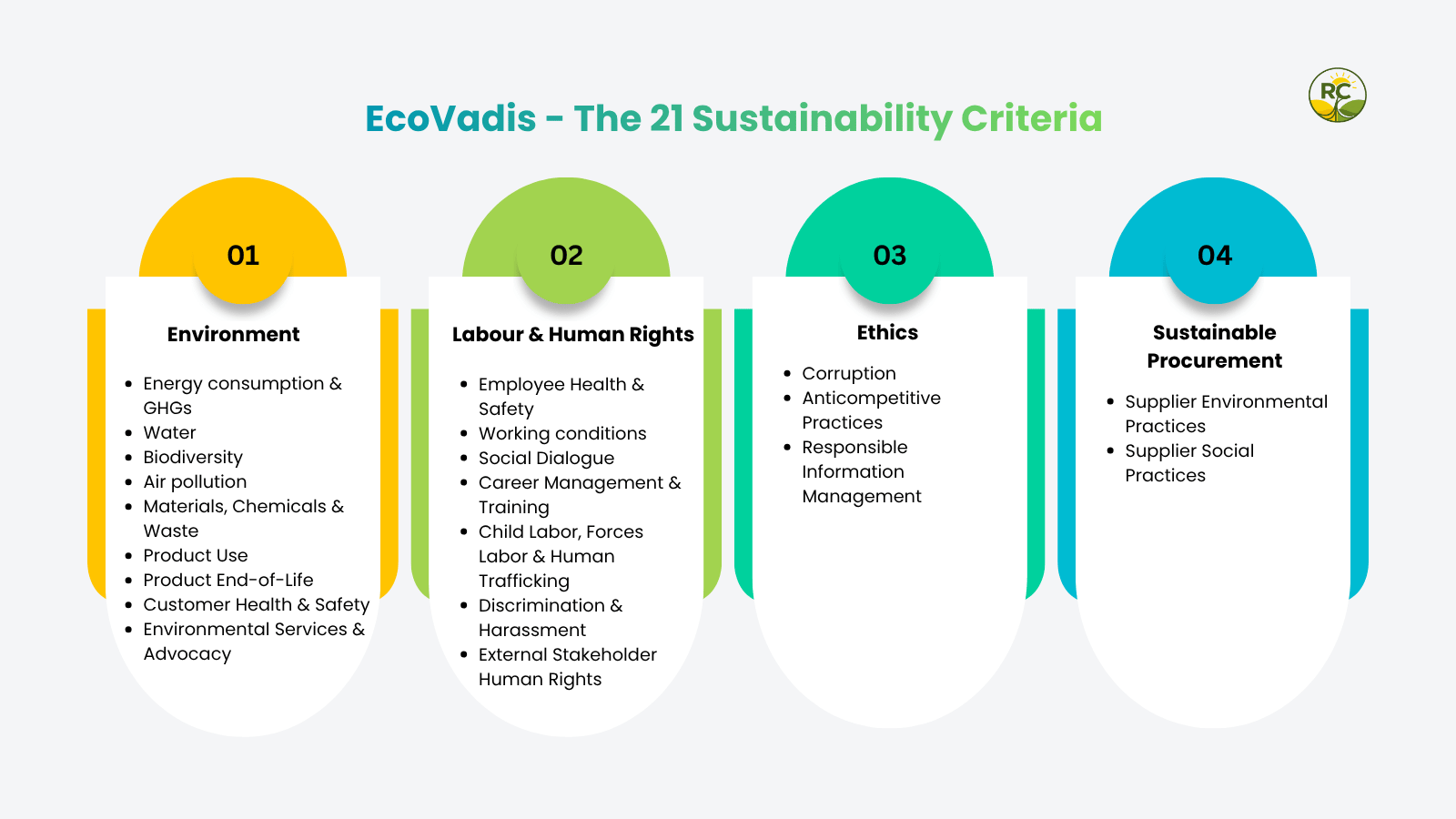
The 21 sustainability criteria of EcoVadis. Source: EcoVadis
What changed for supporting documents in 2026?
1. Audit reports can support more types of answers
Since 15 April 2026, external sustainability audit reports and relevant certification audit reports can be used more broadly as evidence for policies, actions and reporting.
Previously, their use was more limited. This change may help food manufacturers that already hold detailed external audit reports containing relevant evidence about environmental management, employee health and safety or other sustainability topics.
But an audit report is not automatically suitable for every answer. The relevant content still needs to:
address the sustainability topic being assessed;
cover the correct company or assessment scope;
show sufficient evidence of implementation; and
meet the applicable coverage requirements.
The change is therefore an opportunity to use existing audit evidence more effectively, not permission to upload every audit report in your quality folder.
2. “In-progress” certificates are no longer accepted
The same 2026 update discontinued the acceptance of management-system certificates marked as “in progress”.
If you are working towards ISO 14001, ISO 45001, ISO 27001 or another relevant certification, do not assume that an unfinished certification process will be treated as a valid certificate.
A completed external audit report may still contain useful evidence under other indicators when it meets the relevant requirements. However, it should not be presented as a final certificate until certification has been awarded.
3. Alternative certification evidence may be possible
EcoVadis also expanded the supporting documents that may be used to demonstrate certain certifications when the standard has a public verification database.
Depending on the standard and the information available, alternative evidence can include:
a screenshot from the official verification database;
an audit report;
official communication with the certification body;
an invoice;
a website screenshot; or
a relevant annual or sustainability report.
The evidence must be linked to a genuine certifiable standard and an accredited certification body. A public database record should clearly show the company name, standard, certification scope and validity status.
There is an important distinction for food companies: a certification can be highly valuable for food safety or quality management without automatically being relevant to an EcoVadis sustainability question. EcoVadis specifically notes that quality-management certifications such as ISO 9001 are outside the scope of its sustainability certification indicator.
The same relevance test should be applied to BRCGS, IFS, HACCP and other food-sector documents. Do not rely on the certificate’s name alone. Check whether the document directly demonstrates an activated sustainability criterion.
4. Site-level evidence coverage is calculated differently
For site-level evidence supporting Policies, Endorsements and Reporting, turnover can no longer be used to demonstrate coverage.
Since April 2026, coverage is calculated using the number of employees or sites. The relevant threshold is typically 80%, while reporting on energy consumption and greenhouse-gas emissions generally requires 95% coverage.
This matters for food businesses with several factories, warehouses or packing sites.
For example, a policy used by the company’s largest factory may cover most revenue but only a minority of employees and sites. Under the updated approach, revenue alone would not demonstrate sufficient coverage.
Before submitting site-level documents, calculate exactly how much of the assessed organisation they cover.
5. Scorecards now receive a short pre-publication review window
During the 2026 pre-publication process, the rated company receives exclusive access to its scorecard for two business days before it is released to the EcoVadis network.
The company can report factual errors during this period, such as:
the wrong company name, size, industry or location;
a 360° Watch item belonging to another legal entity; or
the rejection of a document that met the submission requirements.
The window is not intended for general disagreement with the score, methodology or analyst judgement. The scorecard also publishes automatically when the two-day period ends, even if a reported error is still being reviewed.
Assign someone to monitor the platform and review the scorecard immediately. Two business days leave little room for internal delays. These changes are explained in the official EcoVadis Q1 2026 methodology update.
What makes an EcoVadis supporting document credible?
A useful supporting document should pass seven basic checks:
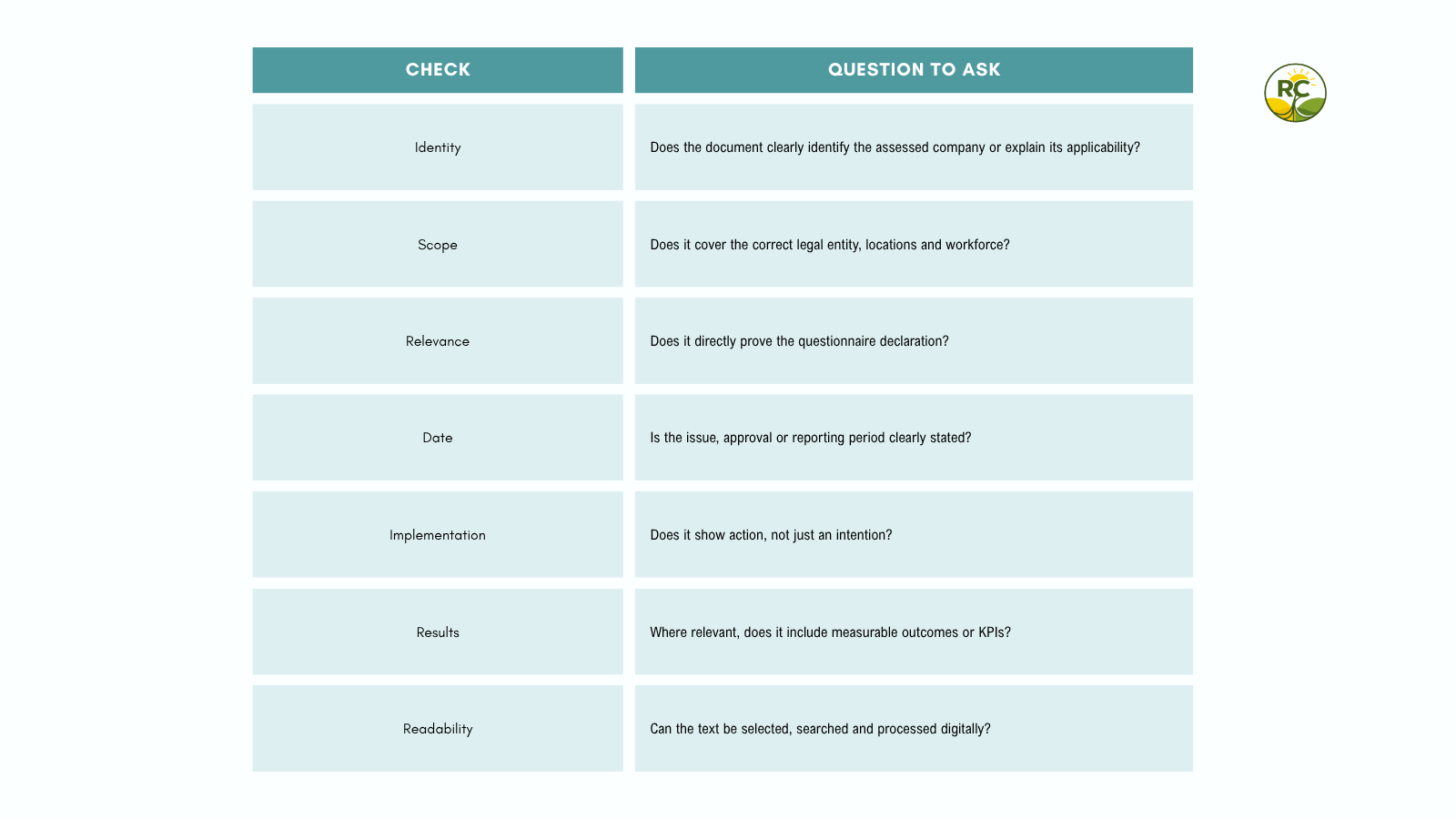
Seven questions to check whether a supporting document is relevant, credible and ready for an EcoVadis assessment.
EcoVadis currently applies an eight-year validity period to documents related to policies and actions, and a two-year period to KPI reporting. Those are maximum methodological validity periods, not a reason to leave an old policy untouched. Internal review dates, changing operations and customer expectations may justify more frequent updates.
Documents should also be formal, complete and part of the real management system. A generic policy downloaded from the internet or written solely to answer the questionnaire is not a credible substitute for an implemented company document.
The official supporting-document guidance provides further details on accepted formats, dates and evidence quality.
Do not overlook machine readability
A scan may look perfectly clear to a person while remaining difficult for an automated system to extract or translate.
EcoVadis advises companies to submit documents in machine-readable formats where text can be selected or copied. Files exported directly from Word, Excel, an ERP system or another internal platform are generally safer than photographs or image-only scans.
Before uploading a PDF, try this simple test:
Open the file.
Select a sentence with your cursor.
Copy it into a blank document.
Check whether the text appears correctly.
Search the PDF for a distinctive word or figure.
If neither copying nor searching works, replace the file with a digital export or a properly processed OCR version. Do not upload encrypted, password-protected or corrupted files.
EcoVadis warns that documents which do not meet its automated readability criteria may not be fully translated or reviewed. See its current guidance on preparing machine-readable documents.
Useful evidence may already exist in your food-safety system
Food manufacturers often start an EcoVadis assessment by assuming they need an entirely new set of documents. In reality, part of the evidence may already exist across Quality, HR, Operations, Procurement and Finance.
Potential examples include:
Environment
energy, fuel and water consumption records;
waste-transfer and disposal records;
environmental permits and monitoring reports;
refrigerant or leakage records;
greenhouse-gas calculations;
packaging-reduction projects;
environmental risk assessments; and
evidence that corrective environmental actions were completed.
Labor & Human Rights
health-and-safety risk assessments;
accident and incident records;
safety training logs;
worker consultation records;
working-time procedures;
employee handbooks;
grievance procedures; and
relevant social or health-and-safety audits.
Ethics
a Code of Conduct;
anti-bribery and anti-corruption procedures;
ethics training records;
whistleblowing procedures;
data-protection procedures; and
records showing that concerns are investigated and addressed.
Sustainable Procurement
supplier codes of conduct;
supplier approval criteria;
environmental and social supplier questionnaires;
supplier risk screening;
audit plans and reports;
corrective-action records; and
documented follow-up of supplier non-conformances.
The key word is “potential”. A food-safety record only helps when it directly supports an activated EcoVadis criterion and meets the evidence requirements.
A HACCP plan, for example, is central to food-safety management. It should not automatically be presented as proof of environmental policy, labour practices or sustainable procurement. A broader audit report may contain relevant sections, but those sections need to be identified and linked to the correct questionnaire answer.
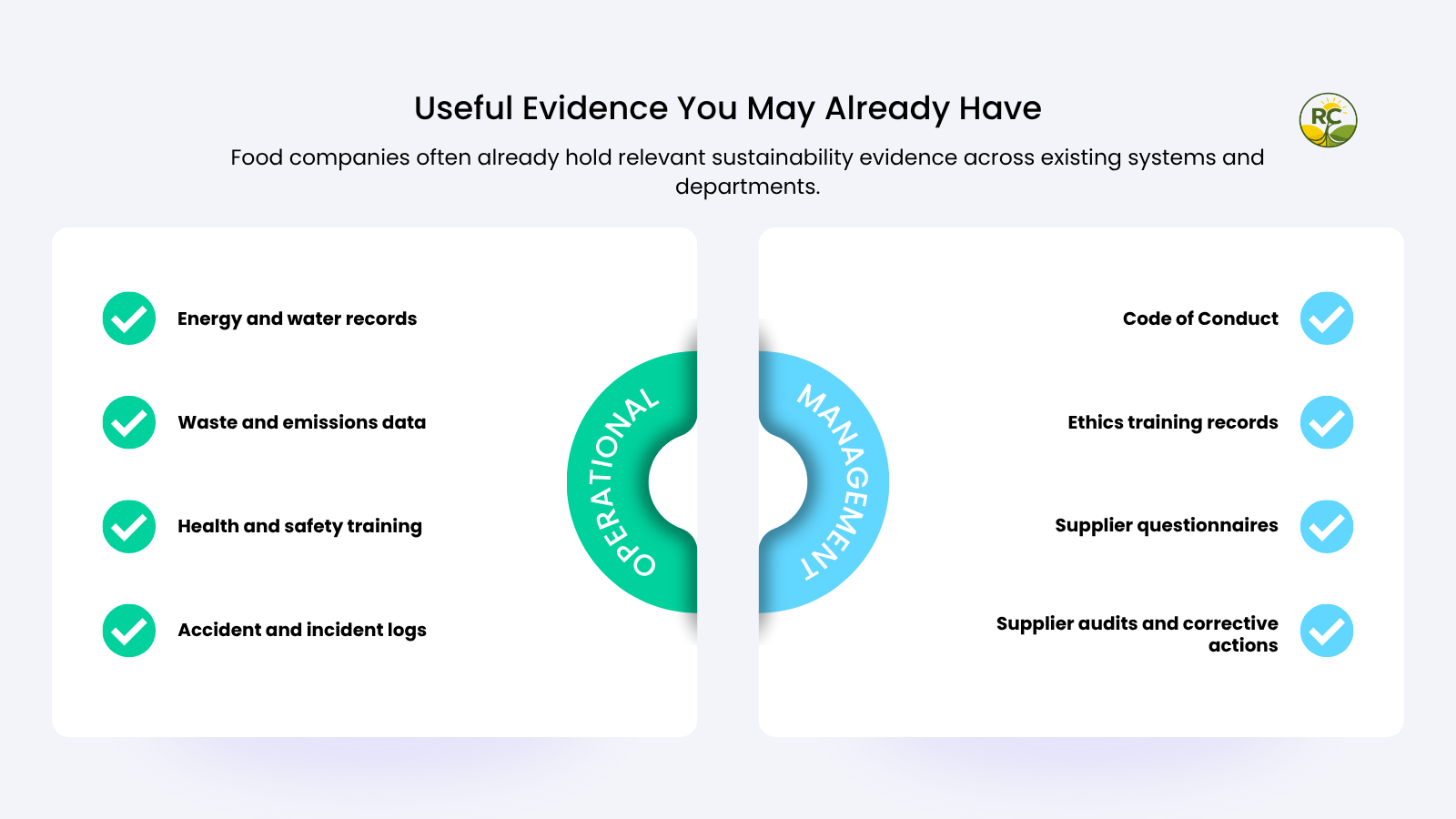
Relevant EcoVadis evidence may already exist across Quality, HR, Operations and Procurement.
How to audit your evidence before submission
Step 1: Confirm the assessment scope
Write down the exact legal entity, employee count, industry classification, locations and assessment type.
Do not begin document selection until this information is confirmed. A strong group-level policy may still need evidence showing that it applies to the subsidiary or site being assessed.
Step 2: Review your activated criteria
EcoVadis customises the questionnaire according to the company’s activity, size and location. Not all 21 criteria are activated for every organisation.
Use the Industry Risk Profile available on the platform and build your evidence plan around the criteria that actually apply.
Step 3: Create a document inventory
List the potentially relevant files held by:
Quality and Food Safety;
Health and Safety;
Human Resources;
Procurement;
Operations and Engineering;
Finance;
Legal or Compliance; and
Sustainability.
For each file, record its owner, date, scope, format and the criterion or management indicator it may support.
Step 4: Separate policies, actions and results
A policy states what the company has committed to do. An action shows implementation. A result shows what happened.
Do not expect one short policy to prove all three.
For example:
Environmental policy: commitment
Energy-efficiency project record: action
Annual energy consumption and emissions data: result
Looking at the evidence in this sequence quickly exposes gaps.
Step 5: Check multi-site coverage
Confirm how many employees and sites each document covers. Pay particular attention to environmental policies, reporting and KPI files prepared locally.
If several sites use the same process, retain evidence showing that the process is deployed across the required scope.
Step 6: Test every file technically
Check that each document:
opens without errors;
is not password-protected;
is below the applicable file-size limit;
contains selectable text;
includes all referenced pages and appendices; and
has a clear, descriptive filename.
A filename such as Environmental_KPIs_2025_All_EU_Sites.pdf is more useful internally than final_report_v7_new.pdf.
Step 7: Select the strongest evidence
EcoVadis currently limits each assessment to 55 documents. More documents may not automatically produce a better score.
Do not circumvent the limit by combining unrelated policies, screenshots and records into one artificial evidence pack. EcoVadis does not generally accept these “combined documents”.
There are reasonable exceptions, including consolidated KPI reporting for multiple sites and management manuals that already contain related policies and procedures as part of the real management system. The distinction is whether the document existed as a coherent business document before the assessment.
The official explanation of the 55-document limit provides examples.
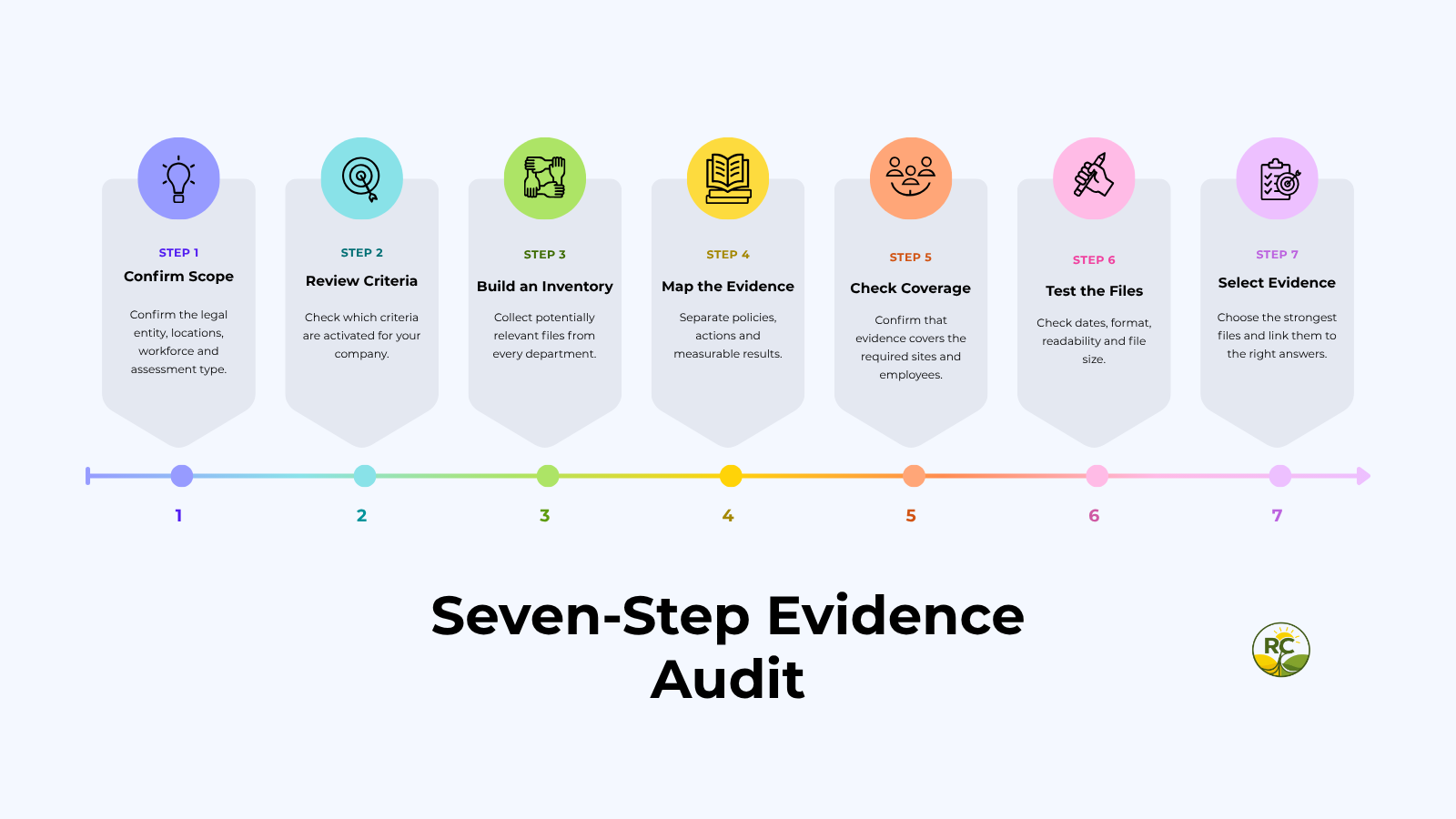
A structured evidence audit helps identify scope, quality and documentation gaps before submission.
Common document problems in food companies
Before you submit, it can be useful to look specifically for these issues:
A sustainability policy with no owner, approval date or review date.
A KPI spreadsheet with no reporting period, units or organisational scope.
A group policy that does not explain whether it applies to the assessed subsidiary.
A signed policy saved as an unreadable photograph.
A supplier code that exists, but no evidence it was issued to suppliers.
An audit report uploaded without identifying the relevant section.
A food-safety certificate linked to an unrelated sustainability claim.
Several unrelated documents merged together to bypass the upload limit.
A report containing useful evidence that was not linked to the relevant answer.
An expired certificate that remains in the submission folder.
These are usually easier to correct before the questionnaire is submitted than after the scorecard is issued.
A practical final review
Two people should review the submission if time allows.
The first person should understand the sustainability content. The second should be unfamiliar enough with the files to test whether the evidence is understandable without additional explanation.
For each questionnaire answer, ask:
👉 If I knew nothing about this company, would this document clearly prove the claim?
If the answer is no, either choose better evidence or make the existing business document clearer before submission. Do not add claims the company cannot substantiate.
For a broader preparation review, use the EcoVadis gap-analysis guide alongside this document audit.
Strong evidence is organised evidence
The goal is not to fill all 55 document spaces. It is to present a focused, credible set of records that reflects how your company actually manages sustainability.
For food companies, that often means making better use of existing operational evidence while being honest about what a food-safety, quality or supplier document does and does not prove.
Confirm the scope. Select evidence against the activated criteria. Check dates and coverage. Make every file machine-readable. Link it to the correct answer. Then assign someone to review the scorecard as soon as the two-day pre-publication window opens.
That preparation is far more valuable than uploading another folder of loosely related documents.
Already have the evidence but are unsure if it is ready to upload?
My Quick Expert Check is designed for companies that have much of their documentation in place but want an expert review before submission.
It includes:
Review of up to 25 existing documents
Identification of the most important gaps
Prioritised recommendations
A written action plan, see example here
A 60-minute results call
The review helps identify which documents provide strong evidence, which are attached to the wrong questions and where one part of the evidence chain is missing.
What if implementation records or KPIs do not exist yet?
Document mapping cannot replace an operational process.
If a procedure exists but no completed records can be found, the next step is implementation. If activities take place but no performance data is collected, the company needs a reporting process.
My Full EcoVadis Support is more suitable for you when policies, procedures, implementation evidence, KPIs or internal capacity are still missing.
The practical difference is:
Quick Expert Check: Most documentation exists and your team can implement recommendations internally.
Full EcoVadis support: The management system or evidence still needs to be developed.
Disclaimer: The author is a former EcoVadis analyst. This article is based solely on publicly available information, professional experience, and independent analysis. No confidential, proprietary, non-public, or privileged information obtained during any previous employment or professional engagement has been used in the preparation of this article. The content is provided for informational purposes only and does not represent official EcoVadis guidance, methodology documentation, or scoring criteria. The author is not affiliated with, endorsed by, or acting on behalf of EcoVadis. Any views, interpretations, or recommendations expressed are solely those of the author and do not represent the views of EcoVadis.
