

The 21 EcoVadis Criteria: How to Prepare for Each One

Introduction
If you're a supplier, manufacturer, or service provider being asked to complete an EcoVadis assessment, you've probably already noticed: it's not just a questionnaire. EcoVadis is one of the world's most widely used business sustainability rating platforms, trusted by over 175k+ rated companies globally (Source: EcoVadis, last accessed 1st of June 2026) — from DACH grocery retailers to multinational food brands. A strong EcoVadis score can open doors to new customers, strengthen existing relationships, and demonstrate that your sustainability commitments are real, documented, and verifiable.
But what exactly does EcoVadis evaluate? And how do you prepare for each criterion without wasting time on the wrong documentation?
This guide provides an independent overview of the sustainability topics and 21 sustainability criteria commonly assessed within the EcoVadis framework. The descriptions below are based on publicly available information and professional experience and are intended as practical examples and preparation guidance.
📋 Want to know whether your documentation would hold up in an EcoVadis assessment? My Quick Expert Check provides an independent review of a former EcoVadis Sustainability Analyst before you submit: Get your Expert Check now
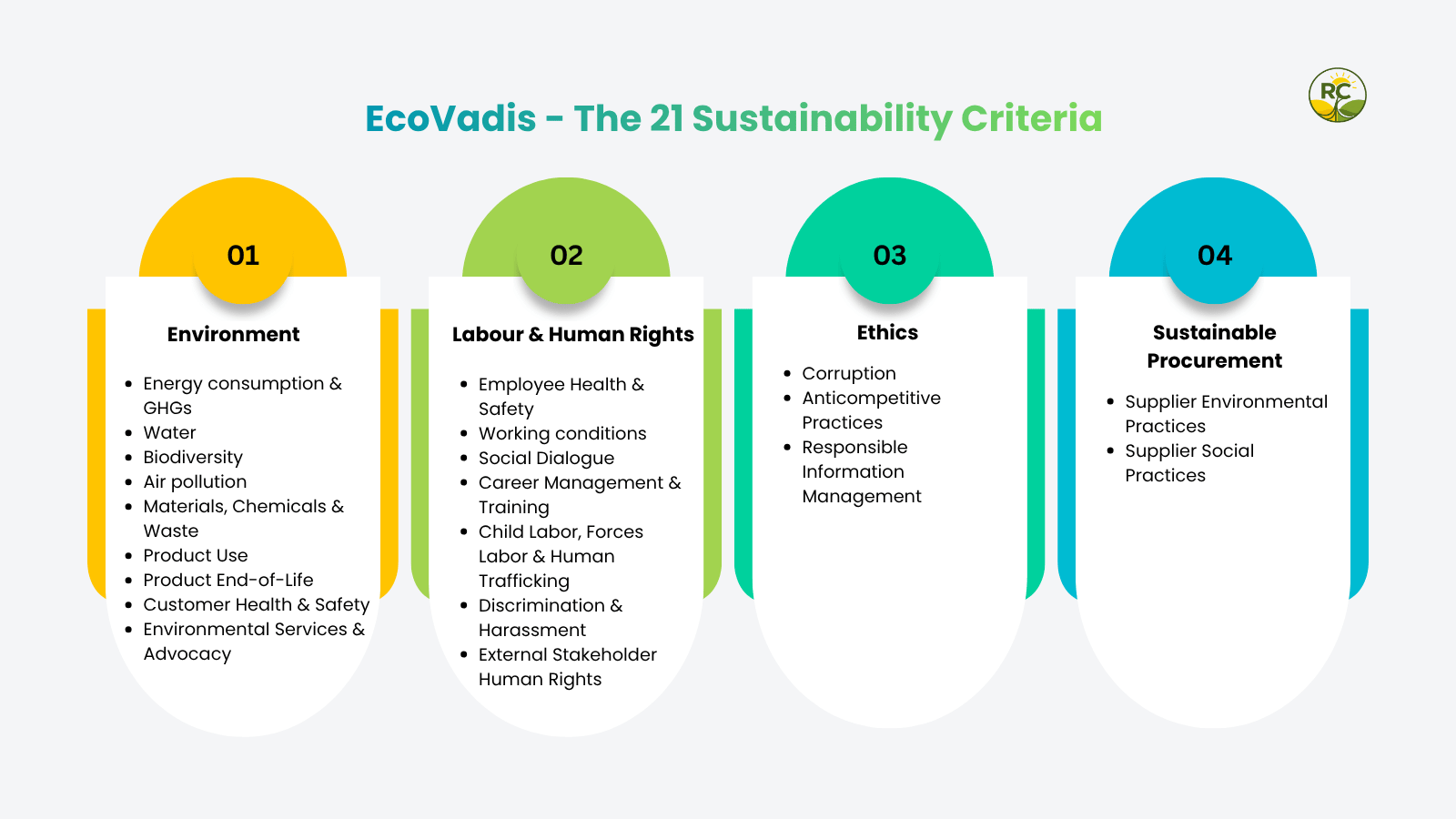
The 21 sustainability criteria of EcoVadis. Source: EcoVadis
How EcoVadis Works: A Quick Overview
Before diving into the criteria, a brief orientation. EcoVadis scores companies on four themes, each containing several individual criteria:
Environment — 9 criteria
Labor & Human Rights — 7 criteria
Ethics — 3 criteria
Sustainable Procurement — 2 criteria
Your score for each theme is weighted based on your industry and company size. Not all 21 criteria carry equal weight for every company — EcoVadis adjusts relevance based on your activity, size and location.
Each criterion is assessed across three management pillars:
Policies — Do you have written commitments?
Actions — Do you take concrete measures?
Results — Do you measure and report on outcomes?
Policies are an important starting point. However, companies can often strengthen their sustainability management by documenting not only commitments, but also implementation measures and measurable outcomes.
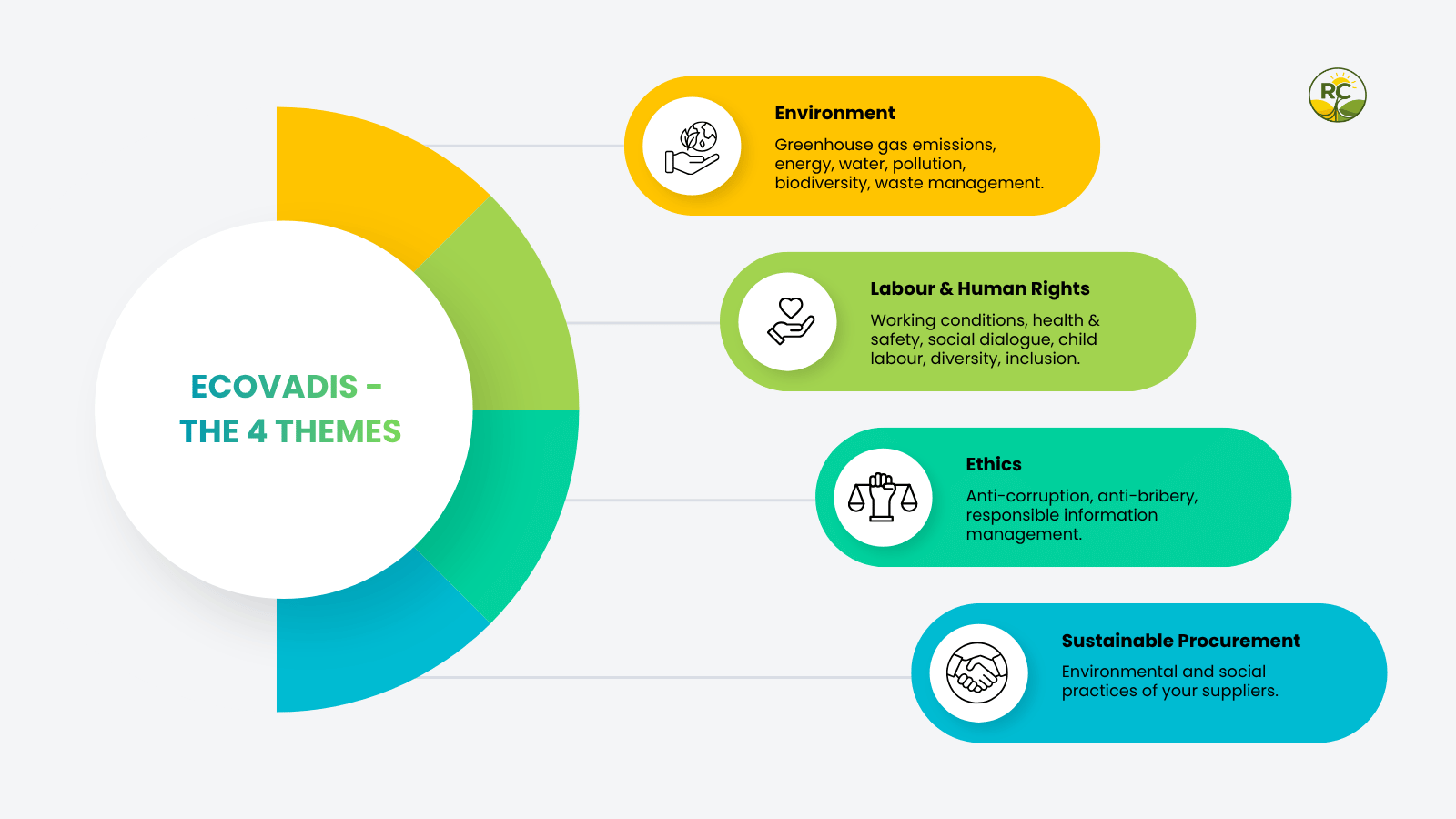
EcoVadis - The 4 Themes. Source: EcoVadis
Theme 1: Environment (9 Criteria)
Criterion 1 — Energy Consumption & GHGs
This criterion generally focuses on whether you track, manage, and reduce your energy use and greenhouse gas (GHG) emissions — including Scope 1, 2, and ideally Scope 3.
Potential supporting evidence and practices:
Criterion 2 — Water
Water management may be evaluated in terms of consumption tracking, reduction efforts, and — for high-risk sectors like food and agriculture — wastewater management.
Potential supporting evidence and practices:
Total water withdrawals by source
Water reduction initiatives and their outcomes
If you operate in water-stressed regions, you can show site-level risk assessment
Relevant certifications: for example ISO 14001 environmental management covering water
Criterion 3 — Biodiversity
This criterion generally covers your impact on natural habitats, land use, and ecosystems — particularly relevant for agricultural producers and companies sourcing raw materials.
Potential supporting evidence and practices:
Identify operations or supply chains that intersect with protected areas or biodiversity hotspots
Biodiversity-related commitments or site management plans
For agrifood companies: relevant certifications like organic certification, RSPO, or Rainforest Alliance membership
Criterion 4 — air Pollution
Companies may be assessed on their management of spills, air emissions, noise, and other forms of local environmental pollution.
Potential supporting evidence and practices:
Criterion 5 — Materials, Chemicals & Waste
This criterion generally looks at how you manage waste generation, hazardous substances, and materials efficiency across your operations.
Potential supporting evidence and practices:
Criterion 6 — Product Use
Companies may be assessed on the environmental impact of their products during the use phase — energy or water consumed when customers use their product, emissions released during use, and whether their product design actively works to reduce these impacts.
Potential supporting evidence and practices:
Life Cycle Assessments (LCA) or simplified use-phase impact assessment for your key products
Documented eco-design principles that consider end-user environmental impact
For food companies: documented storage instructions and food waste reduction guidance on packaging
Ecolabel certifications that cover use-phase criteria (EU Ecolabel, Blue Angel)
Criterion 7 — Product End-of-Life
Separate from the use phase, this criterion focuses on what happens to your product and packaging once the customer is done with it — recyclability, design for disassembly, and participation in take-back or extended producer responsibility (EPR) schemes.
Potential supporting evidence and practices:
Recyclability profile of your packaging by material type and market
Participation in national EPR systems (Grüner Punkt in Germany, ARA in Austria)
Design-for-recyclability principles in your product development process
Compliance with EU Packaging and Packaging Waste Regulation (PPWR) targets
Criterion 8 — Customer Health & Safety
This criterion may assess your responsibility for the health and safety of end users — product safety testing, labeling accuracy, regulatory compliance, and recall management.
Potential supporting evidence and practices:
Food safety certifications (IFS Food, BRC, FSSC 22000, ISO 22000)
Product recall and withdrawal procedures, including test or live exercise records
Allergen management protocols or labeling compliance with EU Regulations
Product complaint register and how it feeds into product improvement
Criterion 9 — Environmental Services & Advocacy
This criterion may reward engagement that goes beyond your own operations: industry sustainability initiatives, NGO partnerships, public environmental commitments, or voluntary programs at community or sector level. It is the criterion most companies leave points on the table with — often because it sounds too large-scale for an SME. But in reality it isn't.
Potential supporting evidence and practices:
Memberships in sustainability initiatives (UN Global Compact, CDP, Science Based Targets)
Public sustainability commitment or report on your website
Community environmental projects or NGO partnerships
For agrifood companies: involvement in EUDR or deforestation-free commodity working groups can be a possible supporting evidence
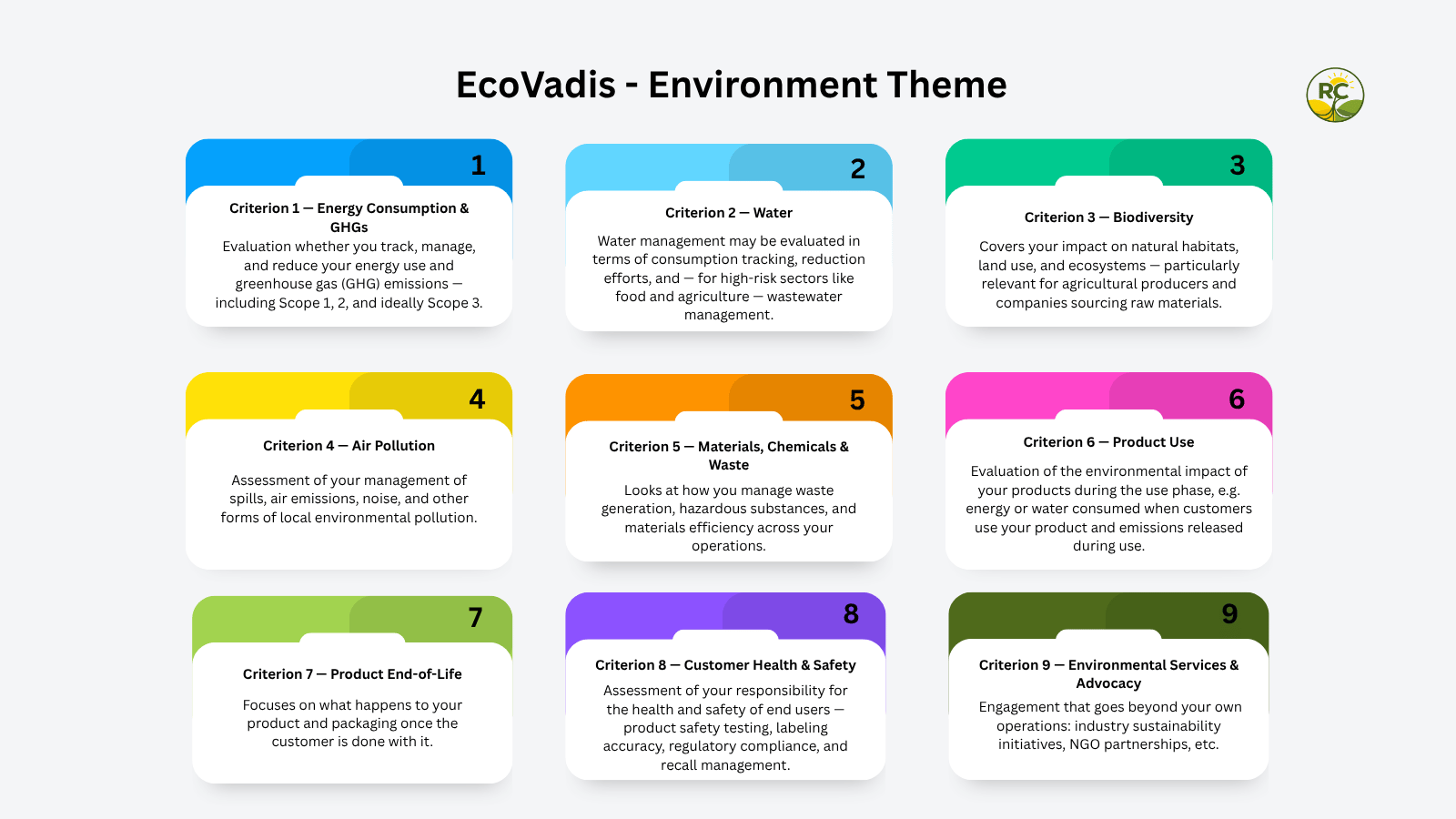
EcoVadis - Environment Theme and its criteria. Source: EcoVadis
Theme 2: Labor & Human Rights (7 Criteria)
Criterion 10 — Employee Health & Safety
Usually one of the most heavily weighted criteria for manufacturing and food production companies. Your company may be assessed on your occupational health and safety (OHS) management system, incident rates, and safety culture.
Potential supporting evidence and practices:
Formal OHS management system (ISO 45001 or equivalent)
Accident frequency rates (AFR) and lost-time injuries (LTI)
Documented safety training programs and records
IFS Food audits, SMETA/Sedex assessments, and ISO 45001 certifications
Criterion 11 — Working Conditions
This criterion generally covers working hours, rest periods, fair wages, and the general dignity of working conditions — including compliance with local labor law.
Potential supporting evidence and practices:
Working time policies and overtime management
Compliance with minimum wage requirements in all jurisdictions where you operate
Evidence of employment contracts and HR policy documentation
SMETA audits (Sedex Members Ethical Trade Audit)
Criterion 12 — Social Dialogue
Companies my be assessed whether their company supports freedom of association, collective bargaining, and meaningful employee representation.
Potential supporting evidence and practices:
Position on trade unions and collective bargaining
Works councils or employee representative structures
Evidence of regular employee communication and feedback mechanisms
Criterion 13 — Career Management & Training
This criterion generally looks at employee development, training programs, skills assessment, and career progression — especially relevant for demonstrating long-term investment in your workforce.
Potential supporting evidence and practices:
Documented training investment (hours per employee, budget)
Structured onboarding and regular performance review processes
Mentoring, professional development, or apprenticeship programs
Compliance with national training levy obligations
Criterion 14 — Child Labor, Forced Labor & human trafficking
This criterion focuses on your commitment to the prohibition of child labor, forced labor and human trafficking - in your own operations or supply chain.
Potential supporting evidence and practices:
Documented policy explicitly prohibiting child labor and forced labor
Supplier due diligence against the ILO core conventions
Alignment with the German Supply Chain Due Diligence Act (LkSG) if you operate in or sell to the German market
SMETA audits and Fair Trade or SA8000 certifications
Criterion 15 — discrimination & harassment
This criterion may evaluate your commitment to non-discrimination, equal opportunity, and workforce diversity across gender, age, disability, and other protected characteristics.
Potential supporting evidence and practices:
Equal opportunities policy
Reported gender pay gap data if available in your jurisdiction
Diversity in hiring and leadership pipelines
Evidence of accommodation for workers with disabilities or parental responsibilities can support this criterion
Criterion 16 — External Stakeholder Human Rights
Beyond the workforce, this criterion my assess whether your company identifies and addresses human rights risks affecting external stakeholders — communities living near your operations, smallholder farmers in your supply chain, indigenous peoples affected by land use, or other groups impacted by your business activities.
Potential supporting evidence and practices:
Human rights risk assessment covering your operations and supply chain, explicitly including external stakeholder groups
Human Rights Policy that goes beyond employees and explicitly names communities, suppliers, and affected third parties
Grievance mechanism accessible to external stakeholders — not just internal staff
For agrifood companies sourcing from high-risk regions: documented evidence of how smallholder farmer rights and community land rights are addressed in supplier due diligence
LkSG-compliant risk analysis and complaints procedure documentation
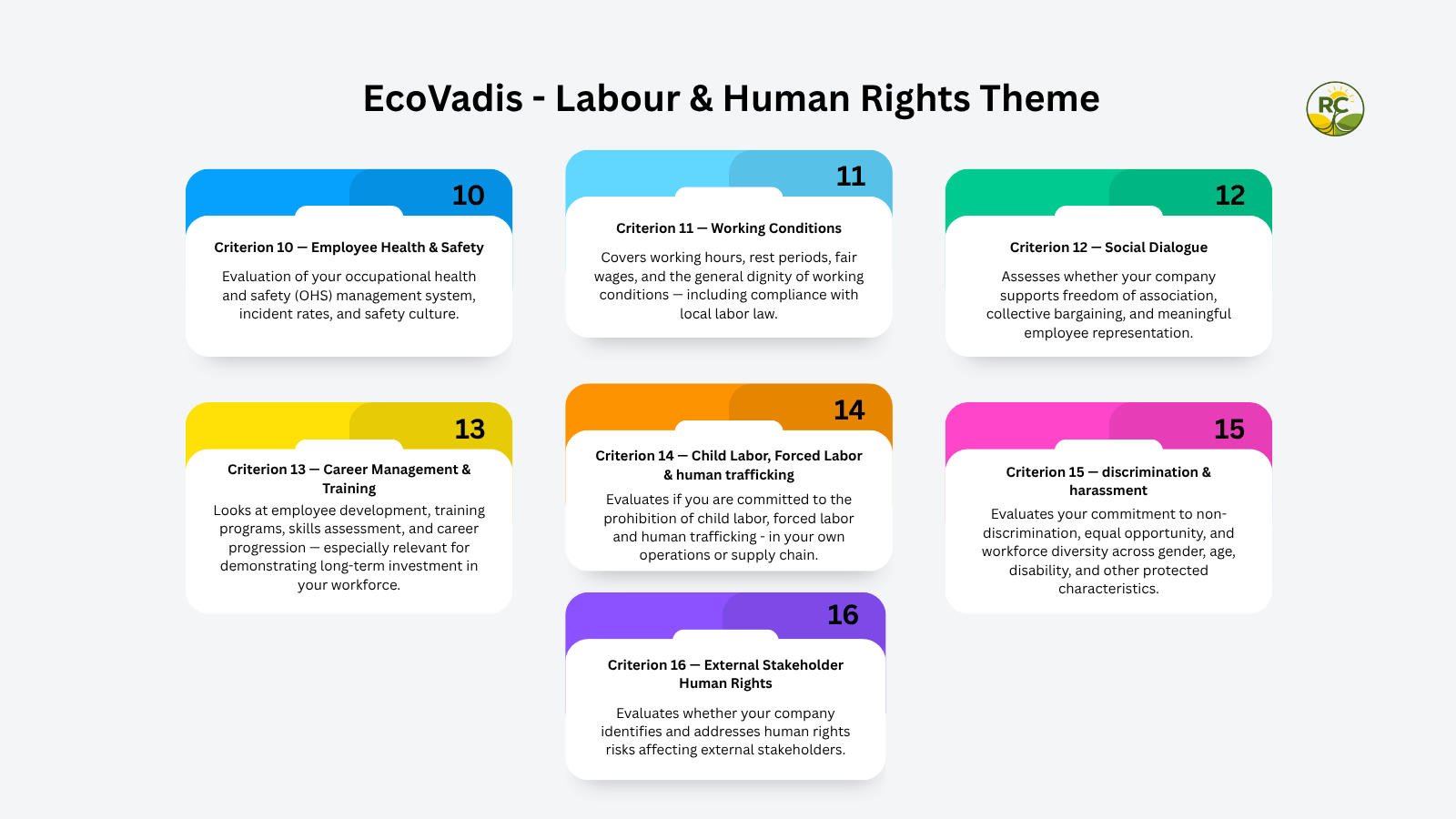
EcoVadis - Labour & Human Rights Theme and its criteria. Source: EcoVadis
Theme 3: Ethics (3 Criteria)
Criterion 17 — Corruption
This criterion may focus on your anti-corruption framework — policies, controls, and training — as well as your whistleblower mechanisms.
Potential supporting evidence and practices:
Formal anti-bribery and corruption policy
Documented employee training on anti-corruption and gift/hospitality rules
Confidential whistleblower reporting channel
For companies subject to LkSG: your compliance management system may cover this criterion
Criterion 18 — AntiCompetitive practices
This criterion may assess your measures to prevent price-fixing, market allocation, and other anti-competitive practices.
Potential supporting evidence and practices:
Documented competition law compliance policies and training programs
Evidence of management accountability for competition law compliance
Legal function sign-off on contracts and trade association participation
Criterion 19 — Responsible Information Management
This criterion may look at how you protect personal data, respect customer privacy, and handle cybersecurity risks.
Potential supporting evidence and practices:
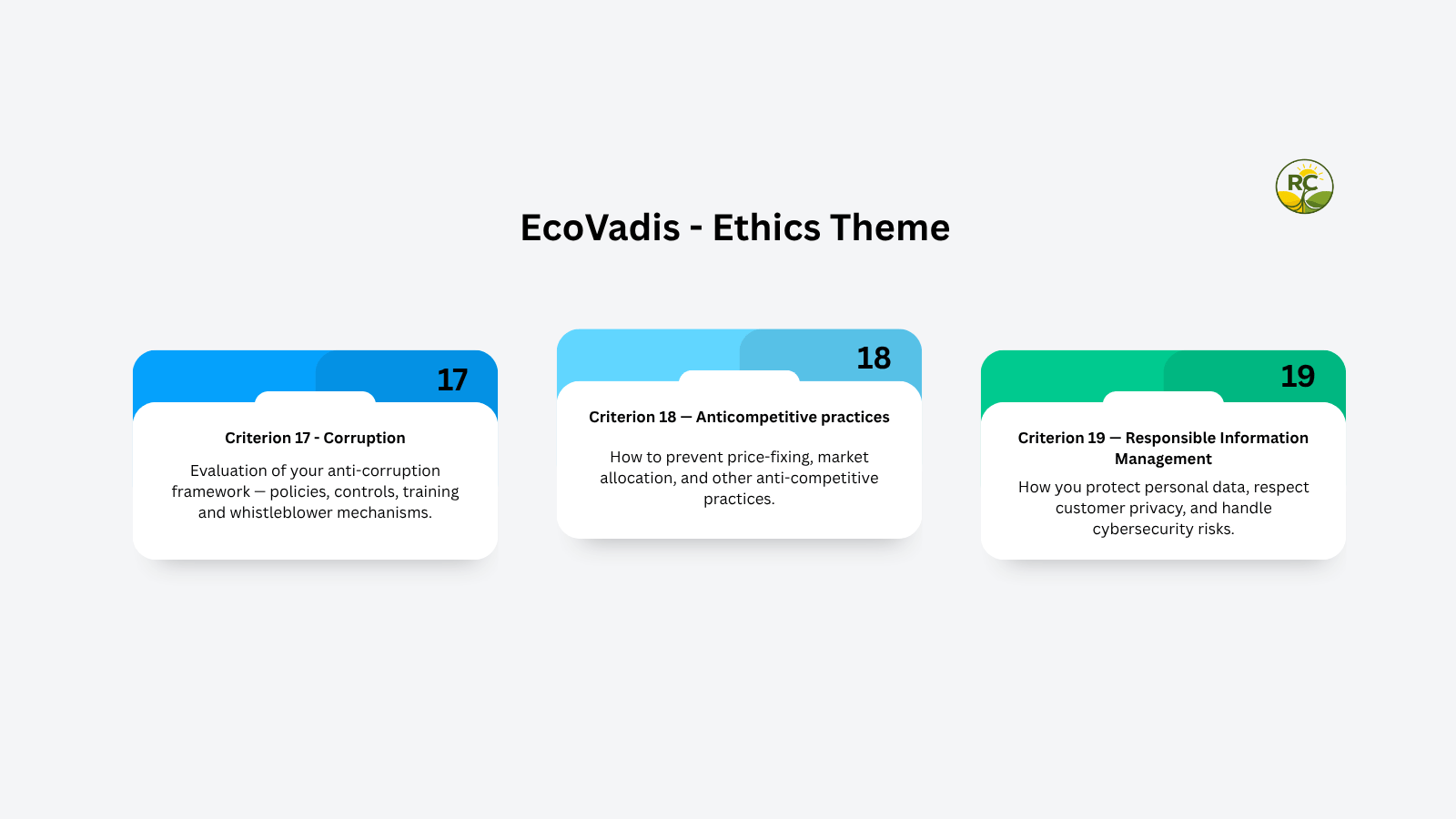
EcoVadis - Ethics Theme and its criteria. Source: EcoVadis
Theme 4: Sustainable Procurement (2 Criteria)
Criterion 20 — Supplier Environmental Practices
This criterion may evaluate whether you extend your environmental expectations to your own suppliers — through screening, contracts, and monitoring.
Potential supporting evidence and practices:
Inclusion of environmental requirements in supplier contracts or codes of conduct
Documented supplier screening or selection process for environmental criteria
Examples of supplier environmental audits or questionnaires sent
If you're a buyer in the food sector: EUDR (EU Deforestation Regulation) due diligence documentation may be an evidence for this criterion
Criterion 21 — Supplier Social Practices
This criterion mirrors Criterion 20 but may focus on social standards — labor practices, human rights, and ethical conduct across your supplier base.
Potential supporting evidence and practices:
Supplier Code of Conduct covering ILO core conventions and local labor law
Documented supplier social risk mapping process
Show how you handle non-conformances when suppliers fall short
LkSG-compliant due diligence documentation can be used as evidence for this criterion
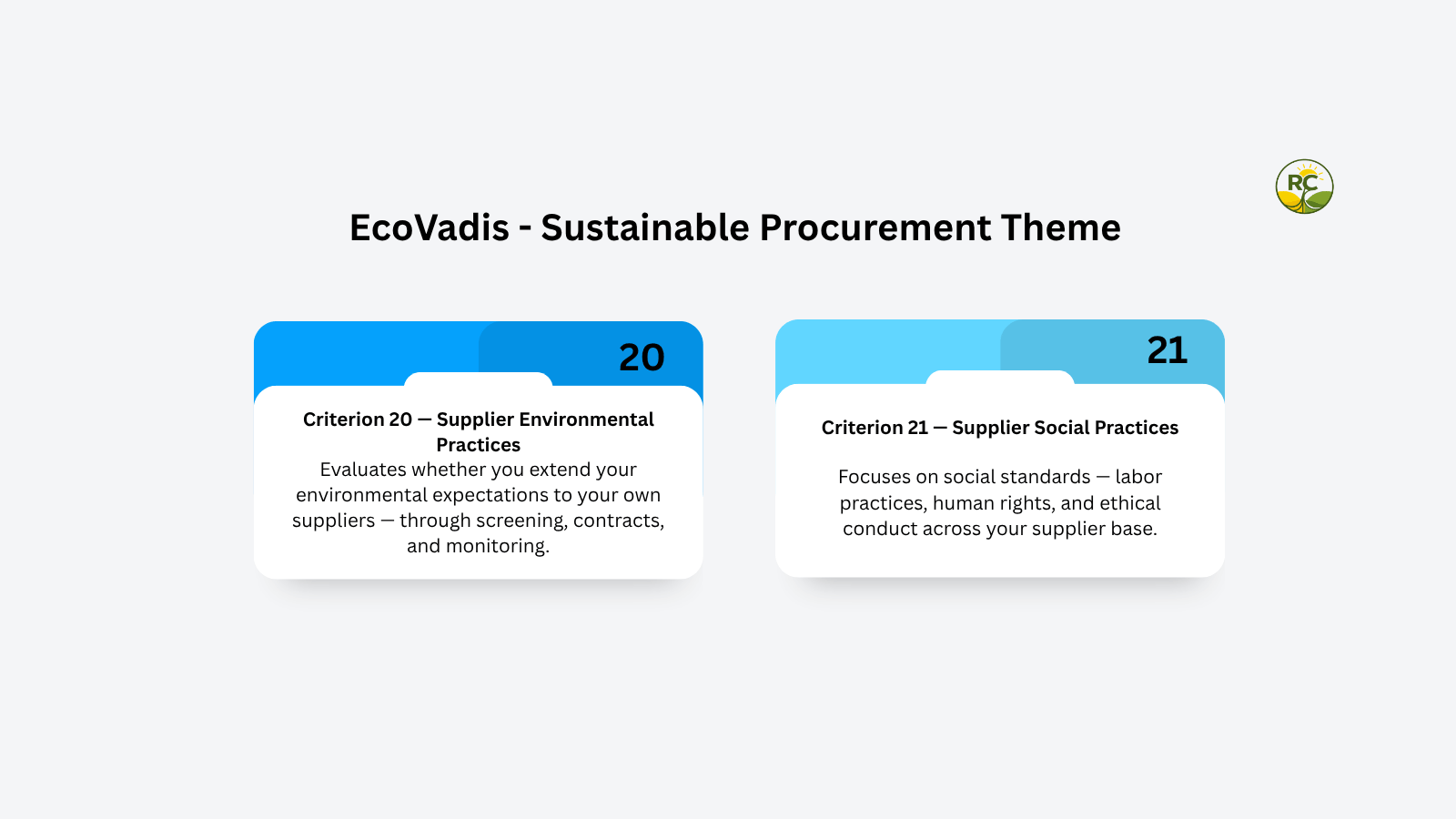
EcoVadis - Sustainable Procurement Theme and its criteria. Source: EcoVadis
Common Mistakes That Hurt Your EcoVadis Score
Even well-prepared companies lose points in avoidable ways. Here are the most common pitfalls:
1. Policy without evidence. Having a sustainability policy is necessary but often not sufficient. EcoVadis may want to see that policies translate into actions and measurable results.
2. Outdated documents. Policies and procedures should be reviewed regularly and kept up to date.
3. Ignoring the industry weighting. If you're in food manufacturing, Environment and Labor & Human Rights may be often weighted much more heavily than for a software company. Focus your preparation accordingly.
4. Missing KPIs. The "results" layer of each criterion requires quantitative data. If you're not measuring energy, water, waste, and accident rates: start now. Even partial data is better than none.
5. Forgetting Sustainable Procurement. Many companies deprioritize Theme 4, but it may account for a significant share of the total score — especially for companies with complex supply chains.
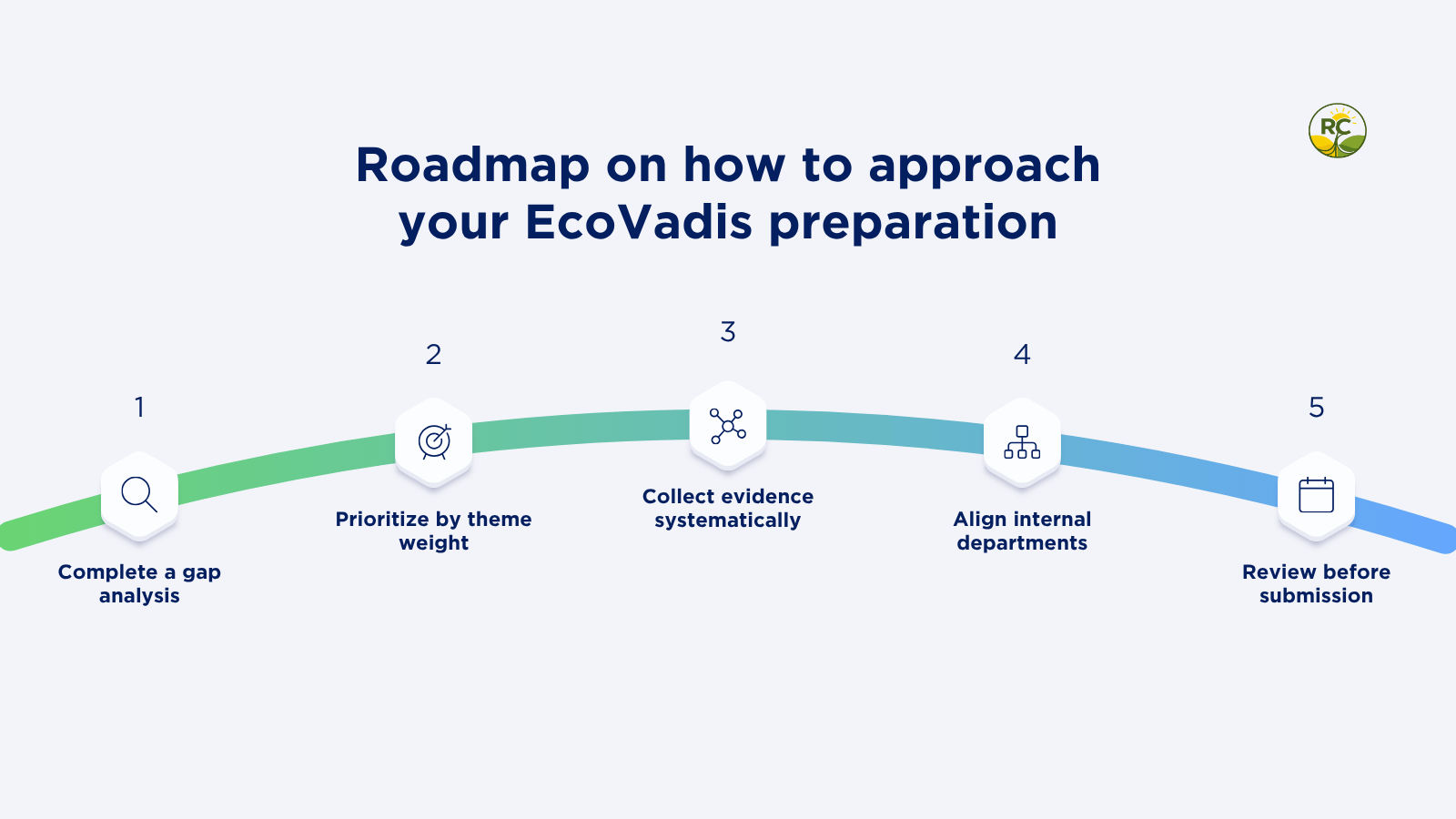
How to Approach Your EcoVadis Preparation
A structured approach saves significant time and avoids last-minute scrambles. A practical sequence:
Complete a gap analysis against all 21 criteria before starting the questionnaire
Prioritize by theme weight for your industry
Collect evidence systematically — policies, certifications, KPI data, training records
Align internal departments — HR, procurement, operations, legal, and sustainability all own different criteria
Review before submission — make sure your documents are uploaded for the right criteria and question
Already have the evidence but are unsure if it is ready to upload?
My Quick Expert Check is designed for companies that have much of their documentation in place but want an expert review before submission.
It includes:
Review of up to 25 existing documents
Identification of the most important gaps
Prioritised recommendations
A written action plan, see example here
A 60-minute results call
The review helps identify which documents provide strong evidence, which are attached to the wrong questions and where one part of the evidence chain is missing.
What if implementation records or KPIs do not exist yet?
Document mapping cannot replace an operational process.
If a procedure exists but no completed records can be found, the next step is implementation. If activities take place but no performance data is collected, the company needs a reporting process.
My Full EcoVadis Support is more suitable for you when policies, procedures, implementation evidence, KPIs or internal capacity are still missing.
The practical difference is:
Quick Expert Check: Most documentation exists and your team can implement recommendations internally.
Full EcoVadis support: The management system or evidence still needs to be developed.
Disclaimer: The author is a former EcoVadis analyst. This article is based solely on publicly available information, professional experience, and independent analysis. No confidential, proprietary, non-public, or privileged information obtained during any previous employment or professional engagement has been used in the preparation of this article. The content is provided for informational purposes only and does not represent official EcoVadis guidance, methodology documentation, or scoring criteria. The author is not affiliated with, endorsed by, or acting on behalf of EcoVadis. Any views, interpretations, or recommendations expressed are solely those of the author and do not represent the views of EcoVadis.
