


A large customer requests an EcoVadis rating. You have six weeks. You log into the platform, stare at the questionnaire, and realise you have no idea where to start.
Sounds familiar?
EcoVadis is the world's most widely used sustainability rating for supply chains. Over 175k+ companies globally are rated on it (Source: EcoVadis, last accessed 1st of June 2026) — and the number is growing every year as large corporations tighten their supplier requirements. If your customers include multinationals or publicly listed companies, the question is no longer whether they'll ask for an EcoVadis rating. It's when.
The frustrating reality is that most companies that score poorly on EcoVadis are not poorly run. Their sustainability practices are often genuinely solid. They just make avoidable mistakes in how they prepare, document, and present their work — and those mistakes cost them points, medals, and sometimes contracts.
This article breaks down the five most common preparation mistakes — and what can be done instead.
💡 Not sure where EcoVadis fits in the bigger ESG picture? Start with my guide: What ESG Compliance Really Means for Your Business: A Practical Guide for SMEs.
First: a quick primer on how EcoVadis actually works
EcoVadis evaluates companies across four themes:
Environment — emissions, energy, pollution, biodiversity, waste
Labor & Human Rights — working conditions, health & safety, social dialogue
Ethics — anti-corruption, anti-bribery, data privacy
Sustainable Procurement — how you manage your own suppliers
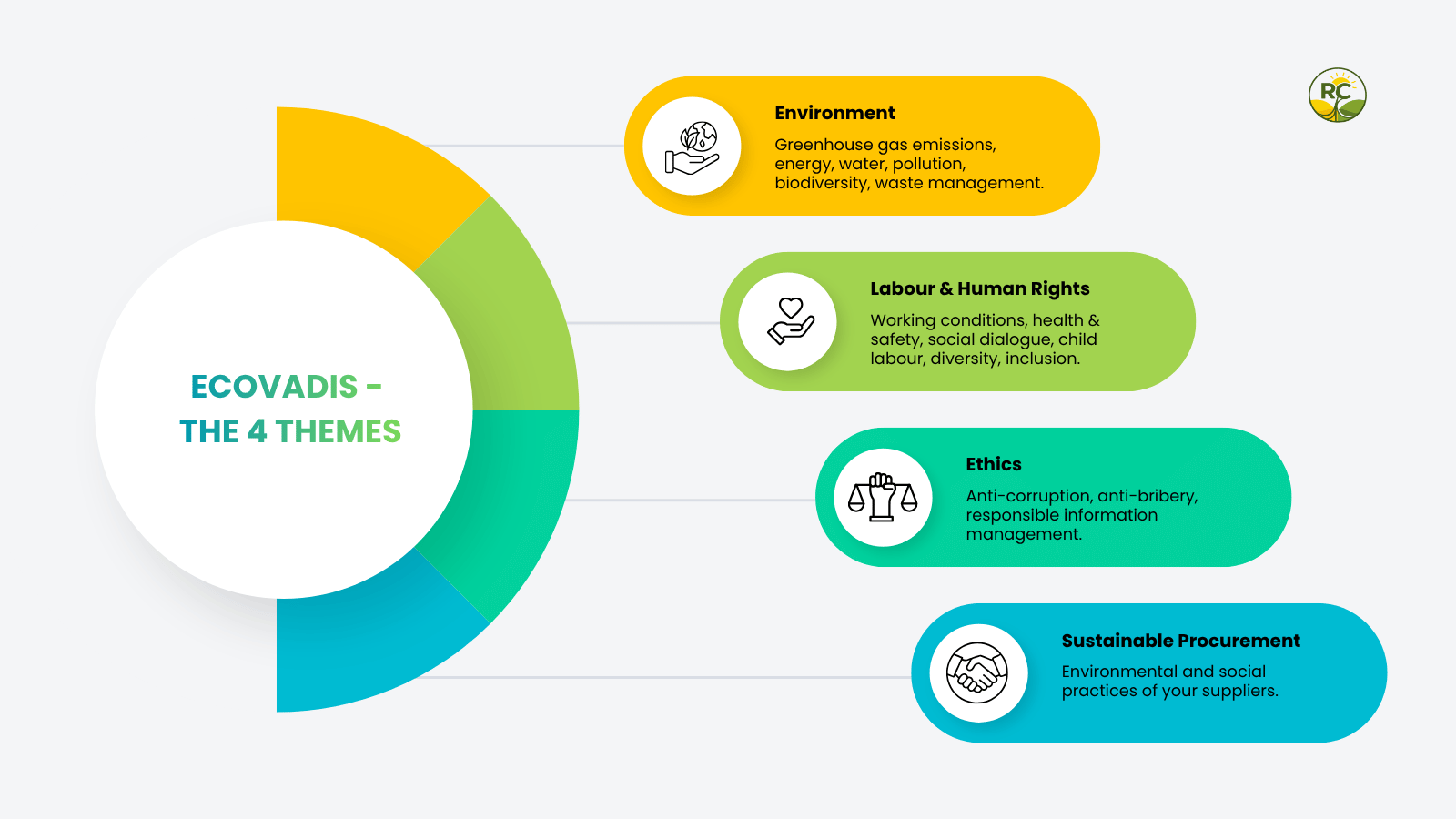
EcoVadis - The 4 Themes. Source: EcoVadis
Each theme is scored 0–100 using EcoVadis' P-A-R framework: Policies (do you have documented commitments?), Actions (are you actually doing something?), and Results (can you prove the impact?).
Your overall score sits on a 0–100 scale. EcoVadis Medals are awarded based on your percentile rank against all companies assessed globally in the past 12 months — not a fixed score. The current medal thresholds are:
Bronze — Top 35% (65th percentile and above)
Silver — Top 15% (85th percentile and above)
Gold — Top 5% (95th percentile and above)
Platinum — Top 1% (99th percentile and above)
One critical rule: to be eligible for any medal, you must score at least 30 out of 100 in every theme. A single weak theme can block your medal, even if your overall score is strong.
And one important reality for 2026: the bar is rising. As more companies invest in their sustainability systems, the percentile thresholds shift upward. Aiming for the exact score that earned Bronze last year is no longer enough.
The key is to build in a buffer.
📋 Want to know whether your documentation would hold up in an EcoVadis assessment? My Quick Expert Check provides an independent review of a former EcoVadis Sustainability Analyst before you submit: Get your Expert Check now
Mistake #1 — Treating EcoVadis like a one-time compliance exercise
The most fundamental mistake: approaching EcoVadis as something you do once when a customer asks, file away, and forget about until the renewal notice arrives.
EcoVadis is a percentile-based system. Your medal is not tied to an absolute score — it's tied to how you rank against all other companies assessed in the past 12 months. That pool improves continuously. A score that earned Silver this year might not earn it next year if your competitors have caught up.
What this means in practice: Companies that prepare reactively — scrambling when the request arrives — tend to submit incomplete evidence, miss opportunities, and start each cycle from scratch. Companies that treat EcoVadis as an ongoing process build better documentation, improve steadily, and score higher with less effort each time.
What to do instead: Set a calendar reminder six months before your renewal date. Use the off-cycle months to close documentation gaps, collect supplier data, and update your policies. Treat your EcoVadis Corrective Action Plan (the improvement recommendations EcoVadis provides after each assessment) as a live roadmap — not a PDF that sits in a folder.
Mistake #2 — Ignoring your activated criteria
EcoVadis does not evaluate every company on every criterion. Based on your industry, size, and geographic footprint, it activates a specific subset of the 21 criteria that are most relevant to your business profile.
Many companies spend hours preparing documentation for criteria that aren't activated for them — while completely overlooking high-weight criteria that are. The result: wasted effort and missed points.
What to do instead: As soon as you receive your assessment invitation, log into the EcoVadis platform and review your Industry Risk Profile. This tells you exactly which criteria are activated and how they are weighted for your company. Build your preparation plan around those criteria — not a generic sustainability checklist.
If a criterion seems irrelevant to your business, EcoVadis allows you to mark it as "Not applicable" — but use this sparingly for activated criteria. An activated criterion marked N/A without a strong justification signals a gap, not an exemption.
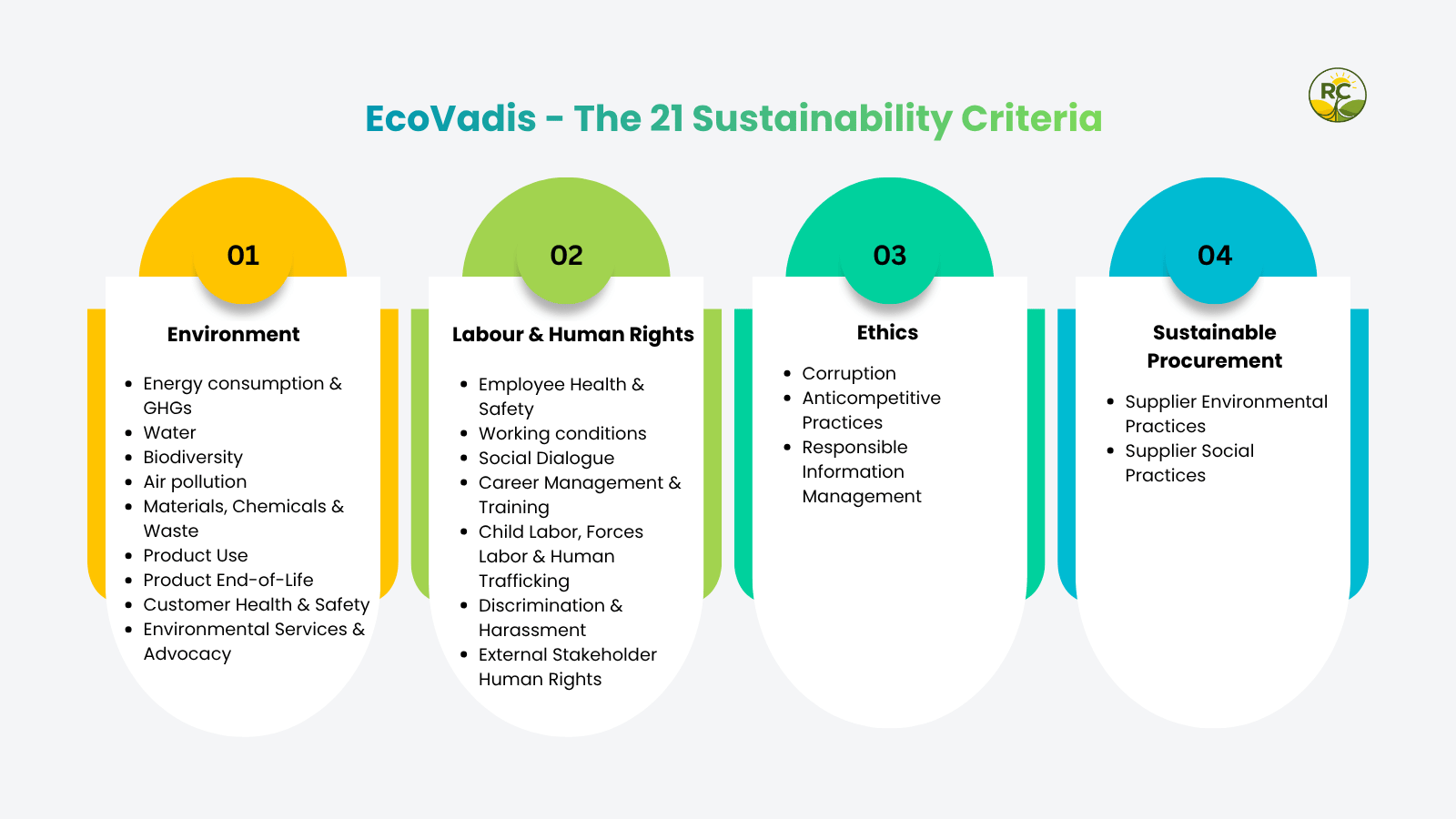
The 21 sustainability criteria of EcoVadis. Source: EcoVadis
Mistake #3 — Uploading the wrong evidence
This is usually the most common reason for unexpected low scores: companies upload documents that feel relevant but don't actually prove what the question asks.
EcoVadis analysts assess evidence against specific criteria. A document needs to directly and clearly prove the corresponding point — not hint at it, not mention it in passing, not cover it as a footnote in a larger sustainability report.
Common evidence mistakes include:
Uploading a general sustainability report as proof of a specific policy (a report that mentions energy consumption is not the same as a formal, signed energy policy).
Submitting marketing brochures or PR materials instead of internal policy documents.
Using outdated documents — evidence must be dated, current, and officially approved.
Not guiding the analyst — if you upload a 60-page report where the relevant section is on page 43, say so in the comment box and indicate the relevant sections or page numbers. This makes it easier for analysts to locate the supporting evidence and reduces the risk that important information is overlooked.
What to do instead: Map every document to a specific question before uploading. Ask: "Does this file directly prove the claim I've made?" If the answer is anything other than a clear yes, either find a better document or note the gap.
A policy is a good starting point, but it is often more effective when supported by evidence of implementation and measurable results. Wherever possible, demonstrate all three elements: commitments, actions, and outcomes.

Mistake #4 — Scoping misalignment
One of the most costly — and least discussed — preparation errors is scoping misalignment: answering questions based on one part of your business when the assessment should cover your full legal entity.
EcoVadis assesses the whole legal entity that was invited to the assessment, not only a specific site, department or division. Moreover, sister companies are generally not in scope of the assessment. Your policies need to apply company-wide. Your data needs to reflect the whole entity. If you operate across multiple sites and only report data from your headquarters, your score will reflect the inconsistency.
The reverse also happens: companies with multiple subsidiaries sometimes include activities that belong to a different legal entity — which inflates their submission and can cause problems in the review process.
What to do instead: Before answering a single question, confirm which legal entity is being assessed. Then review every policy document, every data point, and every certification to ensure it applies to that entity — not a subset of it, and not a parent company whose practices you haven't formally adopted.
Mistake #5 — Having no policies at all
This sounds obvious, but it is consistently the biggest scoring gap for SMEs doing their first EcoVadis assessment: you cannot score well on Policies if you don't have documented policies.
EcoVadis evaluates your management system — not just your good intentions or informal practices. Installing LED lighting without a formal energy policy can be seen as an informal, ad-hoc activity. But that same action backed by an updated policy with a measurable target increases the robustness significantly.
For SMEs, some core policies typically include:
An environmental policy (covering climate, energy, waste, pollution)
A health & safety policy
An anti-corruption and ethics policy
A human rights and labour policy
A supplier code of conduct
A complaints and whistleblowing procedure
None of these need to be 50-page documents. A clear, signed, two-page policy with a named owner, a review date, and at least one measurable commitment is far better than an elaborate report that doesn't explicitly state your position on the relevant topic.
What to do instead: Run a gap analysis against your activated criteria before you start the questionnaire. For any activated criterion where you have no written policy, developing one should be your first priority. It takes less time than most people expect — and it pays off not just in your EcoVadis score, but in every supplier audit, customer questionnaire, and ESG due diligence request you'll receive going forward.

What a realistic first score probably looks like
If this is your first EcoVadis submission: you can probably expect a score in the 20–50 range. This is completely normal. Very few companies achieve medal level on their first assessment, and that's fine — the system is designed around continuous improvement, not perfection in round one.
The goal of your first submission is to establish a realistic baseline and use the Corrective Action Plan EcoVadis provides as a roadmap for your second assessment. Companies that approach it this way — submitting what they have, understanding the gaps, systematically closing them — typically improve in their second cycle.
The smarter way for SMEs
For most small and mid-sized businesses, the EcoVadis process looks like this: a customer request arrives, internal panic follows, a rushed submission goes in, the score disappoints, the customer is unimpressed, and the cycle repeats. It doesn't have to.
The companies that consistently score well on EcoVadis share one thing: they build their ESG documentation as an ongoing system, not a one-off project. Their policies exist before the request arrives. Their supplier data is already collected. Their evidence is organised and current.
That's the outcome you're building toward — and it's achievable for SMEs of any size.
🔗 Want to understand the broader regulatory context? My guide on LkSG, CSDDD and EUDR explains why EcoVadis pressure from large customers is only going to increase in 2026 and beyond.
Already have the evidence but are unsure if it is ready to upload?
My Quick Expert Check is designed for companies that have much of their documentation in place but want an expert review before submission.
It includes:
Review of up to 25 existing documents
Identification of the most important gaps
Prioritised recommendations
A written action plan, see example here
A 60-minute results call
The review helps identify which documents provide strong evidence, which are attached to the wrong questions and where one part of the evidence chain is missing.
What if implementation records or KPIs do not exist yet?
Document mapping cannot replace an operational process.
If a procedure exists but no completed records can be found, the next step is implementation. If activities take place but no performance data is collected, the company needs a reporting process.
My Full EcoVadis Support is more suitable for you when policies, procedures, implementation evidence, KPIs or internal capacity are still missing.
The practical difference is:
Quick Expert Check: Most documentation exists and your team can implement recommendations internally.
Full EcoVadis support: The management system or evidence still needs to be developed.
Disclaimer: The author is a former EcoVadis analyst. This article is based solely on publicly available information, professional experience, and independent analysis. No confidential, proprietary, non-public, or privileged information obtained during any previous employment or professional engagement has been used in the preparation of this article. The content is provided for informational purposes only and does not represent official EcoVadis guidance, methodology documentation, or scoring criteria. The author is not affiliated with, endorsed by, or acting on behalf of EcoVadis. Any views, interpretations, or recommendations expressed are solely those of the author and do not represent the views of EcoVadis.
