

How to Conduct an EcoVadis Gap Analysis - Before You Start the Assessment

Stop collecting documents before you know what you actually need.
Most companies approach their EcoVadis assessment the same way: they gather whatever sustainability documentation they can find, work through the questionnaire, and hope for the best. The result is often a scramble in the final days — missing evidence, last-minute policy drafts, and a score that doesn't reflect what the company actually does.
A structured EcoVadis gap analysis can change that. Instead of reacting to gaps when they're already costing you points, you identify them early, fix what matters most, and enter the assessment with a clear picture of where you stand.
This guide walks you through a structured EcoVadis gap analysis, step by step.
What Is an EcoVadis Gap Analysis?
An EcoVadis gap analysis is a systematic review of your current sustainability management against EcoVadis requirements - conducted before you start the official questionnaire.
The goal isn't to compile documents. The goal is to identify which requirements are not yet covered, so you can close those gaps while there's still time.
Think of it as a pre-assessment health check that answers one central question:
"Where are we not yet ready — and what do we need to do about it?"
Done properly, a gap analysis helps you:
Identify missing policies, actions, and results before they become scoring losses
Prioritise improvements based on actual impact rather than assumption
Avoid last-minute document creation
Build a realistic timeline for assessment readiness
Reduce the risk of a disappointing score on a first or repeat submission
📋 Want to know whether your documentation would hold up in an EcoVadis assessment? My Quick Expert Check provides an independent review of a former EcoVadis Sustainability Analyst before you submit: Get your Expert Check now
Why Most Companies Skip This Step - and Pay for It
The gap analysis is skipped for one of two reasons: time pressure, or the assumption that "we already have most of this covered."
Both are costly mistakes.
Time pressure almost always backfires. Without a gap analysis, you spend more time in the assessment phase hunting for documents, chasing colleagues for information, and realising late that key policies don't exist or don't meet EcoVadis standards. A few days invested upfront saves weeks of reactive work.
The assumption of coverage is even more dangerous. Many companies genuinely do have strong sustainability practices, but lack the formal documentation EcoVadis requires. In the EcoVadis methodology, undocumented activities generally contribute little to your score regardless of how embedded they are operationally. What isn't documented effectively doesn't exist.
The gap analysis surfaces exactly this kind of mismatch and gives you time to fix it.
Step 1: Understand the 21 EcoVadis Criteria
Before you can identify gaps, you need to know what EcoVadis actually evaluates. EcoVadis assesses companies across four themes, covering 21 criteria in total:
Environment (9 criteria)
Labour & Human Rights (7 criteria)
Ethics (3 criteria)
Sustainable Procurement (2 criteria)
Within each criterion, EcoVadis looks for three levels of evidence: policies (formal commitments), actions (implemented programmes and procedures), and results (measurable outcomes and KPIs). A company that has policies but no evidence of implementation usually score lower than one that can demonstrate all three.
Understanding which criteria are weighted most heavily for your industry and company size is also important. EcoVadis adjusts the relative importance of criteria based on your sector — environmental topics often carry higher weight for manufacturers, for example, while governance and ethics often weigh more heavily in professional services.
💡 For a full breakdown of all 21 criteria and what evidence to prepare for each, see my other article:
The 21 EcoVadis Criteria: How to Prepare for Each One
Pro tip: 💡 Use that article as your reference checklist throughout the gap analysis process.
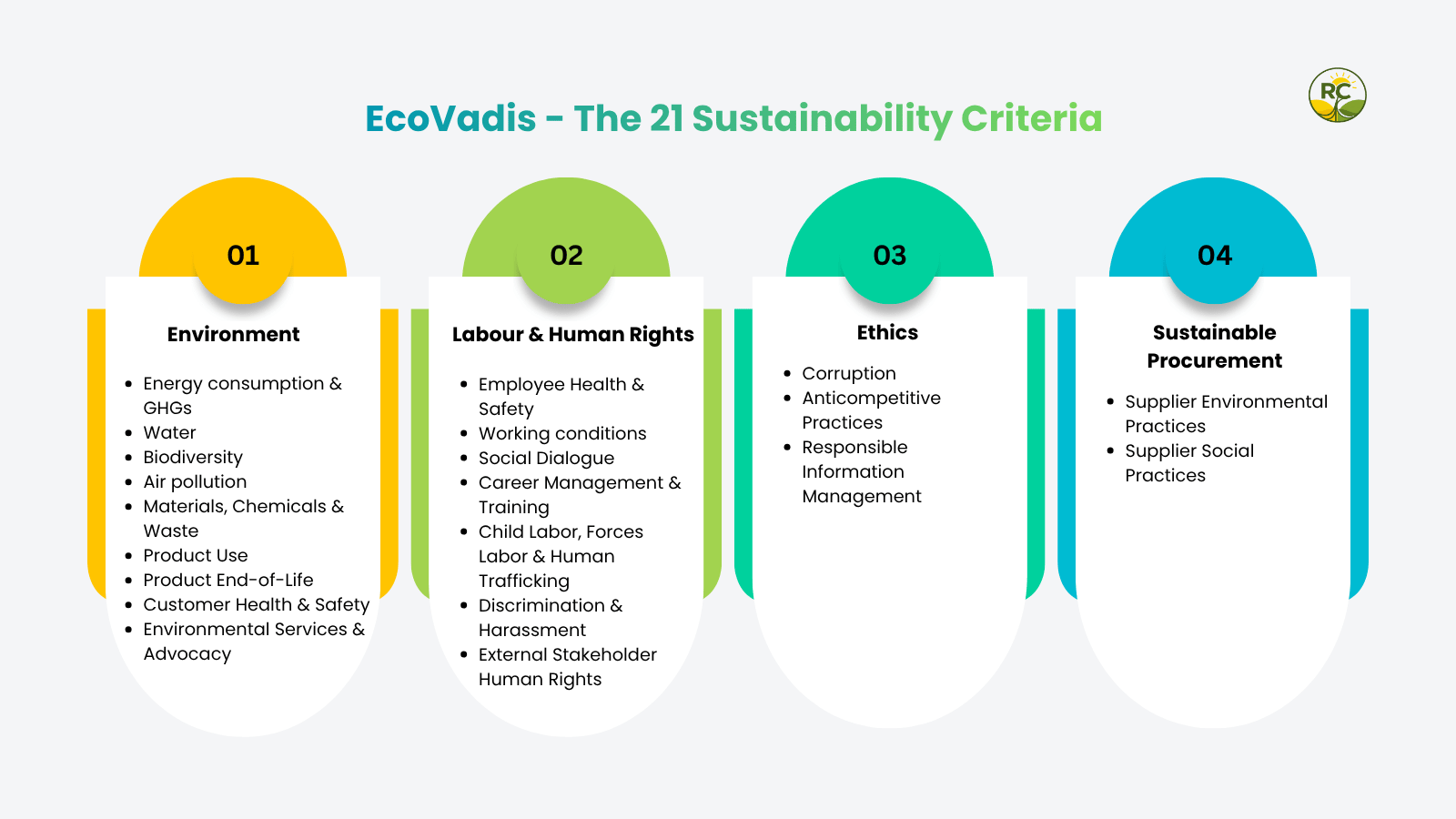
The 21 sustainability criteria of EcoVadis. Source: EcoVadis
Step 2: Create an Evidence Inventory
The next step is a comprehensive review of what you already have.
Go through every relevant folder, shared drive, and department and collect all existing sustainability-related documentation. At this stage, don't judge quality, just gather everything that could potentially be relevant.
What to look for:
Policies and commitments
Environmental Policy
Code of Conduct
Human Rights Policy
Supplier Code of Conduct
Health & Safety Policy
Anti-Corruption / Anti-Bribery Policy
Data Protection Policy
Actions and procedures
Employee training records
Energy management or efficiency programmes
Waste reduction initiatives
Supplier assessment processes
Internal audit reports
Health & safety management procedures
Reporting and results
Carbon emissions data
Energy and water consumption figures
Accident and incident statistics
Diversity and inclusion metrics
Supplier monitoring reports
Annual sustainability reports or CSR disclosures
Once you have everything in one place, you're ready to compare it against what EcoVadis requires.
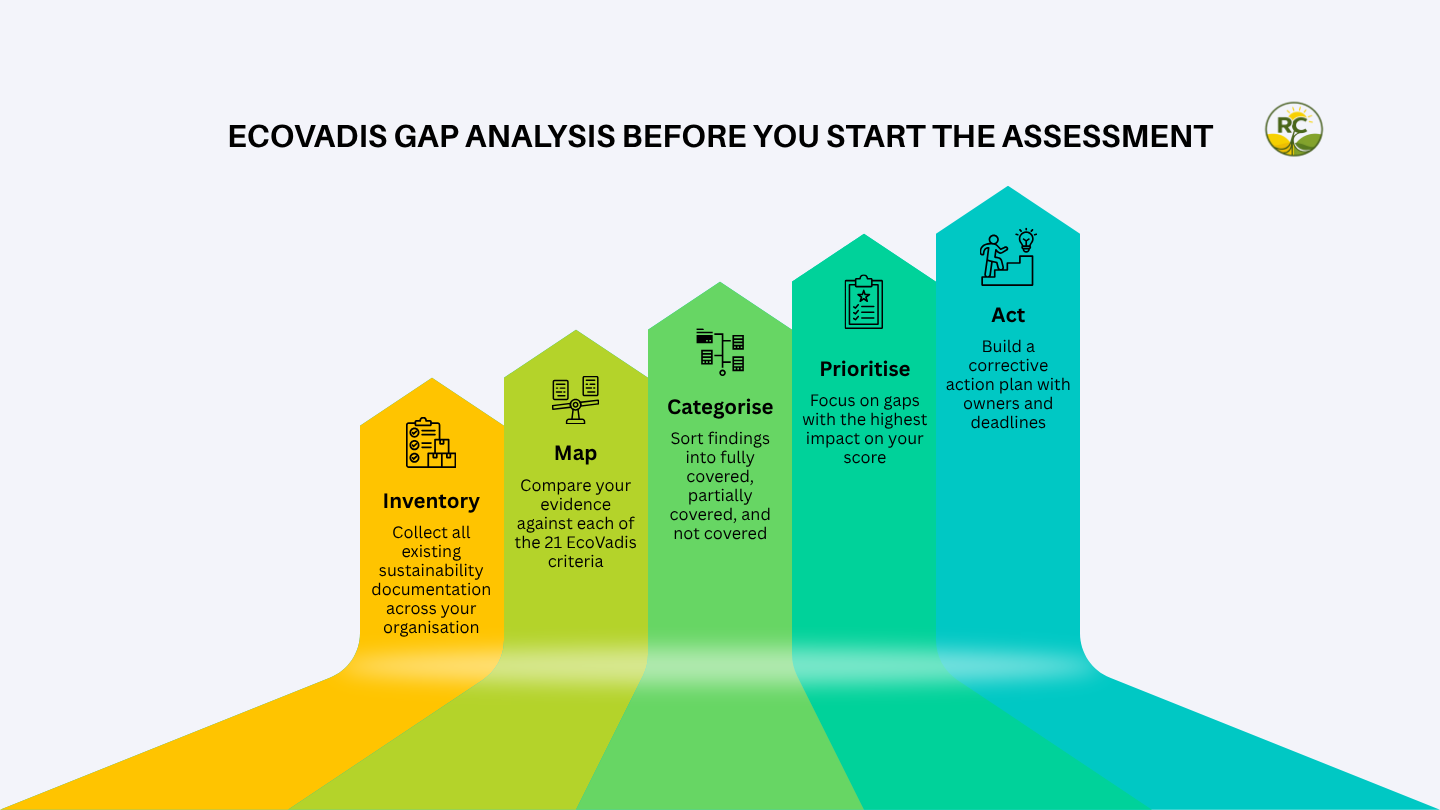
Step 3: Map Existing Evidence Against EcoVadis Requirements
Now work through each of the 21 criteria and, for every one, ask three questions:
Do we have a formal policy covering this topic?
Do we have evidence that this policy is implemented in practice?
Do we have measurable results or KPIs?
This is where the gap analysis delivers its core value.
Companies are often surprised by what they find. Strong operational practices with no written policy. Solid internal processes documented nowhere. KPI dashboards that exist but have never been linked to sustainability reporting.
In EcoVadis, these mismatches matter. An action that isn't documented is an action that can't be scored.
Create a simple mapping table as you work through this step. One row per criterion, three columns for policy, actions, and results. A traffic light system (green / amber / red) works well here and makes prioritisation easier in the next step.
Step 4: Categorise your findings
Once the mapping is done, sort every criterion into one of three categories:
Fully Covered You have a formal policy, clear evidence of implementation, and measurable results or KPIs. No action required before submission.
Partially Covered Some evidence exists, but there are gaps. For example: you have an environmental policy and energy reduction initiatives, but no performance data to show outcomes. These areas need targeted work before submission.
Not Covered No relevant documentation currently exists. These are your highest-priority gaps and should feed directly into the action plan in Step 6.
The categorisation step is useful not just for planning - it also gives you a realistic assessment of where you are right now and what a reasonable target score could look like given your available timeline.
Step 5: Prioritize High-Impact Improvements
Not all gaps are equal. Before you start working through a list of everything that's missing, identify which improvements will have the greatest impact.
Consider prioritising gaps that:
Affect multiple EcoVadis criteria (for example, a missing Code of Conduct can have implications for both Ethics and Labour & Human Rights)
Involve foundational documents like a sustainability report
Require significant lead time to implement properly
Create a documentation trail that supports future assessments
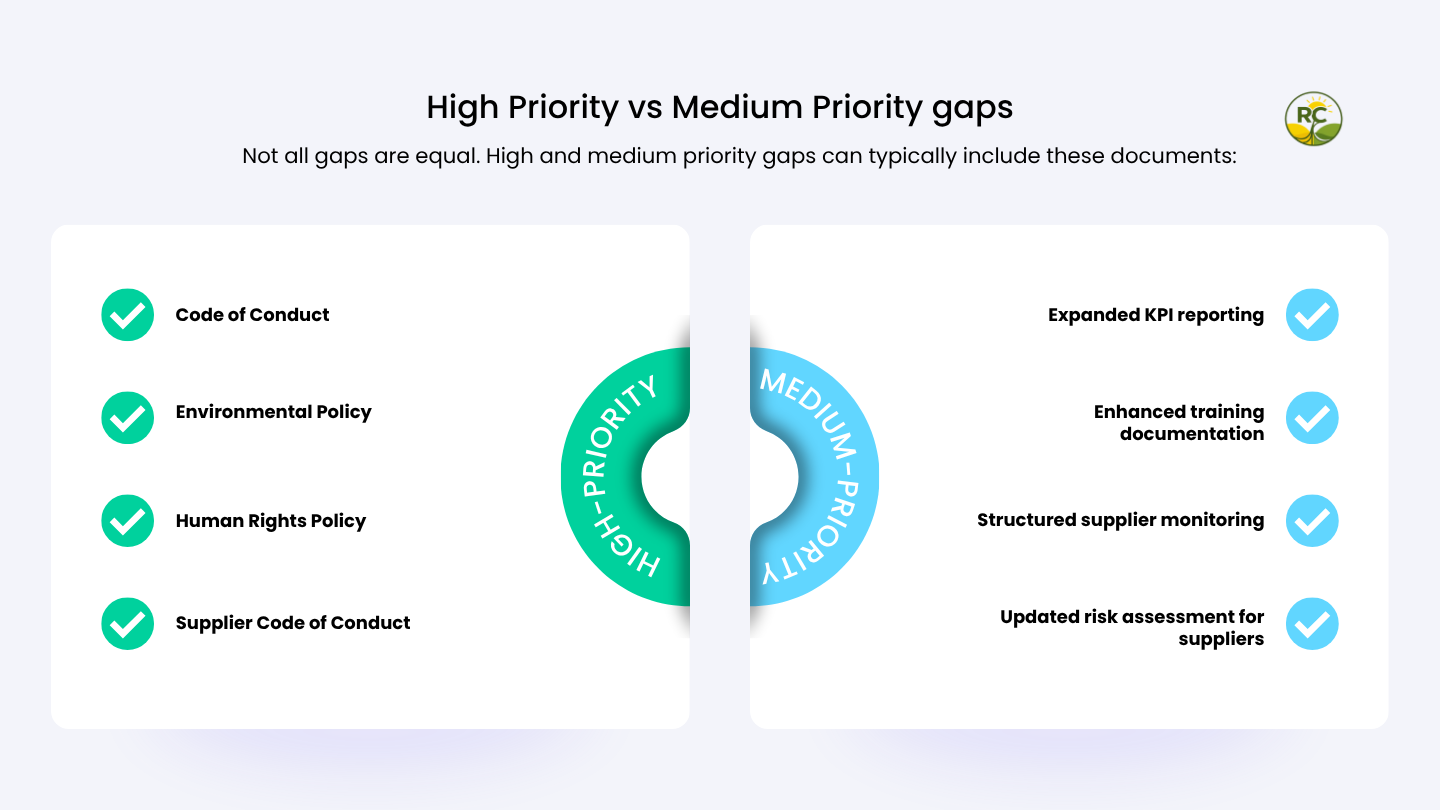
High-priority gaps typically include:
Code of Conduct
Environmental Policy
Human Rights Policy
Supplier Code of Conduct
Sustainability governance structure
Medium-priority areas: where you already have some coverage but need to strengthen it. These can typically include expanded KPI reporting, enhanced training documentation, and structured supplier monitoring.
The goal is not to close every gap before submitting. The goal is to make meaningful, credible progress on the areas that matter most.
Step 6: Build a Corrective Action Plan
Findings without next steps have no value. Convert your gap analysis into a structured action plan that assigns ownership, sets realistic deadlines, and makes it clear who is responsible for what.
A simple format works well here:
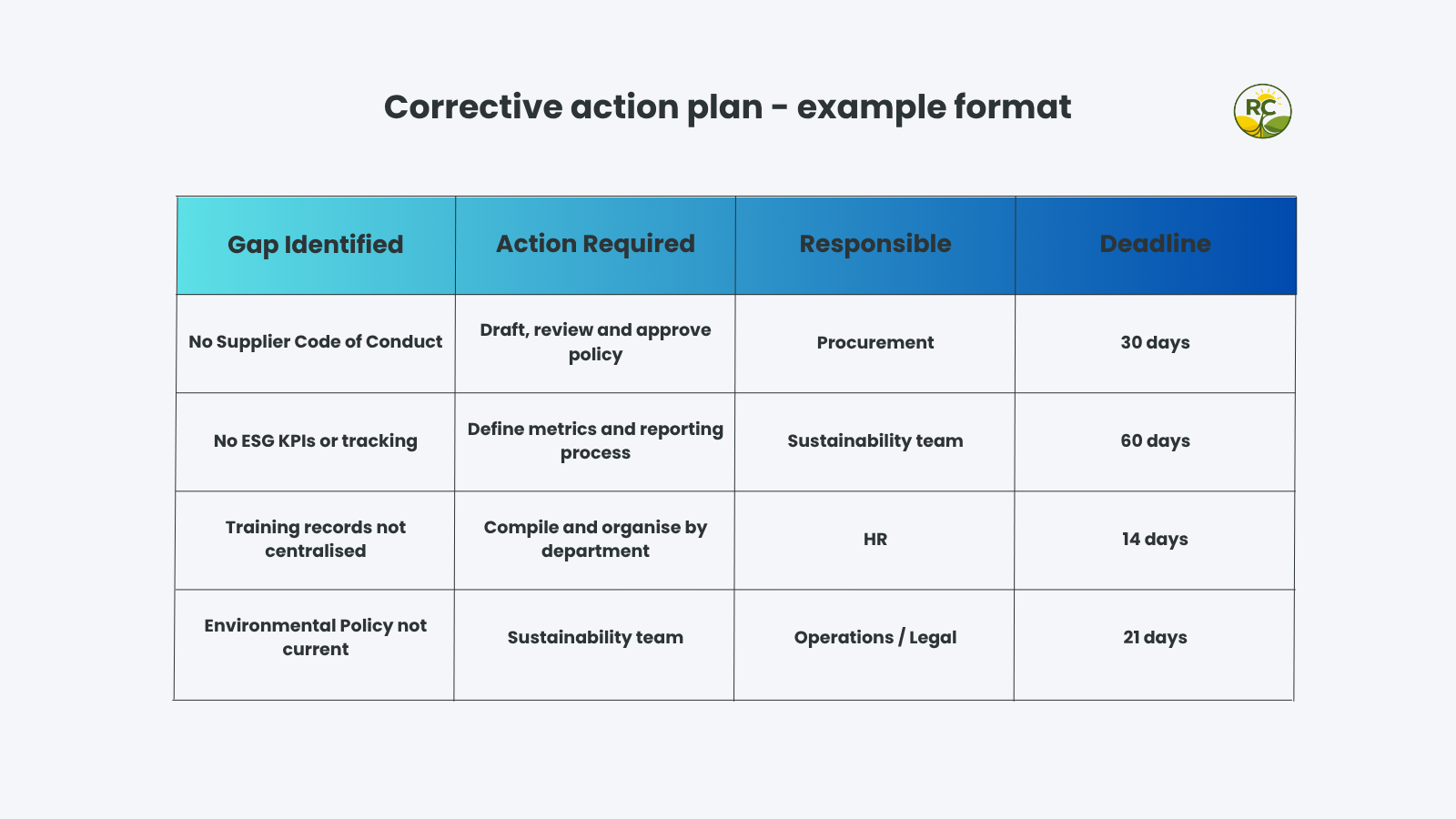
The action plan transforms the gap analysis from a diagnostic exercise into a preparation roadmap. It also ensures accountability across departments — especially important when sustainability documentation sits across multiple teams.
Review progress against the plan weekly. If a deadline slips, it's better to know early and adjust than to discover the gap is still open when the assessment starts.
Step 7: Validate Evidence quality Before you submit
Once gaps have been addressed and documentation updated, do a final evidence review before starting the EcoVadis questionnaire.
For each document you plan to submit, confirm:
It is current — ideally dated within the last 12–24 months
It covers the correct scope (legal entity, geography, operations)
It contains sufficient detail to demonstrate real implementation
Where relevant, it includes measurable outcomes, not just intentions
It has been approved or signed off at an appropriate level
This final check is often where avoidable scoring losses are caught and where a few hours of careful review can make a meaningful difference to your result.
Common Mistakes in EcoVadis Gap Analyses
Focusing only on policies: EcoVadis evaluates management systems, not just commitments. A strong management system usually contains policies, actions, and results altogether. A file of well-written policies with no implementation evidence can often not produce a strong score.
Underestimating sustainable procurement: This theme is frequently overlooked during gap analyses, especially by companies without a formal procurement function. Yet it can account for a meaningful proportion of the final score - particularly for larger companies or those in manufacturing or food supply chains.
Creating documents purely for the assessment: A policy drafted the week before submission carries significantly less credibility than one that has been in place and referenced in operations for 12 months or more. If you identify a critical gap, prioritise getting it in place early and building evidence of use over time.
Starting the gap analysis too late: The purpose of the exercise is to give yourself time to act. A gap analysis conducted two weeks before the assessment deadline is largely diagnostic at that point and there's little time to close meaningful gaps. Ideally, begin 3–6 months before your planned submission.
EcoVadis Gap Analysis Checklist
Use this as your reference before submitting the assessment:
✓ Reviewed all 21 EcoVadis criteria and their requirements
✓ Audited all existing sustainability documentation across departments
✓ Mapped evidence against each criterion (policy / actions / results)
✓ Identified and categorised gaps (fully covered / partial / not covered)
✓ Prioritised improvements by impact and available time
✓ Created a corrective action plan with owners and deadlines
✓ Validated evidence quality, currency, and scope before submission

Where This Fits in Your EcoVadis Preparation
The gap analysis is one part of a broader preparation process. If you're new to EcoVadis or preparing for a reassessment after a disappointing score, these two resources work alongside this guide:
💡 EcoVadis Preparation: The 5 Most Common Mistakes and How to Avoid Them A practical overview of the preparation errors that consistently cost companies points — and what to do differently. Useful reading before or alongside the gap analysis.
💡 The 21 EcoVadis Criteria: How to Prepare for Each One A detailed breakdown of every criterion, what assessors look for, and what evidence to prepare. Use this as your reference checklist throughout Steps 1–3 of the gap analysis.
Summary
An EcoVadis gap analysis is not optional preparation. It's the difference between a reactive assessment process and a strategic one.
Companies that invest the time upfront to map their current position against EcoVadis requirements usually achieve better outcomes: stronger scores, more efficient preparation, and fewer last-minute surprises. More importantly, they build a sustainability documentation foundation that holds value beyond the assessment itself — for customer due diligence, procurement requirements, and future regulatory obligations.
The earlier you start, the more you can do with what you find.
Already have the evidence but are unsure if it is ready to upload?
My Quick Expert Check is designed for companies that have much of their documentation in place but want an expert review before submission.
It includes:
Review of up to 25 existing documents
Identification of the most important gaps
Prioritised recommendations
A written action plan, see example here
A 60-minute results call
The review helps identify which documents provide strong evidence, which are attached to the wrong questions and where one part of the evidence chain is missing.
What if implementation records or KPIs do not exist yet?
Document mapping cannot replace an operational process.
If a procedure exists but no completed records can be found, the next step is implementation. If activities take place but no performance data is collected, the company needs a reporting process.
My Full EcoVadis Support is more suitable for you when policies, procedures, implementation evidence, KPIs or internal capacity are still missing.
The practical difference is:
Quick Expert Check: Most documentation exists and your team can implement recommendations internally.
Full EcoVadis support: The management system or evidence still needs to be developed.
Disclaimer: The author is a former EcoVadis analyst. This article is based solely on publicly available information, professional experience, and independent analysis. No confidential, proprietary, non-public, or privileged information obtained during any previous employment or professional engagement has been used in the preparation of this article. The content is provided for informational purposes only and does not represent official EcoVadis guidance, methodology documentation, or scoring criteria. The author is not affiliated with, endorsed by, or acting on behalf of EcoVadis. Any views, interpretations, or recommendations expressed are solely those of the author and do not represent the views of EcoVadis.
