

EcoVadis Policy vs Procedure: What’s the Difference?

You have an Environmental Policy and a waste-management procedure.
Both documents discuss waste. Both form part of your sustainability management system. But they do not prove the same thing in an EcoVadis assessment.
The policy shows that your company has made a formal commitment. The procedure explains how that commitment is implemented in daily operations.
Confusing the two can lead to the wrong document being attached to the wrong questionnaire answer. A relevant document is not automatically suitable evidence: it must prove what the question is asking.
This guide explains how policies and procedures differ, what each should contain and how companies, especially the ones in the food sector, can use them correctly.
First, an important clarification: evidence is not one document type
EcoVadis assesses how companies manage sustainability across four themes:
Environment
Labour and Human Rights
Ethics
Sustainable Procurement
Its methodology considers an effective management system to be one that develops policies, implements actions and reports on results. These layers are divided into seven management indicators, including Policy, Measures, Certifications and Reporting.
According to the current EcoVadis Sustainability Rating methodology, the Policy indicator assesses objectives and commitments. The Measures indicator examines the actions used to implement them.
This creates a practical distinction:
A policy says what the company intends to do. A procedure explains how the company does it.
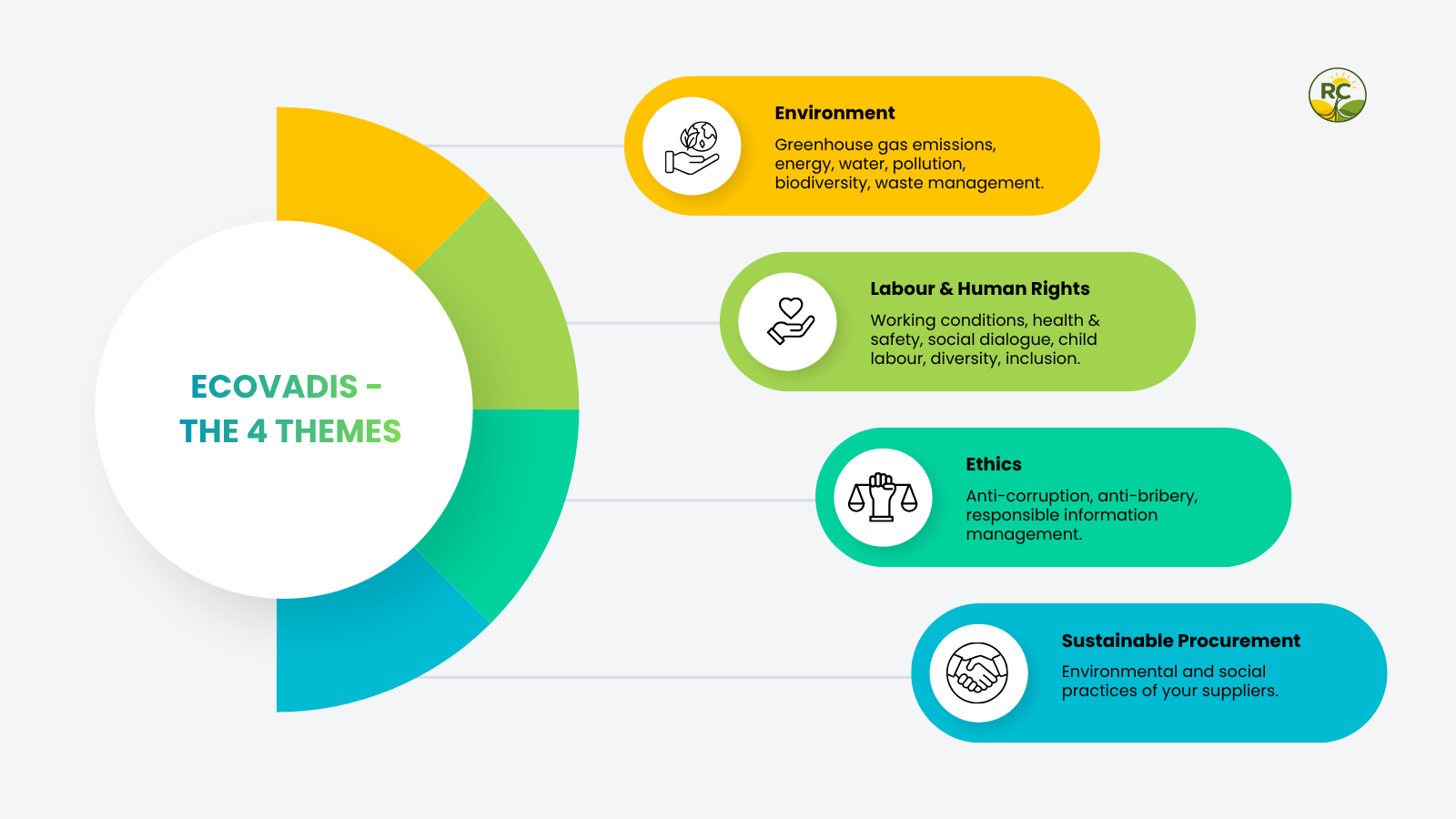
EcoVadis - The 4 Themes. Source: EcoVadis
1. What is a policy?
A policy is a formal statement of direction and commitment.
It defines what the company stands for, which sustainability topics it addresses and what it aims to achieve. It should provide accountability without becoming a detailed operating manual.
A useful policy commonly identifies:
The company or entities covered
The sustainability issues addressed
Formal commitments and principles
Applicable employees, sites or suppliers
Responsibility for implementation
Objectives or measurable targets
Approval and document ownership
Issue or review date
For example, an Environmental Policy may commit a food manufacturer to:
Reducing energy use and greenhouse-gas emissions
Preventing pollution
Managing water responsibly
Minimising food and packaging waste
Complying with environmental requirements
Monitoring environmental performance
This establishes direction. It does not explain how employees segregate waste, how energy data is collected or how an environmental incident is reported.
💡 Small companies do not need to imitate the documentation systems of multinational businesses. My guide EcoVadis for SMEs: What Small Companies Really Need in 2026 explains which core documents are usually worth prioritising and what can often wait.
2. What is a procedure?
A procedure describes how a specific process is carried out.
It turns a general commitment into consistent, repeatable work. A good procedure should be practical enough that the responsible employee can use it.
A procedure commonly explains:
Who is responsible
When the activity takes place
Which steps must be followed
Which criteria or thresholds apply
Which records must be retained
Who reviews the outcome
What happens when a deviation is found
For example, a supplier sustainability procedure may explain:
Which suppliers must be screened
Which risk factors are considered
How suppliers are classified
When a questionnaire or audit is required
Who approves high-risk suppliers
How corrective actions are monitored
Where the assessment is recorded
The corresponding policy might contain only the broader commitment to considering environmental and human-rights risks in procurement.
Policy versus procedure at a glance
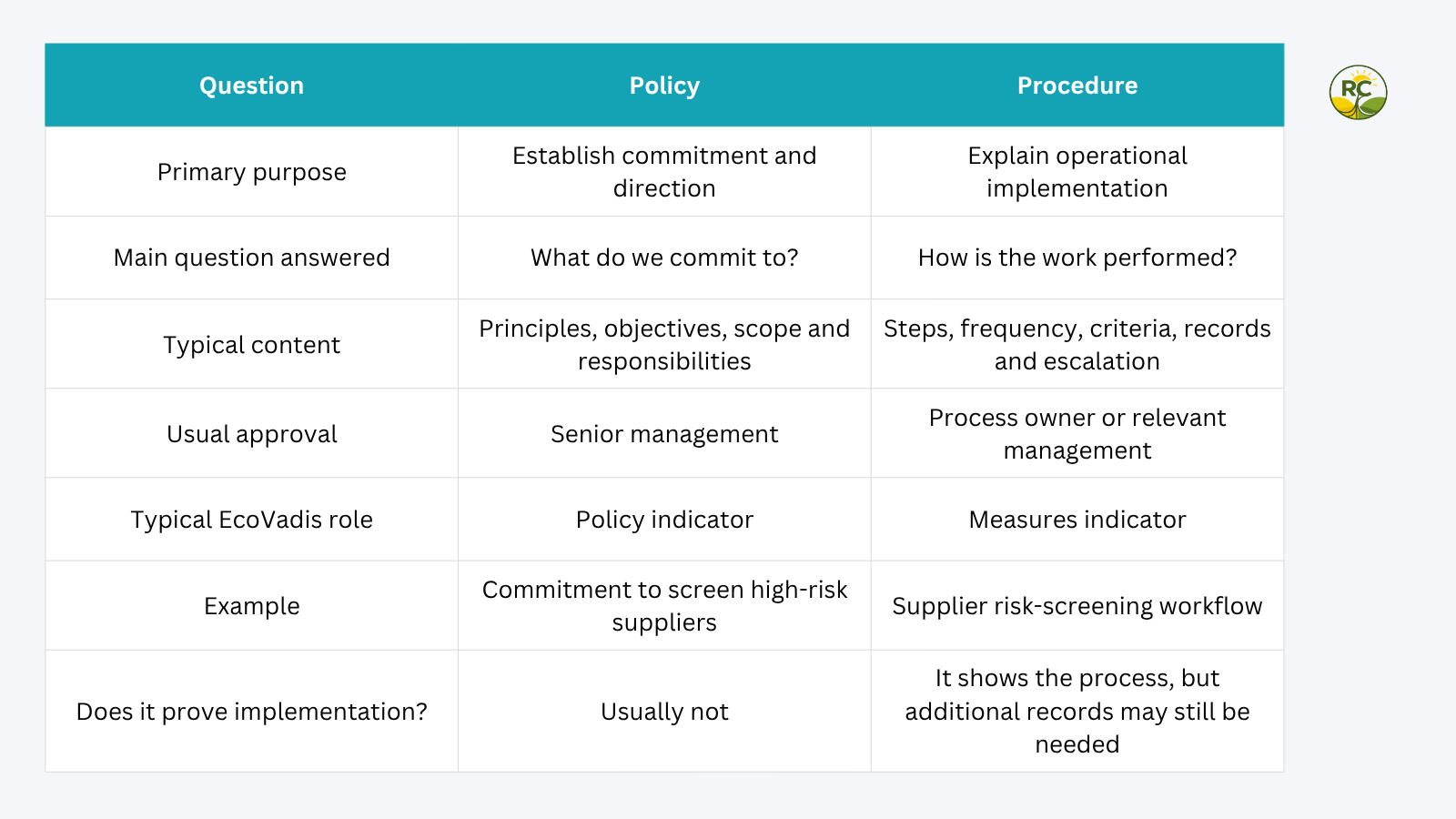
A policy defines the company’s commitment and direction, while a procedure explains how that commitment is implemented in practice.
Examples across the four EcoVadis themes
Environment
Policy: Environmental Policy
Possible commitments:
Reduce energy and water consumption
Prevent pollution
Minimise waste
Track environmental performance
Procedures:
Waste segregation and disposal procedure
Refrigerant-leak inspection procedure
Environmental incident response procedure
Energy-data collection procedure
Labour and Human Rights
Policy: Health and Safety Policy
Possible commitments:
Provide a safe working environment
Prevent occupational injuries
Train employees
Investigate incidents and near misses
Procedures:
Workplace incident-reporting procedure
Accident-investigation procedure
Safety-training procedure
Emergency-response procedure
Ethics
Policy: Anti-Corruption and Ethics Policy
Possible commitments:
Prohibit bribery
Manage conflicts of interest
Protect whistleblowers
Maintain accurate business records
Procedures:
Gifts and hospitality approval procedure
Conflict-of-interest declaration procedure
Whistleblowing procedure
Ethics incident-investigation procedure
Sustainable Procurement
Policy: Sustainable Procurement Policy or Supplier Code of Conduct
Possible commitments:
Consider environmental and social risks in purchasing
Communicate sustainability expectations to suppliers
Monitor high-risk suppliers
Follow up on serious non-conformities
Procedures:
Supplier onboarding procedure
Sustainability risk-assessment procedure
Supplier audit procedure
Corrective-action follow-up procedure
Can one document contain both?
Yes. A genuine management manual may contain policy statements and procedural sections.
For example, an Environmental, Health and Safety manual may include:
A formal environmental commitment
Assigned responsibilities
Waste-management instructions
Incident-reporting steps
Monitoring requirements
The document can potentially support more than one questionnaire answer if the relevant information is clearly present and correctly linked.
The risk is not having both elements in one document. The risk is creating a confusing file in which the commitment, process and responsibilities cannot be distinguished.
Use clear headings such as:
Policy statement
Scope
Responsibilities
Operational procedure
Monitoring
Records
Review

A procedure still needs proof of implementation
A detailed procedure shows that the company has formalised a process. It does not necessarily demonstrate that the process is being used.
You can find current document requirements and food-industry examples in my guide to EcoVadis supporting documents in 2026.
As a first step, consider anti-corruption training:
The policy requires employees to act ethically.
The procedure explains who receives training and how often.
The training material shows what was taught.
The attendance record shows that employees participated.
The KPI report shows the percentage of employees trained.
Each document adds a different part of the management story.
💡 Continue with the next step: Understanding the difference between a policy and a procedure is only the beginning. You also need to connect each document to the specific EcoVadis question and claim it can actually support. My follow-up guide, How to Map Evidence and Documents for EcoVadis, explains how to build a clear evidence map and identify documentation gaps before submission.
Common policy mistakes
Writing only broad intentions
“We care about the environment” does not establish a clear management commitment.
A stronger policy identifies the relevant issues, responsibilities and objectives.
Adding unrealistic promises
A policy should reflect what the company is prepared to implement. Do not add commitments simply because they appear in a template.
Leaving the scope unclear
It should be possible to determine which legal entities, locations, employees or suppliers the policy covers.
Omitting approval and dates
A policy without an owner, approval or issue date may appear informal or outdated.
Turning the policy into a work instruction
A policy should provide direction. Detailed operational steps usually belong in a procedure.
Common procedure mistakes
Repeating the policy
A procedure that contains only principles and commitments does not explain how the process operates.
Failing to assign responsibilities
Avoid vague wording such as “the company reviews its suppliers”. Identify the department or role responsible.
Omitting frequency
State whether an activity occurs during onboarding, annually, quarterly or when a defined trigger arises.
Forgetting the required records
A procedure should identify what must be documented and retained.
Having no escalation process
Explain what happens when a supplier, site, incident or result fails to meet the defined requirement.
💡 Confusing document types is only one common preparation problem. My article on five common EcoVadis preparation mistakes explains other issues that can weaken an otherwise solid submission.

Policy and procedure self-check
Policy checklist
Does it identify the company or assessment scope?
Does it cover relevant sustainability topics?
Are the commitments clear?
Are responsibilities assigned?
Are measurable objectives included where appropriate?
Has the document been approved?
Does it have an issue or review date?
Does it reflect what the company actually does?
Procedure checklist
Does it describe a defined process?
Is responsibility assigned to a role or department?
Are the individual steps understandable?
Is the timing or frequency clear?
Are decision criteria included?
Does it identify the records that must be retained?
Does it explain corrective action or escalation?
Is there evidence that employees use the procedure?
Do not create documents only for the assessment
EcoVadis states here that supporting documents should be formal, current, relevant and pre-existing elements of the company’s management system. Documents created solely to satisfy the questionnaire are not accepted.
This does not mean that you cannot improve your documentation before an assessment.
It means that a newly developed policy or procedure should become a real company document:
Adapt it to your business
Review and approve it
Communicate it to the relevant people
Put the process into operation
Retain evidence of implementation
Review its effectiveness
The objective is a working management system, not an assessment-only folder.
The practical difference
A policy and a procedure can address the same sustainability issue without being interchangeable.
The policy sets the direction:
We assess environmental and social risks in our supply chain.
The procedure defines the process:
Procurement screens new suppliers using the approved risk criteria before onboarding and reviews high-risk suppliers annually.
One establishes accountability. The other turns that commitment into repeatable work.
For EcoVadis, you often need both and evidence that the procedure is actually being followed.
you Already have policies and procedures but are unsure whether they fit?
My Quick Expert Check is suitable for companies that already have much of their documentation and want an expert review before submission.
It includes:
Review of up to 25 existing documents
Identification of important gaps
Prioritised recommendations
A written action plan, see example report here
A 60-minute results call
The review helps identify where a policy is too general, where a procedure lacks operational detail and where additional implementation evidence is needed.
Want to Get the Most From Your EcoVadis Assessment?
If you want more than a document review, my Full EcoVadis Assessment Support provides hands-on guidance throughout the entire process — from identifying gaps and developing missing policies or KPIs to mapping your evidence and reviewing the questionnaire before submission.
You do not have to work out the process alone. Together, we will build a credible submission that reflects what your company is genuinely doing.
Disclaimer: The author is a former EcoVadis analyst. This article is based solely on publicly available information, professional experience, and independent analysis. No confidential, proprietary, non-public, or privileged information obtained during any previous employment or professional engagement has been used in the preparation of this article. The content is provided for informational purposes only and does not represent official EcoVadis guidance, methodology documentation, or scoring criteria. The author is not affiliated with, endorsed by, or acting on behalf of EcoVadis. Any views, interpretations, or recommendations expressed are solely those of the author and do not represent the views of EcoVadis.
