


A large customer emails asking for an EcoVadis rating. You're a company of 25 people. You don't have a sustainability team. You don't have a compliance department. You have an operations manager who already handles quality, procurement, and half of HR. And now this lands on your desk too.
Sounds familiar?
EcoVadis was built to assess supply chains at scale, and its biggest, most polished case studies tend to feature large multinational suppliers with dedicated CSR teams. But the reality on the ground is different: a growing share of the companies being asked for an EcoVadis rating today are small and mid-sized businesses with no sustainability function at all. If you're in that position, it's easy to either panic and over-invest - hiring consultants, buying software, drafting a 60-page sustainability report - or under-invest and submit something thin that scores poorly.
Usually neither of that is necessary. This article breaks down how SMEs can actually prepare for EcoVadis, and what you can often skip, postpone, or scale down.
💡 New to EcoVadis in general? Start with my guide: The 21 EcoVadis Criteria: How to Prepare for Each One
Why EcoVadis feels different (and harder) for small companies
Larger suppliers preparing for EcoVadis usually have a head start: existing management systems, dedicated staff, and sustainability initiatives already partly documented. Small companies are usually starting from a very different place.
Three things make it genuinely harder for SMEs, not just "harder to find time for":
No dedicated owner. ESG documentation ends up on the desk of whoever has the most bandwidth that month — often the same person also handling quality, HR, or operations.
Limited existing documentation. Many SMEs have solid, sensible practices in place — they simply haven't been written down as formal policies, because until now nobody asked.
Unclear expectations. Nobody has told you what "good enough" looks like for a company your size, so it's tempting to either assume you need everything a large corporate has, or to assume you can get away with very little.
The good news: EcoVadis's own methodology already accounts for company size to some extent through its activated criteria (more on that below). The real skill isn't doing more, it's doing the right things.
📋 Want to know whether your documentation would hold up in an EcoVadis assessment? My Quick Expert Check provides an independent review of a former EcoVadis Sustainability Analyst before you submit: Get your Expert Check now

What SMEs actually need
Need #1 — Good sustainability documentation starts with a handful of clear policies, not a complex management system.
For many SMEs, that simply means five or six practical documents that describe how the business approaches key sustainability topics. For example:
An environmental policy (energy, waste, emissions, pollution)
A health & safety policy
An anti-corruption and ethics policy
A human rights and labour policy
A supplier code of conduct
A signed, two-page policy with a named owner and one measurable commitment can often be a good starting point. Length is not the goal, but clarity and ownership are.
Need #2 — One clearly assigned owner, even if it's part-time
You don’t need a Head of Sustainability. You need one person who owns the process, keeps your sustainability documentation up to date, and makes sure nothing falls through the cracks. For companies without internal resources, that’s often where I step in as an external Sustainability Manager. Without a clear owner, EcoVadis preparation tends to stall between other priorities and gets rushed at the last minute.
Need #3 — A clear view of your activated criteria
EcoVadis doesn't assess every company on all 21 criteria. Based on your industry, size, and location, it activates a specific subset relevant to your risk profile. For a small company, this is good news: your preparation workload is narrower than it looks at first glance. Check your Industry Risk Profile on the platform before doing anything else, and build your plan around what's actually activated for you.
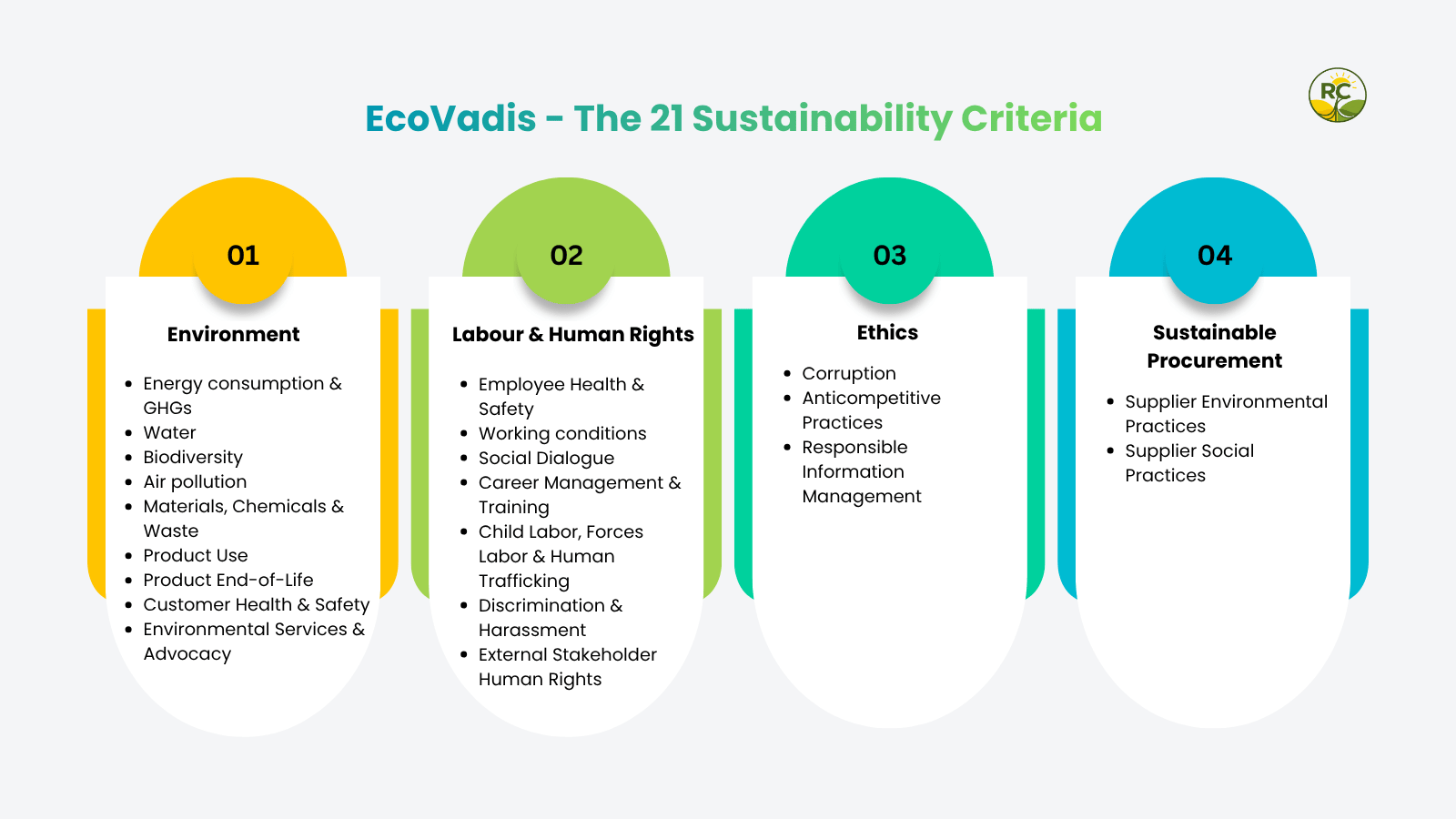
The 21 sustainability criteria of EcoVadis. Source: EcoVadis
Need #4 — Real, dated evidence for the criteria that matter
You don't need evidence for everything - you need clear, current, dated documents that directly prove the specific claim behind each activated criterion. A signed policy plus one example of it being applied (a training record, a supplier questionnaire, a corrective action log) can go a long way.
Need #5 — Proportionate supplier due diligence
If you have five key suppliers, you don't need a formal Supplier Relationship Management platform - you usually need a simple, consistent process: a code of conduct suppliers sign, a basic risk screening, and a record of it.
Need #6 — Realistic scoring expectations
If this is your first assessment, a score somewhere in the 20–50 range can be completely normal, and no reason for concern. The system is generally built around continuous improvement across cycles, not a perfect result the first time around.

What SMEs often don't need
You probably don’t need a full-time Sustainability Manager.
Most small and medium-sized companies simply need someone to own the process, keep documentation up to date, and coordinate the right people internally. That can be an existing team member with the right guidance, or an external Sustainability Manager until the business reaches a stage where a full-time hire makes sense.
You often don’t need an ISO certification.
Formal certifications like ISO 14001 or ISO 45001 can strengthen your sustainability management, but they’re not always the best place to start. Many companies make good progress by first implementing clear policies and documented processes. Certification can come later once the foundations are in place.
You don’t need a 40-page sustainability report.
More documentation doesn’t automatically make your sustainability approach stronger. In many cases, concise, well-structured policies and records are easier to understand and more useful than lengthy reports. Focus on creating documentation that is clear, specific, and reflects what your company is actually doing.
You don't need to aim for Gold on your first attempt.
Very few companies of any size reach medal level on their first submission. Chasing Gold in year one usually means overspending on the wrong things. Aim for a realistic baseline first, then improve with each cycle.
You don't necessarily need an expensive all-in-one ESG software platform. For a company managing a handful of policies and a modest supplier base, a well-organised shared drive and a simple tracker can do the job just as well, at a fraction of the cost. Platforms start to earn their keep once you're managing dozens of suppliers or multiple certifications at once.
You don't need to answer every question exhaustively. Where a criterion is genuinely not activated or not applicable, EcoVadis allows you to mark it as such. Spending hours perfecting an answer to something outside your risk profile is time better spent elsewhere.
A realistic roadmap for your first EcoVadis cycle
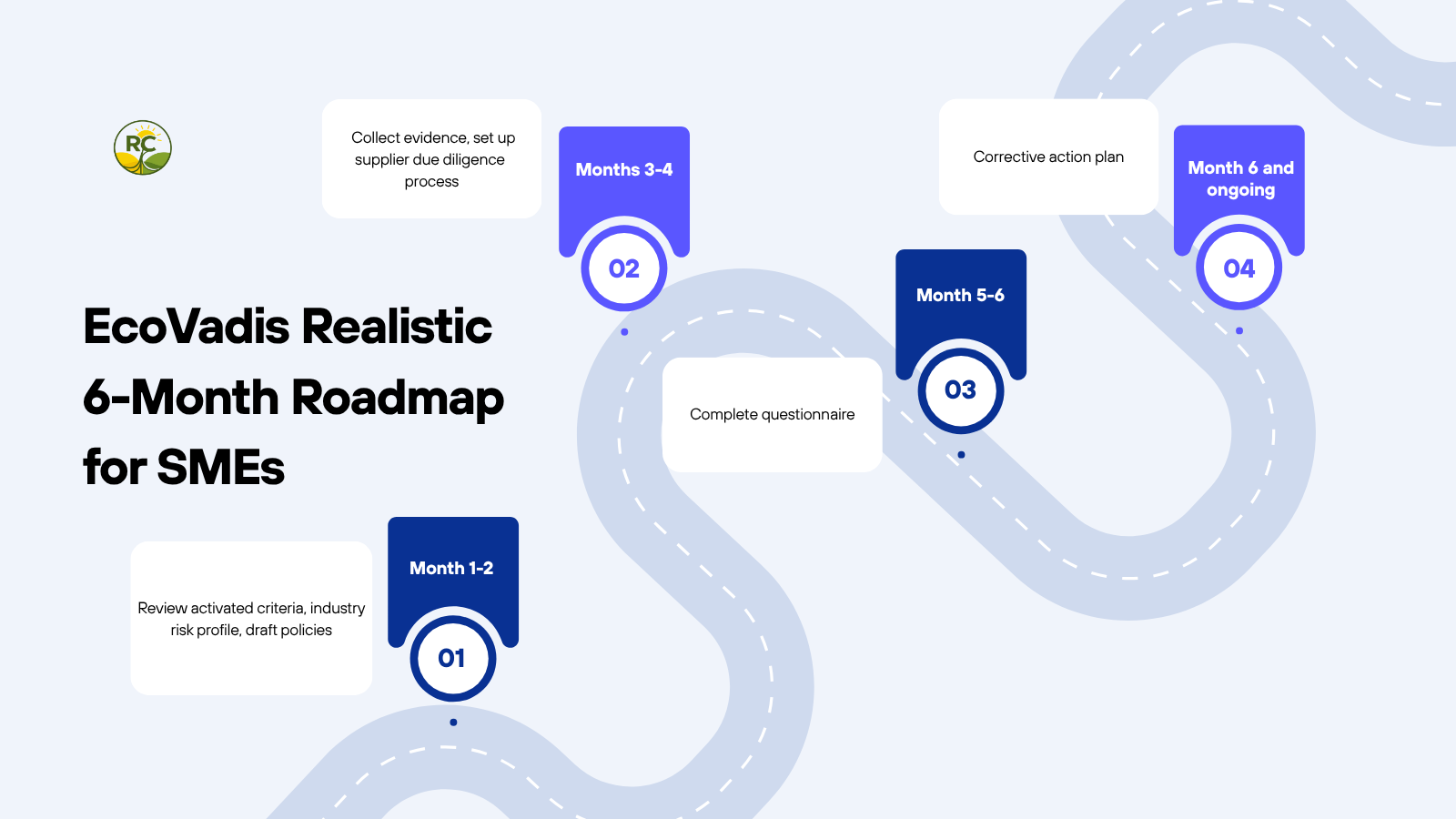
Months 1–2: Confirm your activated criteria via your Industry Risk Profile. Identify which core policies you're missing and draft them: short, signed, with a named owner.
Months 3–4: Collect and organise evidence against your activated criteria only. Set up a simple supplier due diligence process if you don't already have one.
Months 5–6: Complete the questionnaire, guiding analysts to the relevant evidence with clear comments and page references. Submit, then treat the Corrective Action Plan you receive afterwards as your roadmap for the next cycle.
This pace is deliberately unhurried. Companies that rush a first submission in a few weeks tend to submit incomplete evidence and score lower than they otherwise would.
🔗 Want to avoid the most common scoring traps? My guide on EcoVadis Preparation: The 5 Most Common Mistakes covers the errors that cost companies of every size the most points.
The bottom line for small companies
EcoVadis doesn't expect a small company to look like a multinational — its own methodology already scales expectations to your size and risk profile. The companies that navigate it well aren't the ones that throw the most resources at it; they're the ones that focus narrowly on what's actually activated for them, document it clearly, and treat their first score as a starting point rather than a verdict.
Done this way, EcoVadis preparation for an SME is a manageable, bounded project — not an open-ended one.
Already have the evidence but are unsure if it is ready to upload?
My Quick Expert Check is designed for companies that have much of their documentation in place but want an expert review before submission.
It includes:
Review of up to 25 existing documents
Identification of the most important gaps
Prioritised recommendations
A written action plan, see example here
A 60-minute results call
The review helps identify which documents provide strong evidence, which are attached to the wrong questions and where one part of the evidence chain is missing.
What if implementation records or KPIs do not exist yet?
Document mapping cannot replace an operational process.
If a procedure exists but no completed records can be found, the next step is implementation. If activities take place but no performance data is collected, the company needs a reporting process.
My Full EcoVadis Support is more suitable for you when policies, procedures, implementation evidence, KPIs or internal capacity are still missing.
The practical difference is:
Quick Expert Check: Most documentation exists and your team can implement recommendations internally.
Full EcoVadis support: The management system or evidence still needs to be developed.
Disclaimer: The author is a former EcoVadis analyst. This article is based solely on publicly available information, professional experience, and independent analysis. No confidential, proprietary, non-public, or privileged information obtained during any previous employment or professional engagement has been used in the preparation of this article. The content is provided for informational purposes only and does not represent official EcoVadis guidance, methodology documentation, or scoring criteria. The author is not affiliated with, endorsed by, or acting on behalf of EcoVadis. Any views, interpretations, or recommendations expressed are solely those of the author and do not represent the views of EcoVadis.
