


You received an EcoVadis Bronze medal. Now what?
For many companies, the moment the EcoVadis scorecard arrives feels more emotional than expected.
You worked through the questionnaire. You collected documents from different departments. You uploaded policies, certificates, supplier information and KPIs. Maybe you even hoped for Silver.
And then the result comes back: Bronze.
For some teams, that feels like a disappointment. Not terrible, but not quite the level they wanted. Not something they are sure they should celebrate. Not something they know how to explain to customers.
But here is the important part: EcoVadis Bronze is not a failure.
It is proof that your company has already started building a sustainability management system. More importantly, it gives you something many companies do not have yet: a structured roadmap for improvement.
The mistake is treating Bronze as the end of the assessment process.
In reality, Bronze is often the point where the real work becomes much clearer.
This article explains what an EcoVadis Bronze medal actually means, why companies often land there, and how to turn the scorecard into a practical improvement plan for your next assessment.
💡 New to EcoVadis? Before diving into score improvements, you might want to start with my overview: The 21 EcoVadis Criteria Explained: How to Prepare for Each One.
What EcoVadis Bronze Actually Means in 2026
An EcoVadis medal is not a product certification. It does not certify that your products are sustainable, and it should not be used as a product-level environmental claim.
It is a recognition of your company’s sustainability management system at the time of the assessment.
EcoVadis evaluates companies across four themes:
Environment
Labor & Human Rights
Ethics
Sustainable Procurement
The assessment looks at how your company manages these topics through policies, actions and results.
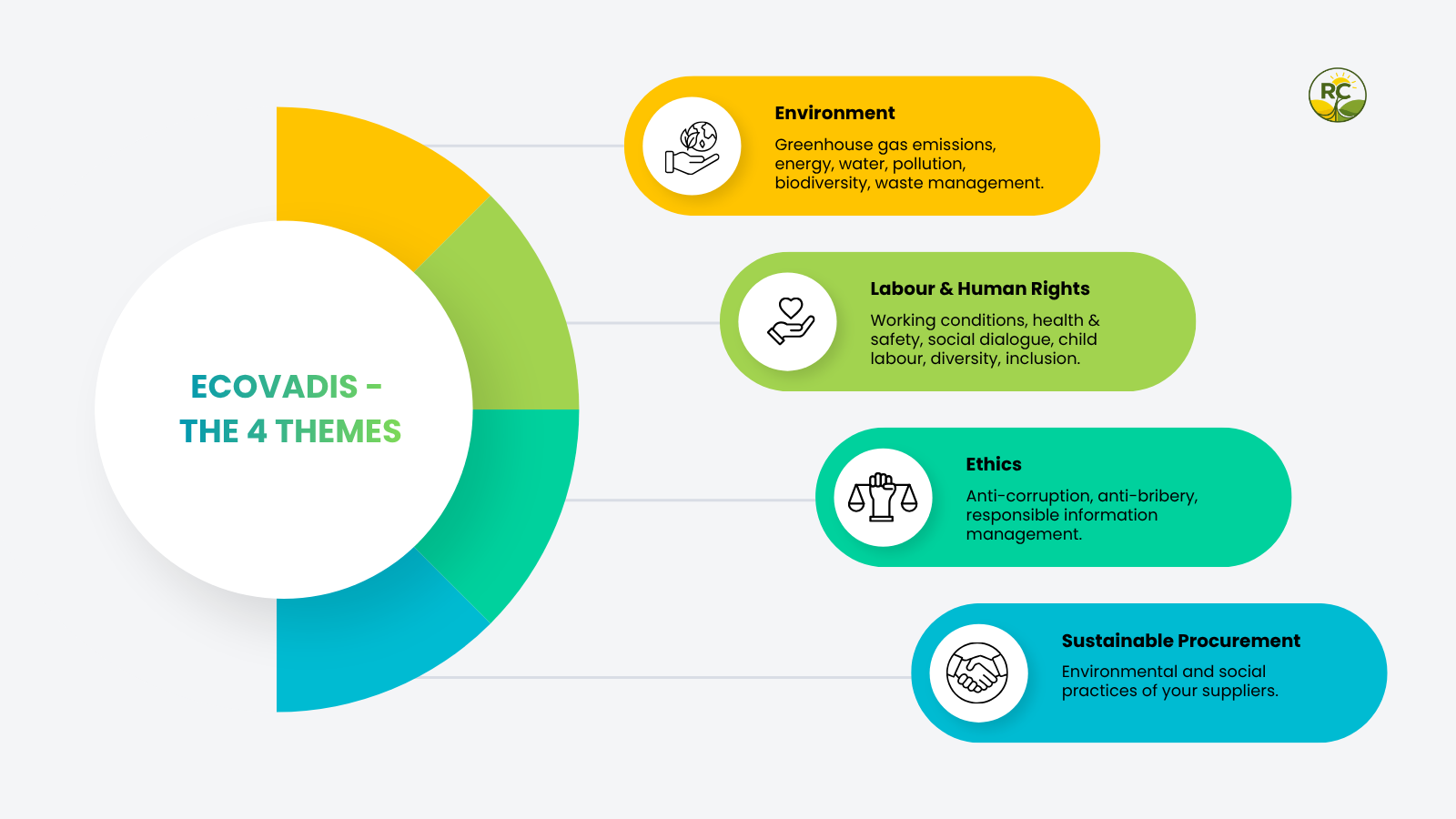
EcoVadis - The 4 Themes. Source: EcoVadis
In 2026, EcoVadis medals are based on percentile ranking rather than fixed score thresholds. Bronze recognises companies that are placed in the top 35% of assessed companies globally, subject to the applicable eligibility criteria.
That matters because it changes how you should interpret the result.
Bronze does not mean “barely passed”.
It means your company has demonstrated enough sustainability management structure to receive recognition, but still has visible gaps that can be addressed.
In practical terms, Bronze often means:
You have some relevant ESG documentation in place
You can demonstrate certain actions and processes
Your company is not starting from zero
But your evidence is probably uneven across themes
Some policies may not be specific enough
Some actions may not be sufficiently documented
Results and KPIs may be missing or incomplete
Sustainable procurement may still be underdeveloped
That is not unusual, especially for SMEs completing EcoVadis for the first time.
📋 Want to know whether your documentation would hold up in an EcoVadis assessment? My Quick Expert Check provides an independent review of a former EcoVadis Sustainability Analyst before you submit: Get your Expert Check now
Why Bronze Often Feels Worse Than It Actually Is
Many companies expect EcoVadis to reward “what they do”.
But EcoVadis can only assess what is documented, uploaded and clearly connected to the questionnaire.
This is where the frustration usually starts.
A company may genuinely care about employee wellbeing, reduce waste, work closely with suppliers and operate responsibly, but if that work is not formalised, documented, measured or connected to the right criteria, it may not translate into the score the company expected.
That is why a Bronze result often says less about your company’s real values and more about the maturity of your sustainability management system.
The scorecard is not only asking:
“Are you doing good things?”
It is asking:
“Can you prove that your sustainability approach is structured, implemented, measured and relevant to your risks?”
That is a much higher standard.
And that is exactly why Bronze can be so useful.
It shows where the system is already visible and where it is not yet strong enough.
Bronze Is Usually a Documentation and Structure gap
Most companies that receive Bronze are not doing nothing. They are usually doing quite a lot.
The problem is that their sustainability work is often scattered.
One department has the health and safety documents. Another has supplier contracts. HR has training records. Management has a Code of Conduct saved somewhere. Operations tracks energy consumption in Excel. Procurement has supplier communication, but no formal supplier sustainability process.
Individually, these pieces may be valuable.
But EcoVadis does not assess good intentions in isolation. It assesses the management system as a whole.
That means the evidence needs to show a clear structure:
What is your commitment?
What concrete actions have you implemented?
How widely are those actions deployed?
What results can you measure?
Who is responsible?
How often is the topic reviewed?
Does the evidence apply to the right legal entity and scope?
If the answer is unclear, the score will usually reflect that.
Bronze often means the foundation exists, but the structure is not yet strong or complete enough to reach Silver or Gold.

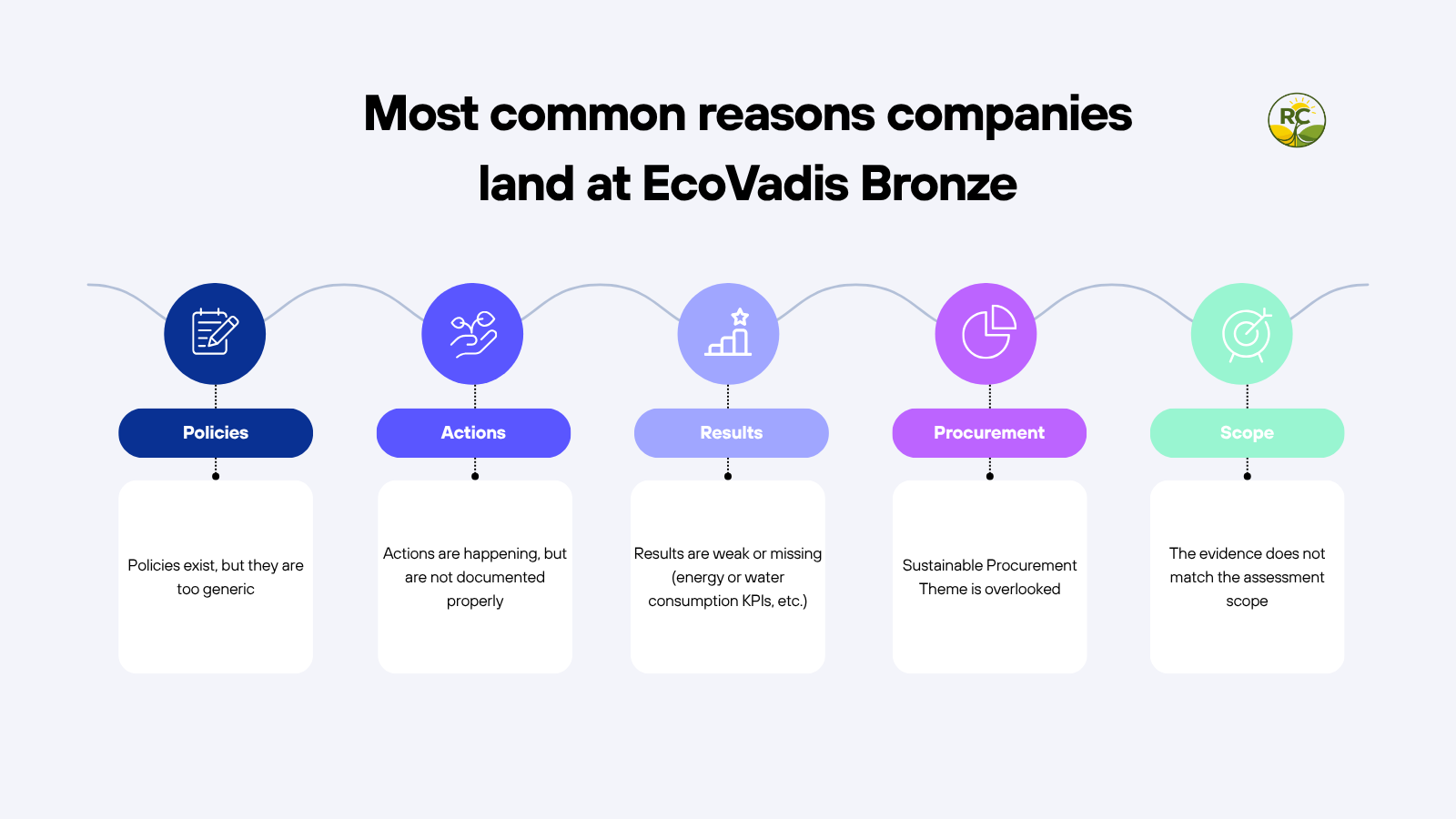
The Most Common Reasons Companies Land at Bronze
Every EcoVadis scorecard is different, but Bronze results may often come from the same types of gaps:
1. Policies exist, but they are too generic
Many companies upload policies that sound professional but do not say much about how the company actually manages the topic.
A generic sustainability policy might mention climate, labour rights, anti-corruption and supplier responsibility in broad terms. But if it does not define responsibilities, scope, commitments, review cycles or concrete expectations, it may not carry much weight.
EcoVadis generally looks for policies that are relevant, specific and connected to the company’s actual risks.
For example, a food producer with agricultural supply chains should not only say that it “cares about the environment”. It should address the environmental topics that are actually relevant to its operations and supply chain, such as energy, water, waste, packaging, biodiversity or supplier practices.
Generic commitments rarely move a company far beyond Bronze.
2. Actions are happening, but not documented properly
This can be one of the most common issues.
Companies often do the work but fail to document it in a way that can be assessed.
Examples may include:
Internal training without attendance records
Supplier checks without a formal process
Waste reduction measures without before-and-after data
Health and safety practices without documented procedures
Ethical business expectations without employee acknowledgement
Environmental improvements without monitoring or targets
Inside your company, these actions may feel obvious, but from an outside perspective, they are only visible if the evidence proves them clearly.
3. Results are weak or missing
Policies and actions are important, but results are where many companies can often lose points.
EcoVadis generally looks at whether a company can measure and report on sustainability performance. That means KPIs, targets, progress tracking and outcomes.
For SMEs, this is often the least developed part of the system.
Common missing results may include:
Energy consumption data
Greenhouse gas emissions
Water consumption
Waste volumes
Accident rates
Training coverage
Supplier assessment results
Ethics training completion
Corrective action progress
You do not need a perfect sustainability dashboard to improve your score. But you do need to show that your company is starting to measure what matters.
Bronze often means the company has commitments and some measures, but limited evidence of performance tracking.
4. Sustainable Procurement is overlooked
Many companies focus heavily on Environment and Labor & Human Rights and forget that EcoVadis also evaluates Sustainable Procurement.
This is especially relevant for food, manufacturing, retail-related and supply-chain-heavy businesses.
If your company buys raw materials, packaging, ingredients, services or finished goods from suppliers, EcoVadis will likely expect to see how you manage sustainability risks in that supplier base.
Typical gaps may include:
No Supplier Code of Conduct
No supplier sustainability questionnaire
No supplier risk assessment
No process for evaluating high-risk suppliers
No sustainability clauses in supplier contracts
No evidence of supplier corrective actions
This topic is often the difference between “we have internal ESG documents” and “we manage sustainability across our value chain”.
For many SMEs, Sustainable Procurement can often be the area with the biggest improvement potential after a Bronze result.
5. The evidence does not match the assessment scope
Another common issue is scope mismatch.
EcoVadis assesses a specific legal entity. If the documents you upload refer to a parent company, sister company, site, group structure or different country without clearly covering the assessed entity, the evidence may not count as expected.
This is frustrating, but important.
A strong policy from the parent company may be useful, but only if it clearly applies to the assessed entity. The same applies to KPIs, certificates, supplier processes and training records.
Before the next assessment, every document should be checked for scope.
You can ask:
Does this document clearly apply to the legal entity being assessed?
Does it cover the relevant sites and operations?
Is it current?
Is it approved?
Is it specific enough?
Does it directly answer the EcoVadis question?
This alone may prevent avoidable scoring losses.
💡 Curious about the most common EcoVadis mistakes? Get an overview about the 5 most frequent mistakes and how to avoid them here: EcoVadis Preparation: The 5 Most Common Mistakes and How to Avoid Them
How to Use Your Bronze Scorecard as a Roadmap
The most valuable part of the EcoVadis assessment is not the medal itself. It is the scorecard.
Your scorecard shows strengths, improvement areas and theme-level performance. If you use it properly, it becomes a roadmap for the next 6–12 months.
Here is how to approach it:
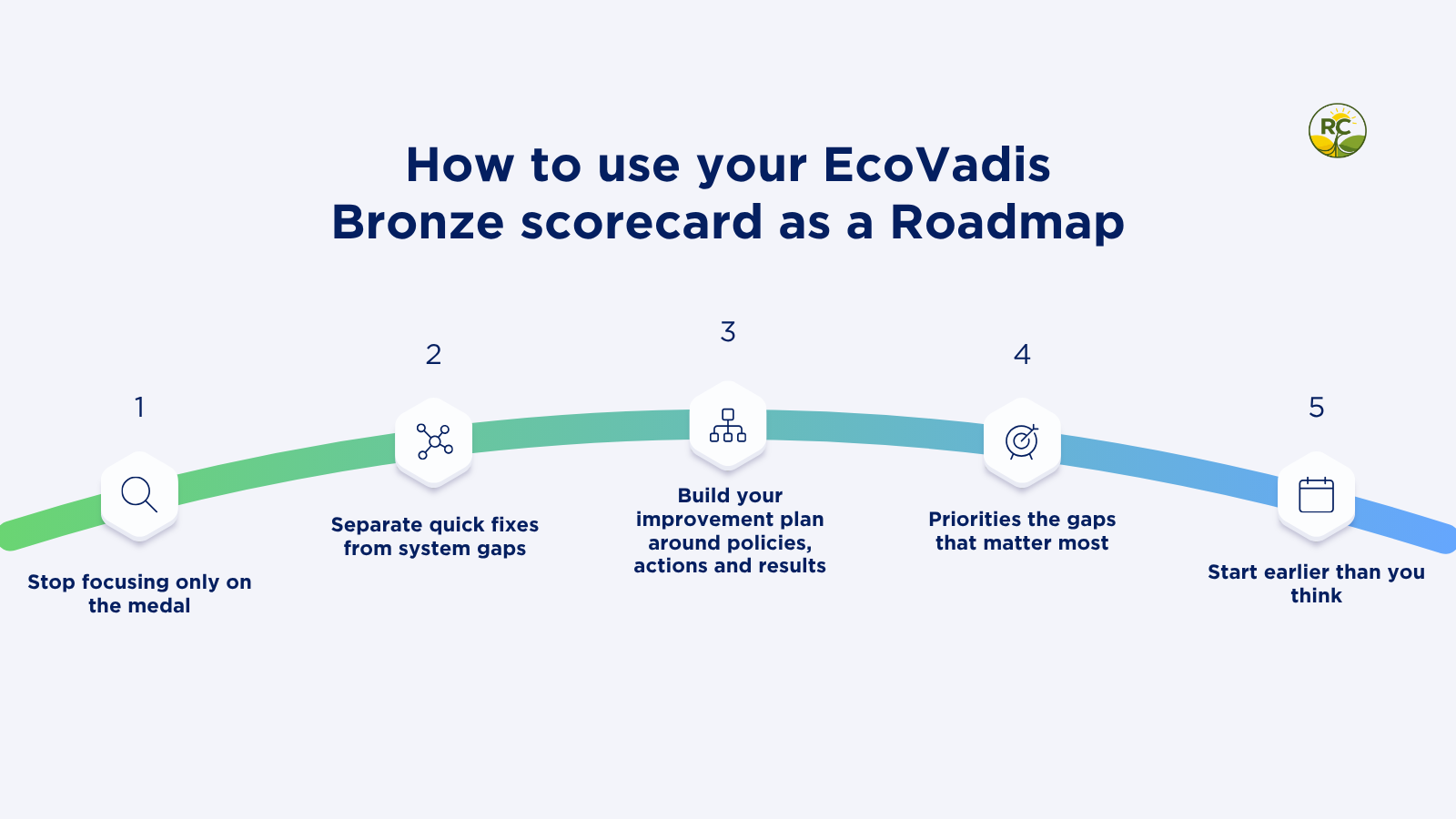
Step 1: Stop Focusing Only on the Medal
The medal is the visible result, but it is not the full diagnosis.
Before you ask “How do we get Silver?”, take a closer look at your scorecard and ask:
Which theme scored lowest?
Which theme carries the highest relevance for our company?
Which improvement areas appear repeatedly?
Are we missing policies, actions or results?
Are there scope or evidence quality issues?
Which gaps can realistically be closed before the next reassessment?
A company can waste a lot of time chasing a higher medal without understanding why it received Bronze in the first place.
The goal is not to guess your way to Silver.
The goal is to build a stronger sustainability management system and let the improved score follow.
Step 2: Separate Quick Fixes From System Gaps
Not every improvement area requires the same level of effort.
Some gaps can often be fixed relatively quickly. Others require several months of implementation before they become credible evidence.
A useful way to review your scorecard is to divide findings into three categories:
Quick fixes
These are gaps where the underlying practice already exists, but the documentation is often incomplete or unclear.
Possible examples may include:
Updating policy dates
Adding the correct legal entity name
Improving document scope
Collecting missing signatures or approvals
Uploading more direct evidence
Organising evidence under the right topic
These can often be addressed before the next assessment without major operational change.
Medium-term improvements
These require some implementation, but can usually be built within a few months.
Possible examples may include:
Creating a Supplier Code of Conduct
Introducing a supplier sustainability questionnaire
Setting up basic ESG KPIs
Formalising training records
Creating an environmental action plan
Developing an ethics policy and communication process
These can often be the most important improvements after a Bronze result.
Long-term system improvements
These require ongoing operation and evidence over time.
Possible examples may include:
Implementing a supplier risk management system
Tracking carbon emissions year over year
Building corrective action plans with suppliers
Expanding sustainability reporting
Setting measurable targets and monitoring progress
Embedding ESG responsibilities into management routines
These are the improvements that move a company from reactive EcoVadis preparation to a real ESG management system.
Step 3: Build Your Improvement Plan Around Policies, Actions and Results
One of the easiest ways to structure your post-Bronze improvement plan can be to use the same logic EcoVadis applies: Policies, Actions and Results.
For each weak theme, you can ask the following questions:
Policies
Do we have a formal commitment?
Is it specific to our company, sector and risks?
Does it apply to the assessed legal entity?
Is it approved, dated and communicated internally?
Does it cover the right topics?
Actions
What are we actually doing to implement the policy?
Do we have procedures, training, controls, supplier engagement or operational measures?
Can we prove that these actions are deployed across the relevant parts of the business?
Are responsibilities clearly assigned?
Results
Can we measure performance?
Do we have KPIs, targets or progress tracking?
Can we show year-on-year development?
Do we review results and take corrective action?
If one of these layers is missing, your improvement plan should address it.
For example:
A company may have an Environmental Policy, but no environmental KPIs. In that case, the next step is not to rewrite the policy again. The next step is to start measuring energy, waste, water or emissions and connect those results to targets and actions.
Another company may have supplier sustainability clauses in contracts, but no supplier assessment process. In that case, the improvement plan should focus on supplier risk mapping, questionnaires and follow-up.
Bronze becomes useful when you stop seeing it as a label and start seeing it as a diagnostic tool.
Step 4: Prioritise the Gaps That Matter Most
After a Bronze result, it is tempting to fix everything at once, but that usually leads to overwhelm.
A better approach is to prioritise by impact and feasibility.
Start with the gaps that are:
Connected to your lowest-scoring theme
Relevant to your industry risk profile
Repeated across several improvement areas
Important for your customers
Realistic to implement before your next reassessment
Useful beyond EcoVadis
The last point is important.
Your EcoVadis improvement plan should not only serve the score. It should also help with customer questionnaires, retailer requirements, supplier due diligence, audits and future ESG reporting.
A good improvement plan creates documents and processes that your business can reuse.
A poor improvement plan creates files that exist only for the next upload.
Step 5: Start Earlier Than You Think
Many companies only start preparing again when the next EcoVadis invitation arrives.
That is too late.
If your goal is to improve from Bronze to Silver or beyond, you need time to implement changes and generate evidence.
For example:
A new policy is stronger if it has been communicated and used
A training programme is stronger if completion can be shown
Supplier due diligence is stronger if suppliers have actually responded
KPIs are stronger if they show a trend
Corrective actions are stronger if progress has been tracked
EcoVadis preparation is not only about what you upload.
It is about what has been implemented before the upload.
That is why the months after receiving Bronze are valuable. You have the scorecard, you know the gaps, and you still have time to act before the next assessment cycle.
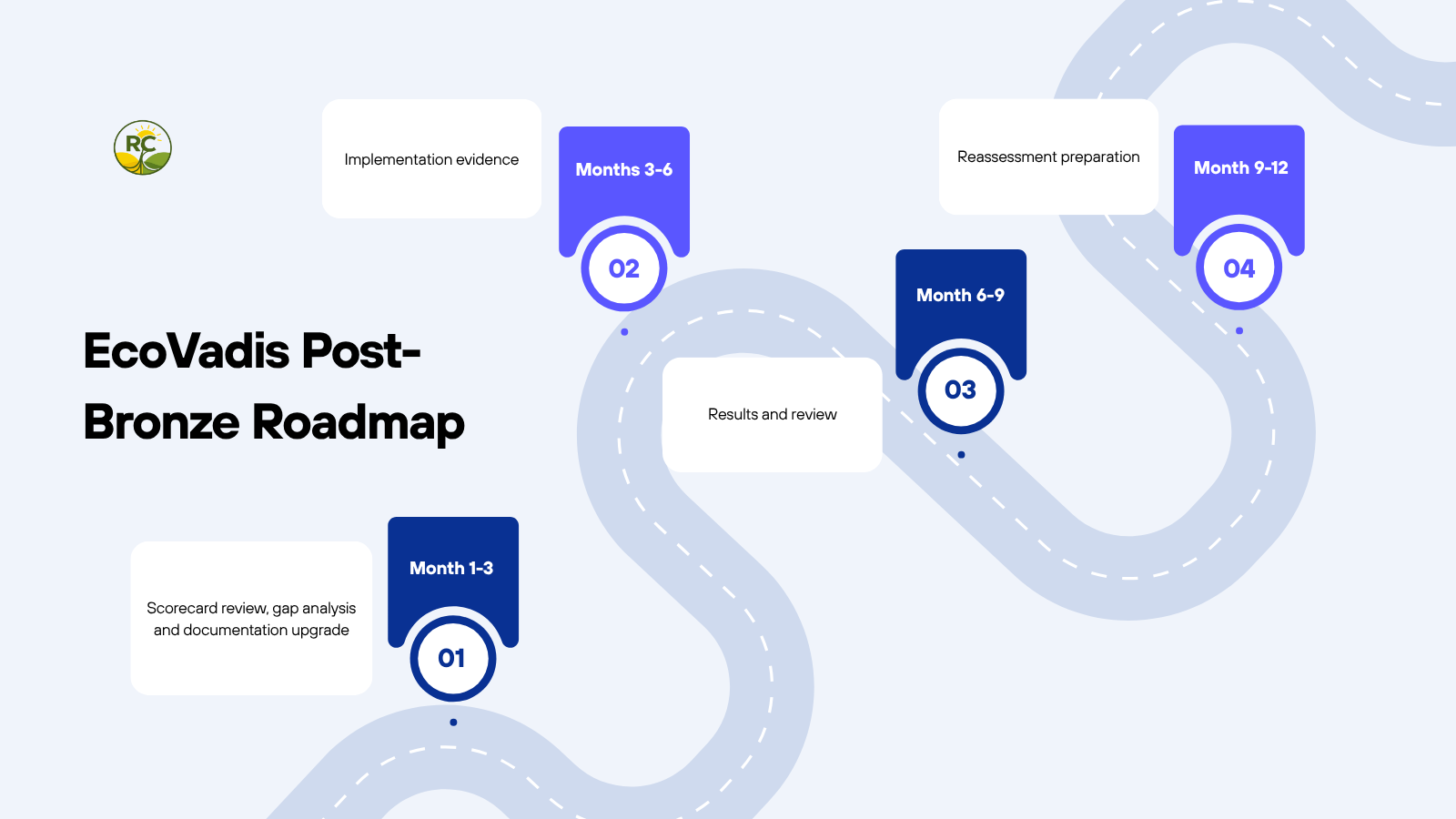
What a Practical Post-Bronze Roadmap Can Look Like
A simple roadmap after receiving Bronze could look like this:
Month 1: Scorecard review and gap analysis
Review the full scorecard, identify weak themes, analyse improvement areas and map existing documents against EcoVadis expectations.
The output should be a prioritised action plan, not just a list of missing documents.
💡 Find out here how to conduct a gap analysis step by step: How to Conduct an EcoVadis Gap Analysis - Before You Start the Assessment
Months 2–3: Documentation upgrade
Update or create the core ESG documents that are missing or weak.
This may include:
Sustainability Policy
Environmental Policy
Human Rights Policy
Code of Conduct
Supplier Code of Conduct
Ethics / Anti-Corruption Policy
Supplier questionnaire
ESG action plan
KPI overview
The goal is to build a coherent documentation base that reflects your actual business.
Months 3–6: Implementation evidence
Start generating proof that the documents are not just written, but used.
This could include:
Training records
Supplier responses
Internal communication
Risk assessment results
Meeting minutes
Action tracking
KPI updates
Corrective actions
This is where many companies move beyond Bronze-level structure.
Months 6–9: Results and review
Review your KPIs, evaluate progress and document management review.
This helps show that ESG topics are actively monitored and not treated as a one-time assessment project.
Months 9–12: Reassessment preparation
Before the next EcoVadis submission, review every document again for quality, scope, relevance and clarity.
Make sure the evidence directly answers the question being asked.
Do not upload everything you have.
Upload what proves the point best.
EcoVadis Bronze to Silver: What Usually Needs to Change
There is no universal formula for moving from Bronze to Silver because each assessment is customised to the company’s size, activity and location.
But in practice, companies usually need to strengthen three areas:
Better evidence quality
Documents need to be current, specific, scoped correctly and directly relevant to the questions.
More implementation proof
Policies alone are not enough. Companies need to show actions, deployment and follow-up.
Stronger results
KPIs, targets and progress tracking often make the difference between a basic management system and a more mature one.
The companies that improve most effectively are not the ones that create the most documents.
They are the ones that build a clearer system.
key takeaways
EcoVadis Bronze is not a failure.
It is a recognised starting point, and more importantly, a roadmap.
A Bronze result usually means your company has already built parts of a sustainability management system, but still needs stronger documentation, clearer implementation evidence and better performance tracking.
The most productive response is not panic, embarrassment or trying to rewrite everything at the last minute.
The most productive response is to use the scorecard strategically:
Review your weakest themes
Understand the improvement areas
Separate quick fixes from system gaps
Build around policies, actions and results
Prioritise what matters most
Start early enough to create real evidence
If you treat Bronze as the end of the process, it may feel disappointing.
If you treat it as the beginning of a structured improvement cycle, it becomes one of the most useful ESG tools your company has.
Already have the evidence but are unsure if it is ready to upload?
My Quick Expert Check is designed for companies that have much of their documentation in place but want an expert review before submission.
It includes:
Review of up to 25 existing documents
Identification of the most important gaps
Prioritised recommendations
A written action plan, see example here
A 60-minute results call
The review helps identify which documents provide strong evidence, which are attached to the wrong questions and where one part of the evidence chain is missing.
What if implementation records or KPIs do not exist yet?
Document mapping cannot replace an operational process.
If a procedure exists but no completed records can be found, the next step is implementation. If activities take place but no performance data is collected, the company needs a reporting process.
My Full EcoVadis Support is more suitable for you when policies, procedures, implementation evidence, KPIs or internal capacity are still missing.
The practical difference is:
Quick Expert Check: Most documentation exists and your team can implement recommendations internally.
Full EcoVadis support: The management system or evidence still needs to be developed.
Disclaimer: The author is a former EcoVadis analyst. This article is based solely on publicly available information, professional experience, and independent analysis. No confidential, proprietary, non-public, or privileged information obtained during any previous employment or professional engagement has been used in the preparation of this article. The content is provided for informational purposes only and does not represent official EcoVadis guidance, methodology documentation, or scoring criteria. The author is not affiliated with, endorsed by, or acting on behalf of EcoVadis. Any views, interpretations, or recommendations expressed are solely those of the author and do not represent the views of EcoVadis.
