


Your product is ready. The samples tasted great. The buyer liked the pitch. And then, instead of a purchase order, you get an email with a list of attachments they need "before we can move forward."
This is the moment where a lot of good food and beverage brands lose momentum, because nobody told them that entering the EU market is as much a paperwork exercise as it is a sales one. I can already tell you: buyers are not trying to make your life difficult. They're covering their own compliance exposure, and they need proof from you to do it.
Here's the good news. Once you know what's actually being asked for, this stops being overwhelming and becomes a checklist.
From Supplier to Buyer-Ready
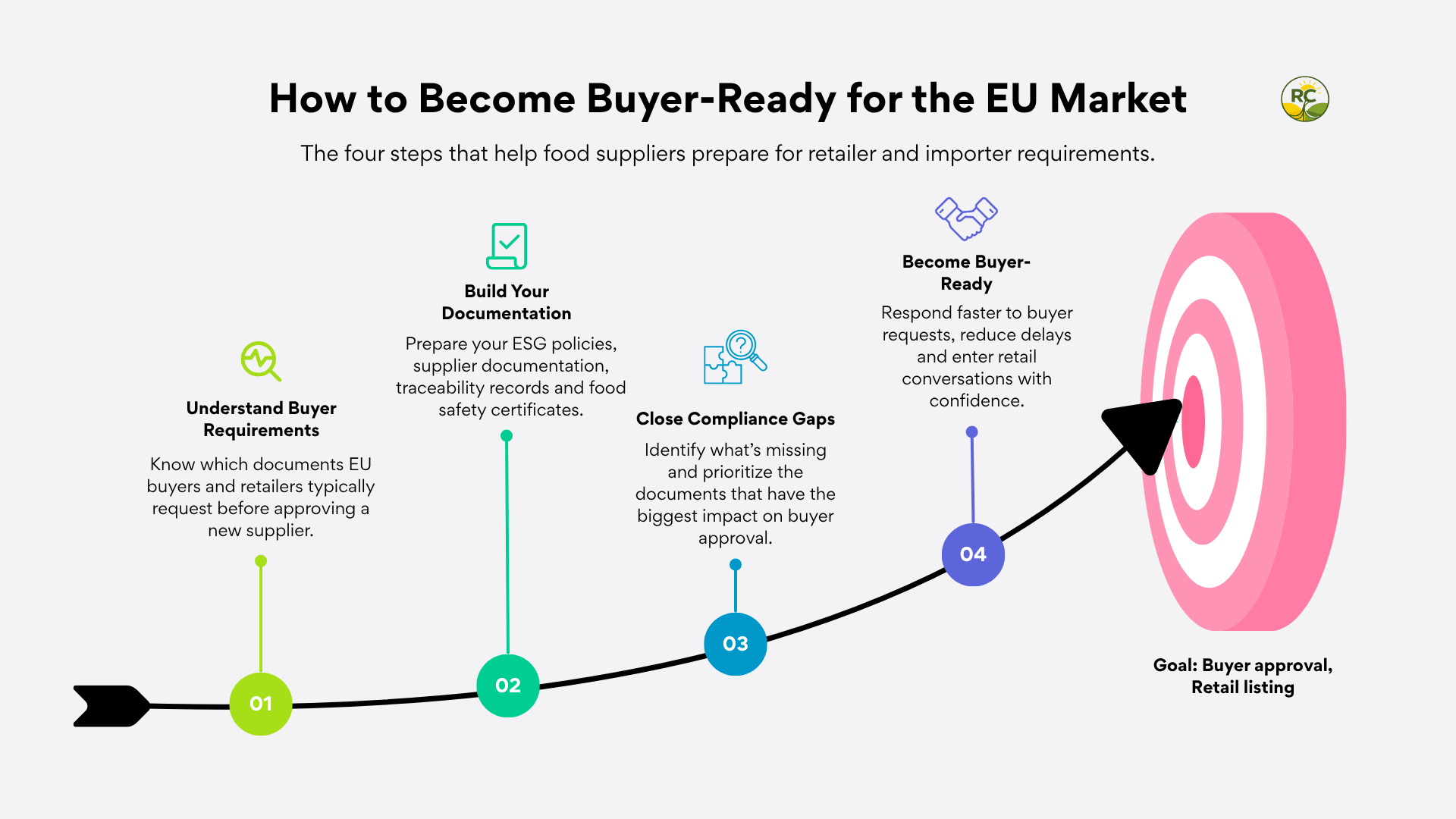
Preparing for an EU buyer isn’t about collecting every possible document overnight. It’s about following a structured process that helps you become easier to work with and reduces the questions buyers have during supplier onboarding.
Most successful suppliers follow the same path:
1. Understand buyer requirements.
Know which documents your target buyers are likely to request and which ones are actually required for your products and markets.
2. Build the right documentation.
Put the essential policies, certifications, traceability records, and sustainability documents in place before they’re requested. This saves valuable time once a commercial opportunity appears.
3. Close the remaining gaps.
Compare what you already have with what buyers expect, identify what’s missing, and focus on the documents that will have the biggest impact first instead of trying to do everything at once.
4. Become buyer-ready.
When your documentation is organized and readily available, supplier onboarding becomes faster, customer requests are easier to handle, and you’re far more likely to be seen as a reliable, low-risk business.
That’s exactly why the companies that move fastest aren’t always the ones with the biggest sustainability teams—they’re the ones that prepared before the buyer asked.
The 10 Documents EU Buyers Typically Ask For
1. Signed Supplier Code of Conduct
Most retailers have their own Code of Conduct covering labor standards, environmental practices, and business ethics. They'll expect you to read it, accept it, and sign it, often before the first commercial conversation even starts.
2. Supplier Self-Assessment Questionnaire (SAQ)
A structured questionnaire covering your company's ESG practices: policies, certifications, working conditions, environmental management. Many retailers use their own template; some rely on platforms like EcoVadis to standardize this across suppliers.
💡 Received an EcoVadis rating request?👉 Get your Quick Expert Check and receive feedback from a former EcoVadis Sustainability Analyst before you submit.
3. Traceability & Chain of Custody Documentation
Proof of where your raw materials come from and how they move through your supply chain — from farm or producer to your facility to the retailer's shelf. For certain commodities, this now overlaps directly with EUDR requirements (more on that below).
4. Food Safety Certification (BRCGS, IFS, FSSC 22000, or equivalent)
A recognized food safety certificate is close to a hard requirement for most EU grocery and retail buyers. Which specific scheme they'll accept usually depends on the retailer and the country — worth confirming early rather than assuming.
5. EUDR Due Diligence Statement
If your product contains cocoa, coffee, palm oil, soy, rubber, wood, or cattle-derived ingredients, buyers will increasingly ask for an EU Deforestation Regulation (EUDR) due diligence statement, including geolocation data on where the raw material was produced. Enforcement was pushed back again in late 2025 — large and medium operators now need to comply from 30 December 2026, small and micro operators from 30 June 2027 — but forward-thinking buyers are already building this into onboarding, since sourcing decisions made in 2026 will still be shipping once the rules apply.

6. ESG / Sustainability Policy
A short, written policy describing your commitments on environmental impact, labor practices, and business ethics. It doesn't need to be a 40-page document — it needs to exist, be dated, and be signed by someone with authority in your company.
7. Carbon Footprint Data
Increasingly, buyers want at least a basic estimate of your product's or company's carbon footprint (Scope 1 and 2, sometimes Scope 3). This is rarely a full lifecycle assessment at supplier stage — a defensible estimate is usually enough to start.
8. EcoVadis Scorecard (or Equivalent Rating)
If your buyer already uses EcoVadis to manage supplier risk, they may ask you to complete an assessment directly on the platform rather than filling in their own SAQ. Retailers increasingly treat a completed EcoVadis scorecard as a shortcut that satisfies several other document requests at once.
Received an EcoVadis rating request?
Before you spend hours uploading documents, it’s worth knowing whether you’re on the right track.
👉 Get your Quick Expert Check and receive feedback from a former EcoVadis Sustainability Analyst before you submit.
9. Human Rights & Labor Policy
Many large EU retailers now carry their own due diligence obligations — through Germany's Supply Chain Act (LkSG) or the EU's Corporate Sustainability Due Diligence Directive (CSDDD, now narrowed to companies above roughly 5,000 employees and €1.5 billion turnover, with a 2029 compliance date). Even though this directly binds only the largest retailers, they pass a version of it down to suppliers of any size as a contractual requirement — which is why smaller brands get asked for a human rights or labor policy even though the law itself doesn't apply to them yet.
10. Certificates of Origin & Customs/Import Documentation
Standard trade documentation proving where goods were produced and confirming they meet import requirements. Not glamorous, but a shipment without it simply doesn't clear customs — so it belongs on this list as much as anything ESG-related.

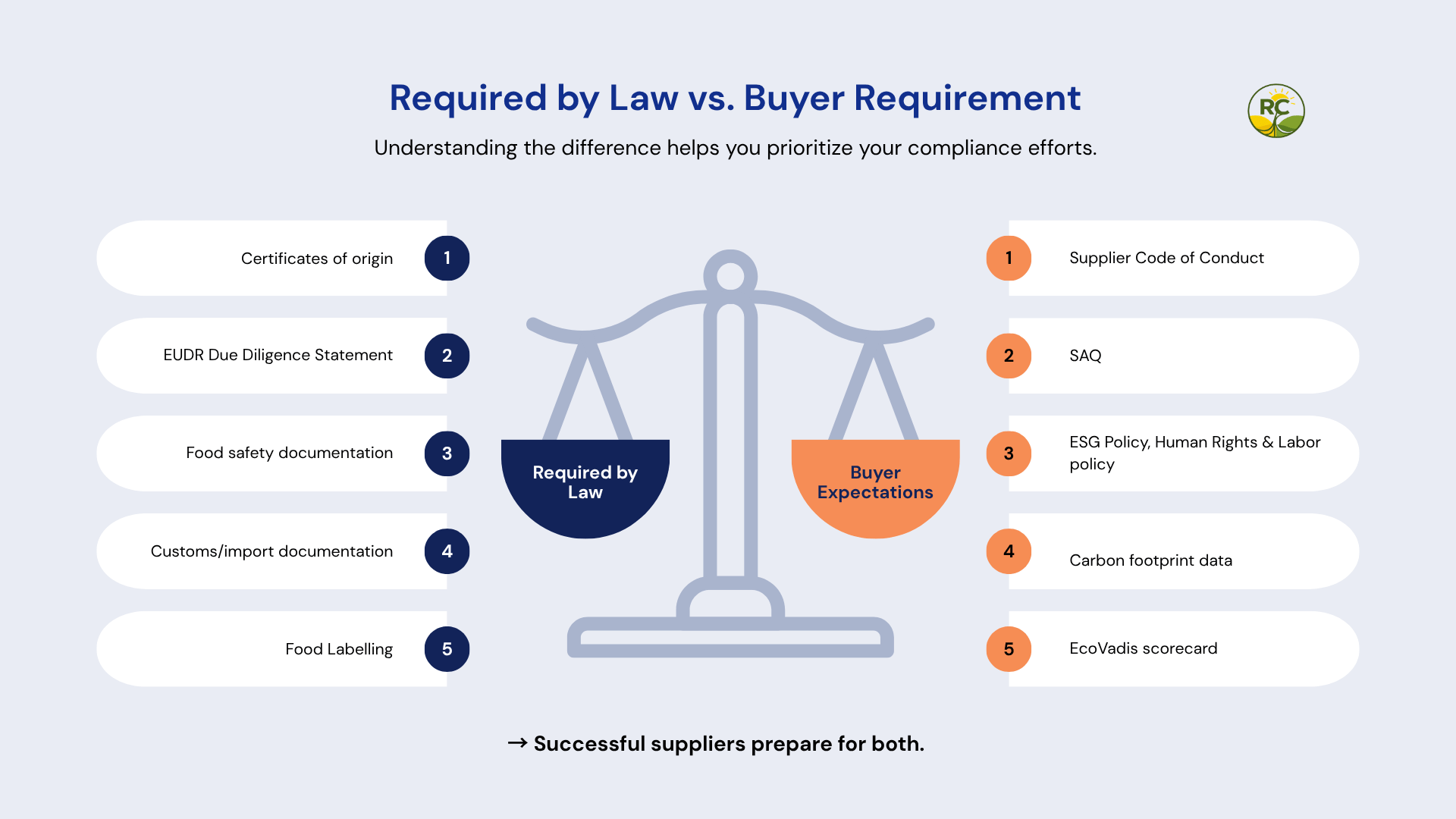
Which of These Are Actually Required by Law?
This is the question I get asked most often, so let's be precise about it.
Legally required, regardless of what any specific buyer wants:
Certificates of Origin and customs/import documentation
EUDR Due Diligence Statement, if you handle in-scope commodities (with the 2026/2027 deadlines above)
A baseline level of food safety documentation to legally place food on the EU market
Mandatory food labelling
Not required by law for most small and mid-sized suppliers, but requested because of buyer policy or the buyer's own compliance obligations:
Supplier Code of Conduct
SAQ
ESG Policy
Carbon footprint data
Human Rights & Labor policy
The specific food safety certification scheme (the certificate itself may be near-mandatory in practice, but BRCGS vs. IFS vs. FSSC is a buyer preference, not a law)
Knowing this distinction matters, because it tells you where you have room to negotiate (buyer preferences) and where you simply need to comply (the law).
What Should You Build First?
If you're staring at this list wondering where to start, here's the order I'd recommend to clients:
Sign the Code of Conduct and complete the SAQ. These cost you almost nothing beyond time, and they're usually the first gate a buyer checks.
Get your food safety certification sorted, since it takes the longest lead time and often blocks everything else until it's in place.
Map your traceability data, especially if you touch any EUDR-relevant commodity — this is the one area where "we'll sort it out later" genuinely isn't an option anymore.
Write your ESG policy. Most companies are already doing more than they realize; this step is about putting it on paper.
Tackle carbon data and an EcoVadis scorecard last — they're the most resource-intensive, and much easier once the first four are already in place.
Trying to do all ten at once is how this becomes overwhelming. Doing them in this order is how it becomes manageable.
be Ready for the Next Buyer Request
Retailers don’t ask for sustainability documents once. They ask for them throughout the business relationship.
I help food and agrifood companies build the policies, supplier documentation, ESG records, and compliance processes they need to respond with confidence, whether it’s a Quick Expert Check or full preparation support, customer questionnaires, audits, or new retail opportunities.
