


An important customer sends a short email: “Please share your EcoVadis score.”
For many small and mid-sized suppliers, that sentence creates immediate uncertainty.
Do they simply want a number? Is this a condition for keeping the account? Does a low score put the relationship at risk? And what happens if your company has never completed an EcoVadis assessment at all?
The first thing to understand is this: a request for your EcoVadis score is usually not just an administrative request. It is often part of how a customer manages sustainability risk in its supply chain, compares suppliers, or prepares a purchasing decision.
That does not mean you need to panic or promise more than you can deliver. But it does mean you should respond deliberately.
This article explains what typically happens after a customer asks for your EcoVadis score, what buyers may be looking for, and how to respond whether you already have a scorecard, are mid-assessment, or are starting from zero.
💡 New to EcoVadis? Start with my practical guide EcoVadis for SMEs: What Small Companies Really Need in 2026 (and What They Don’t)
Why customers ask for an EcoVadis score
Most customers do not ask for an EcoVadis score because they expect every supplier to be perfect. They ask because they need a consistent way to understand sustainability performance and risk across a large supplier base.
Depending on the customer, your scorecard may be used as part of new-supplier qualification, one input in a tender, an annual supplier review, a risk indicator, or a way to identify potential strategic partners. EcoVadis explains that the exact use varies by requesting company: a lower overall or theme score may lead to a corrective action plan, while a strong result may help identify strategic partners.
The score alone does not tell you what decision the buyer will take. So the most useful first step is not to guess, but to clarify the commercial context.
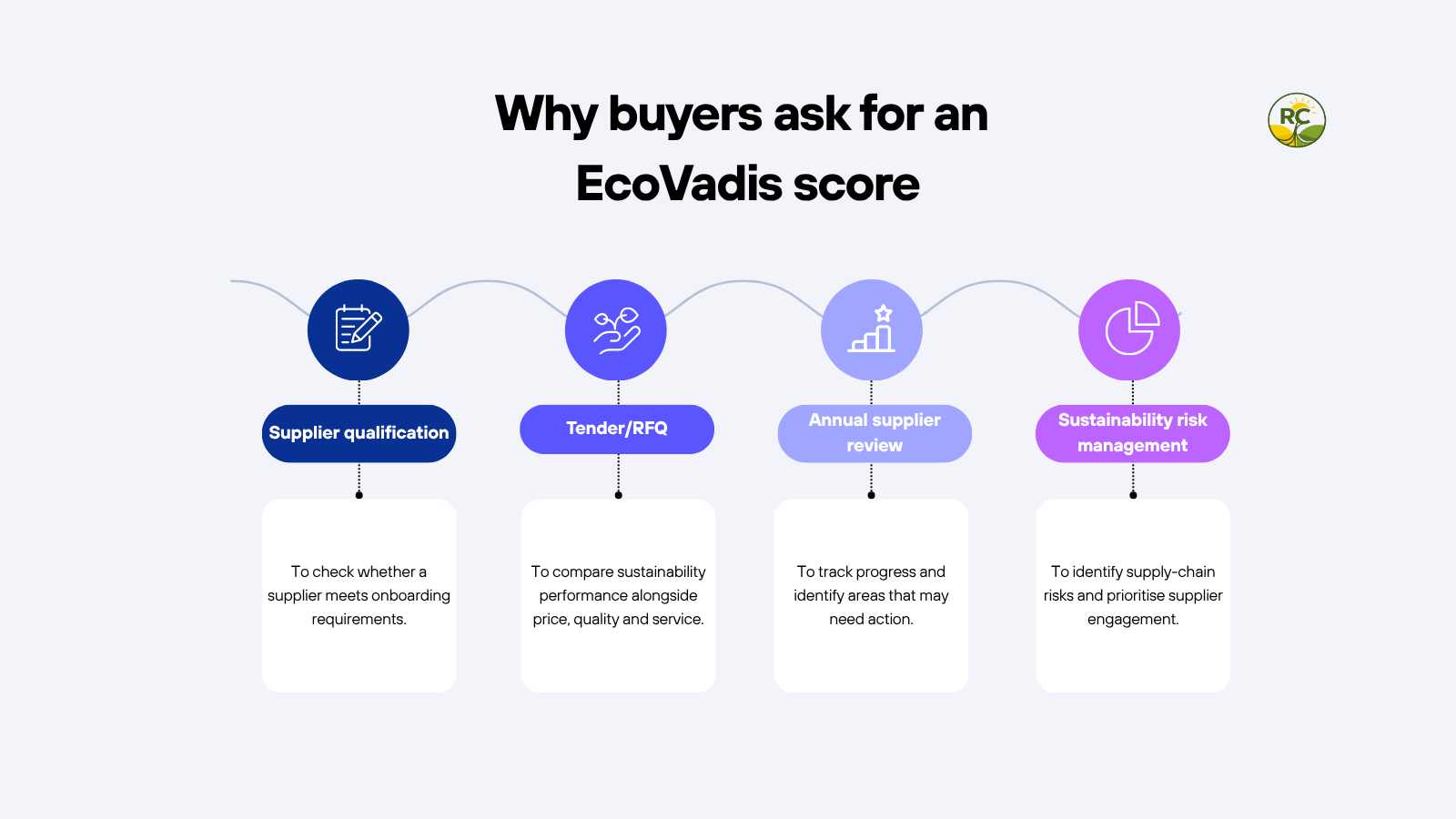
An EcoVadis score helps buyers assess sustainability readiness across their supplier base. How it affects a decision depends on each buyer’s own criteria.
First: find out what the customer is actually asking for
“Please share your EcoVadis score” can mean several different things. Before you click anything, ask the customer (or your internal account manager) to clarify:
Is this mandatory for an existing supplier, a tender requirement, or a general data-collection exercise?
Do they need the full scorecard, the overall score, medal status, carbon information, or a complete sustainability profile?
Is there a target score, a minimum threshold, or a deadline?
If you do not have a current scorecard, will they accept a planned assessment date and interim documentation?
Who will review the result: procurement, sustainability, quality, or supplier management?
These questions are not evasive. They show that you take the request seriously and help you avoid doing the wrong work.
If you already have a valid EcoVadis scorecard
This is the simplest scenario, but it still deserves a careful response. Scorecards are generally valid for 12 months from publication. If yours is current, log in to the EcoVadis platform, check the sharing request and confirm what will be shared.
Before you share, take 30 minutes to review the scorecard internally:
1. Check the publication date and validity.
2. Read the overall and theme-level scores.
3. Review strengths and improvement areas.
4. Prepare a short covering note with status and next actions.
A calm response for your customer could be:
“Thank you for your request. We have shared our current EcoVadis scorecard through the platform. It was published in [month/year] and is valid until [month/year]. We are reviewing the improvement areas internally and have assigned actions for the next assessment cycle. Please let us know if your supplier process requires any additional information.”
The final sentence matters. A buyer wants a scorecard, but also confidence that someone owns the follow-up.
If your score is lower than you expected
Do not disappear, delay your reply indefinitely, or try to explain away the result. A lower score is not automatically a lost customer. Many buyers use the result to understand risk and to see whether a supplier has a credible improvement path.
Your job is to make that path visible. Separate the score into three questions:
What is already working and documented?
Which weaknesses are genuine process gaps?
Which weaknesses are mainly documentation or evidence gaps?
For SMEs, the third category is often larger than expected. A company may have sensible practices around waste, health and safety, ethics or supplier relationships, but no signed policy, dated training record, KPI or written process to demonstrate them.
Build a short corrective-action plan around the most material findings. Name an owner, set a realistic target date, and define the evidence you expect to have at the end. Three to five credible actions are more reassuring than 20 ambitions with no ownership.
💡 If your result was Bronze, this article explains how to turn the scorecard into a practical improvement plan: EcoVadis Bronze Is Not a Failure. It Is a Roadmap
Not sure what your scorecard or documents will hold up to?
My Quick Expert Check is designed for companies that are about to submit or need a clear view of their current position. I review up to 25 existing documents, identify the most significant gaps and quick wins, and provide prioritised recommendations for the next submission. It is a practical option from a former EcoVadis Sustainability Analyst, when your team can implement the actions internally but needs an independent, structured review first.
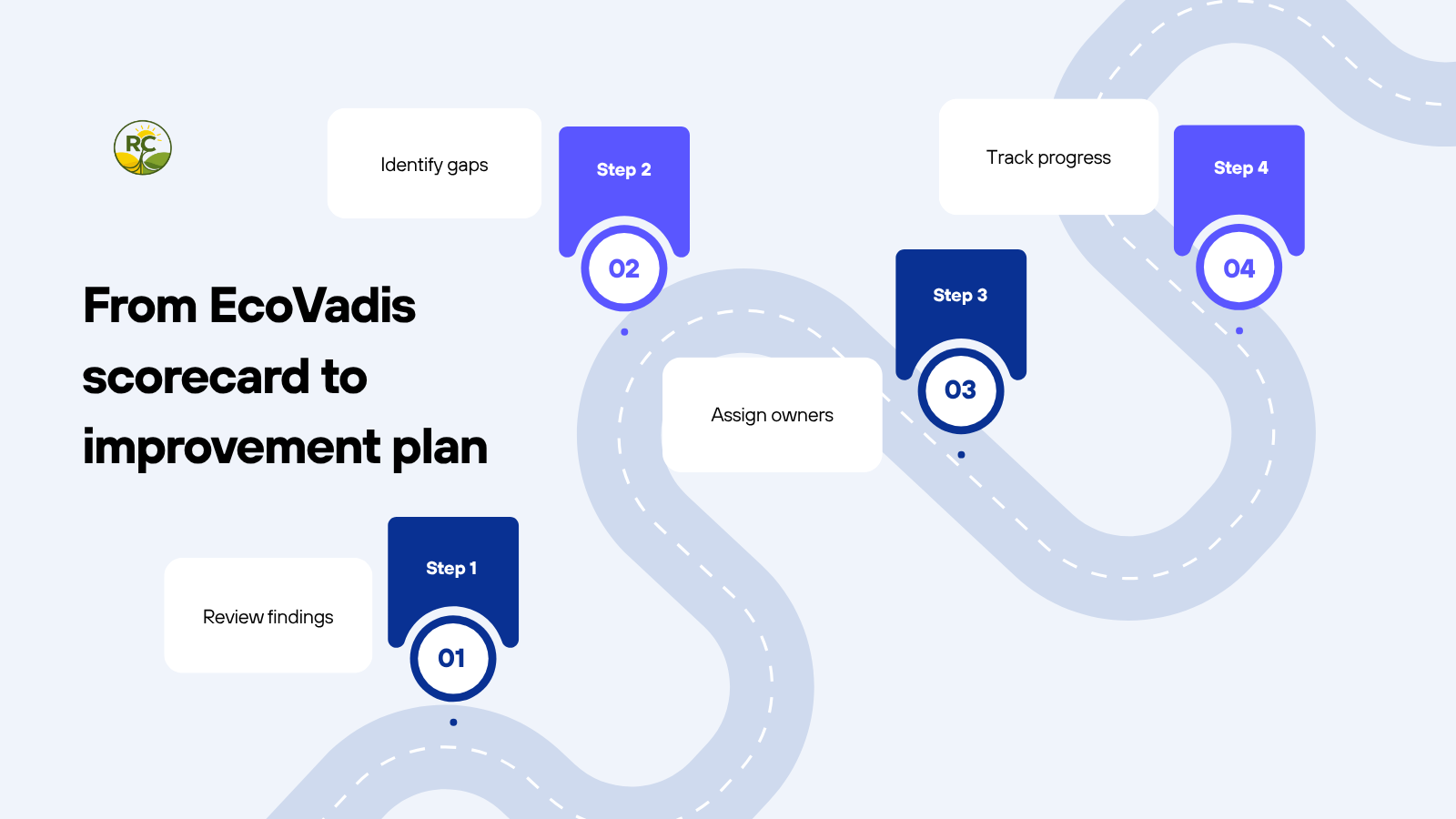
A lower score is most useful when it becomes a focused, owned improvement plan.
If you do not have an EcoVadis score yet
This is where many suppliers make the biggest mistake: they answer with either a flat “we do not have one” or an immediate commitment to complete the assessment in an unrealistic timeframe.
Instead, give the customer a clear status and a proportionate next step:
“Thank you for your request. We do not currently have a published EcoVadis scorecard. We are reviewing the assessment requirements and our existing sustainability documentation so that we can provide a robust response. Could you please confirm whether an EcoVadis assessment is mandatory for our supplier relationship, the required timeline, and whether interim documentation would be useful?”
This response is transparent, shows momentum, and gathers information before you commit time and budget.
If the customer confirms that an assessment is required, start with a gap analysis - not with uploading every document you can find. EcoVadis activates criteria according to a company’s industry, size and location. A focused review helps identify the policies, actions and evidence that matter to your assessment.
For most SMEs, the first priorities are not a glossy sustainability report or new software. They are usually a named owner, short signed policies, basic evidence that these policies are applied, a simple supplier-due-diligence process, and a realistic assessment timeline.
💡 Check out this article for a structured way to begin: How to Conduct an EcoVadis Gap Analysis—Before You Start the Assessment
If you are completing your first assessment, have no internal capacity, or need support all the way through submission, my Comprehensive EcoVadis Support is the more suitable route. It combines the initial review from a former EcoVadis Sustainability Analyst with support for collecting evidence, structuring responses and preparing the final submission.
What the customer may see after you share
Sharing is not always limited to an overall score. The level of access depends on the request and settings. Customers may see score details across the sustainability themes and, in some cases, may ask for a broader sustainability or carbon profile, such as metrics, corrective actions or supporting information.
This is a good reason to involve the right people internally before accepting a request. Sales understands the relationship and deadline. Operations, quality or HR may own important evidence. Procurement may need to explain supplier screening. Management should approve commitments made to an important customer.
Treat the request as a small cross-functional project, even if your business has only 20 employees. A clear owner keeps it moving.
If customer requests, documents and KPIs are repeatedly landing on the desk of someone who already has a full-time role, this is also where an External Sustainability Manager can help: as an ongoing point of contact for questionnaires, documentation maintenance and buyer requirements.

A simple response plan for the first five working days
Day 1: acknowledge and clarify
Thank the customer, confirm you are reviewing the request and ask about purpose, required information, threshold and deadline.
Day 2: establish your starting point
Confirm whether you have a valid scorecard, an assessment in progress, or no assessment. Locate the latest scorecard, questionnaire answers, policies and evidence in one folder.
Day 3: review the commercial and sustainability picture
Ask the account manager how important the customer is and whether a tender or contract decision is involved. Review scorecard findings or carry out a quick gap review.
👉 Find out here how to conduct a gap analysis: How to Conduct an EcoVadis Gap Analysis—Before You Start the Assessment
Day 4: agree ownership and next actions
Assign one owner. Decide what you will share now, what you will improve, and when you can give the customer a meaningful update.
Day 5: respond with confidence
Share the requested information through the appropriate channel. Include a short, factual note on status and next steps, and keep a record of what was shared and with whom.
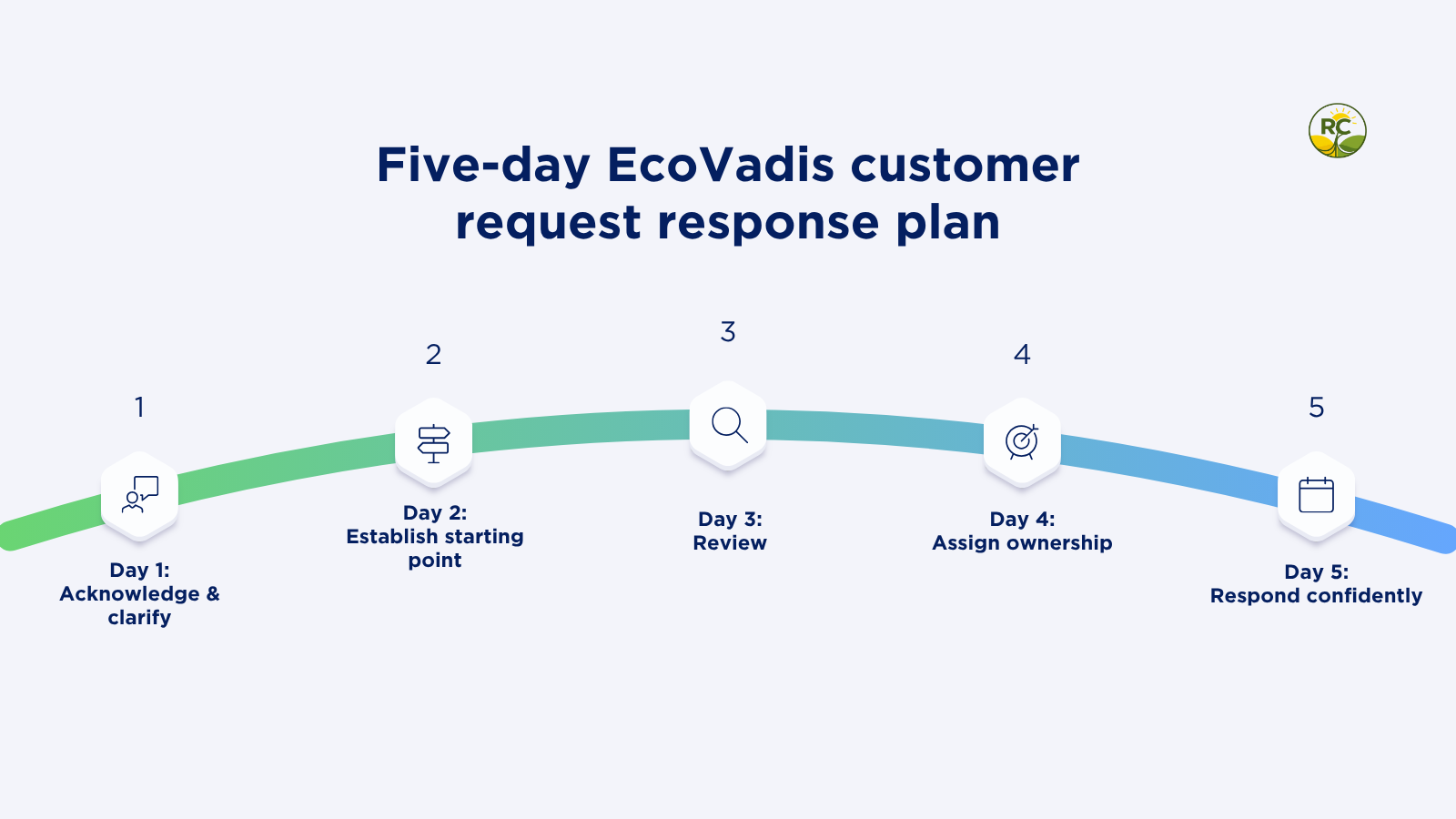
A practical five-day plan helps you respond quickly without making unrealistic promises.
Turn the request into a stronger supplier relationship
The best outcome is not simply sending a score and moving on. It is using the request to build a more reliable way of managing sustainability information across the business.
Keep core evidence organised. Review policies annually. Track a small number of relevant KPIs. Make sustainability questions part of supplier onboarding. Use the scorecard’s improvement areas to prioritise work that will matter to customers as well as future assessments.
Then the next buyer request will not arrive as a scramble. It will be a routine supplier-management task and potentially a chance to show that your company is a dependable long-term partner.
Need to respond to a customer request without overbuilding?
A request for an EcoVadis score can become urgent quickly, especially when it is linked to a tender, supplier review or an important customer relationship. You do not need to build a large corporate sustainability system overnight. You need to understand what your customer requires, identify what you already have, and focus on the next actions that will make the biggest difference.
Having worked as a Sustainability Analyst at EcoVadis and with food businesses facing real buyer requirements, I help companies turn that uncertainty into a clear, proportionate plan.
Choose the support that fits your situation:
You have documents but are unsure how strong they are: My Quick Expert Check gives you an independent, structured review of up to 25 documents, the key gaps, quick wins and prioritised next steps. It is ideal when your team can implement the changes internally.
You are new to EcoVadis or need hands-on help through submission: My Comprehensive EcoVadis Support takes you from preparation and evidence gathering through to a clear, well-structured final submission.
Your customer expects documentation beyond one assessment: The Sustainability Documentation Setup helps build the practical policies, supplier documentation and KPI overview buyers increasingly ask for.
These requests are becoming a recurring workload: An External Sustainability Manager provides ongoing support without the cost of a full-time hire.
If you have just received a customer request and are unsure which route makes sense, book a quick call with me. We will look at the request, your timeline and your current documentation, and identify the most useful next step for your business.
