


Your company trains employees, evaluates suppliers and monitors waste.
But can you prove it?
A written procedure may explain how an activity should happen. EcoVadis may also need evidence that it actually happened and, where relevant, measurable results showing what the activity achieved.
This is where many companies often select the wrong documents.
They upload a blank supplier questionnaire instead of a completed example. They attach training slides without an attendance record. They provide an isolated KPI without a reporting period or calculation method.
The documents are related to the topic, but they do not prove the selected answer.
This guide explains what EcoVadis evidence is, which implementation records and results can support your answers, and how to map documents without wasting the 55 available upload spaces.
💡 Start with the previous guide: Before mapping your evidence, make sure you understand what each document is designed to prove. My guide EcoVadis Policy vs Procedure: What’s the Difference? explains how policies define commitments, while procedures demonstrate how those commitments are put into practice.
Evidence is a relationship, not a document category
An invoice, audit report, policy, spreadsheet and attendance list can all become supporting evidence.
What matters is the relationship between the document and the claim.
Before selecting a document, complete this sentence:
“This document proves that our company…”
For example:
Trained 94% of relevant employees on business ethics
Assessed high-risk suppliers before approval
Monitored water consumption across both production sites
Investigated reported workplace incidents
Implemented a waste-segregation process
If the document cannot clearly complete that sentence, it may not support the answer.
💡 If you first need to distinguish commitments from operational processes, read my guide: EcoVadis Policy vs Procedure: What’s the Difference?
The four-part EcoVadis evidence chain
A useful management-system chain consists of four layers.
1. Policy
The policy establishes the commitment.
Example:
The company commits to assessing environmental and human-rights risks in its supply chain.
2. Procedure
The procedure describes how the process works.
Example:
Procurement screens suppliers during onboarding, classifies risk and initiates enhanced due diligence where necessary.
3. Implementation record
The record demonstrates that the process was used.
Example:
Completed supplier risk assessments, questionnaires, audit reports and corrective-action logs.
4. Result
The result shows the measurable outcome.
Example:
87% of relevant suppliers were screened, including 100% of suppliers classified as high risk.
A company may have strong evidence at one level and a gap at another.
A completed supplier assessment shows activity, but without a procedure the process may appear inconsistent. A procedure shows structure, but without completed records it may remain theoretical. A KPI shows an outcome, but without definitions and coverage its meaning may be unclear.
💡 Document type is only one part of evidence quality. Scope, dates, company identification and technical readability matter too. My detailed guide explains what makes an EcoVadis supporting document credible in 2026.

What is an implementation record?
An implementation record proves that an activity took place.
Common examples may include:
Completed training attendance lists
Signed Supplier Codes of Conduct
Completed supplier questionnaires
Supplier risk assessments
Audit reports
Corrective-action plans and closure records
Workplace inspection logs
Incident investigation forms
Equipment maintenance records
Management-review minutes
Grievance or whistleblowing case records
Waste collection or disposal records
The word completed matters.
A blank supplier questionnaire shows that a tool exists. A questionnaire returned by a real supplier shows that it has been used.
A training presentation shows the planned content. An attendance record shows that employees participated.
A blank audit checklist shows the intended method. A completed audit report shows implementation and findings.
What is a result?
A result demonstrates performance through reporting or KPIs.
For food companies, useful results may include:
Environment
Energy consumption
Scope 1 and Scope 2 greenhouse-gas emissions
Water consumption
Waste generated
Recycling rate
Food-loss rate
Packaging material used
Labour and Human Rights
Number or rate of workplace accidents
Lost-time injury rate
Health and safety training coverage
Average training hours
Employee turnover
Grievances received and resolved
Ethics
Anti-corruption training coverage
Confirmed ethics incidents
Whistleblowing cases received and closed
Information-security training coverage
Sustainable Procurement
Suppliers that signed the Supplier Code of Conduct
Suppliers screened for sustainability risks
High-risk suppliers audited
Corrective actions closed
Relevant purchasing spend covered by assessments
👉 Not every criterion will be activated for every company. Use my overview of the 21 EcoVadis criteria to identify which environmental, labour, ethics and sustainable procurement topics may be relevant to your assessment.
What makes KPI evidence understandable?
An isolated figure is rarely enough.
“Waste: 620 tonnes” leaves several questions unanswered:
Which year does it cover?
Which sites are included?
Does it include all waste types?
Is it an absolute figure or intensity?
How does it compare with previous years?
Was performance improving or deteriorating?
A useful KPI report should identify:
Reporting period
Unit of measurement
Definition
Calculation method
Organisational scope
Sites covered
Baseline
Target, where applicable
Multi-year performance
Explanation of important changes
For example:
Total production waste decreased from 18.4 kg to 15.9 kg per tonne of finished product between 2024 and 2026. The figures cover both production sites and include organic production waste, packaging waste and rejected product.
This provides a period, unit, boundary and trend.
Food-company examples across all four themes
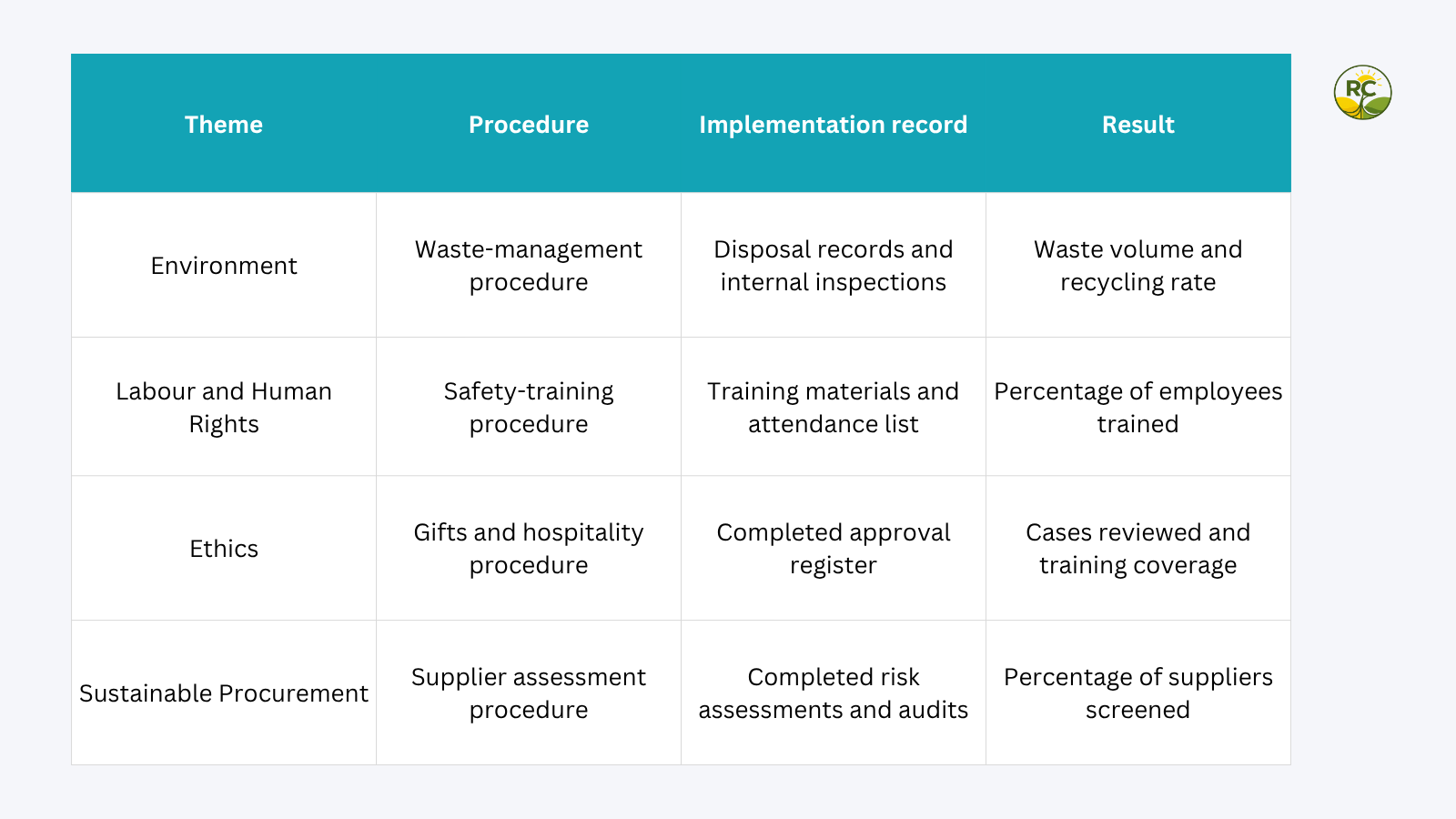
Examples showing how procedures, implementation records and measurable results can support evidence across the four EcoVadis themes.
The correct documents depend on the activated criteria and options in your company’s questionnaire. Use the table as a mapping model, not as a universal upload list.
Seven steps for mapping evidence correctly
Step 1: Identify the management indicator
Check whether the question concerns:
Policy
Endorsement
Measures
Certification
Coverage
Reporting
Another relevant indicator
This establishes what kind of information the answer needs.
A commitment document is unlikely to prove an implemented measure. A completed action record does not necessarily prove a formal policy.
Step 2: Define the exact claim
Write down what you are claiming before opening the document library.
For example:
“Our company provides regular health and safety training to production employees.”
The evidence should demonstrate that training was delivered, not simply that it is required.
Step 3: Select the correct evidence layer
Ask whether the answer needs:
A commitment
An operational process
Proof of implementation
A measurable result
External validation
Select documents based on that need.
Step 4: Check the assessment scope
Evidence should apply to the legal entity, group or site being assessed.
Check:
Company name
Legal entity
Locations covered
Employees covered
Reporting boundary
Certificate scope
A record from one site should not be presented as group-wide evidence without proof of broader implementation.
Step 5: Verify document quality
EcoVadis says here that supporting documents should be formalised, recent, relevant, complete and connected to the assessment scope.
Current guidance indicates an eight-year validity period for policies and actions and a two-year period for KPI reporting. A technically valid document can still be weak if it no longer reflects current operations.
Check for:
Company identification
Clear title
Issue or review date
Defined scope
Complete and readable content
Evidence of actual implementation
Suitable language or machine-readable text
Step 6: Link the document to the correct answer
EcoVadis explains that analysts consider documents attached to the selected questionnaire options. A useful document may not be credited as expected if it is left unattached or connected to an option it does not support.
Use the questionnaire comments or page-reference function where available to identify the relevant content.
Step 7: Test the complete chain
For each important topic, ask:
Is there a formal commitment?
Is there a repeatable process?
Is there proof that the process operates?
Is performance measured?
This reveals whether the real gap is a document-selection problem or a missing part of the management system.

Can one document support several answers?
Yes, if the document genuinely contains relevant evidence for each answer.
A sustainability report may contain:
Environmental commitments
Descriptions of implemented programmes
KPI results
Information about external initiatives
A genuine EHS manual may contain both policy and procedure sections.
An audit report may describe a management policy, verify an implemented measure and record performance findings.
In April 2026, EcoVadis expanded the use of external sustainability and certification audit reports. Depending on their content and coverage, these reports may support Policy, Actions or Reporting. See the official Q1 2026 methodology updates.
The document must still be linked to each relevant answer.
Third-party evidence needs a clear connection
Some evidence is produced by an external organisation:
Certification or sustainability audit reports
External training certificates
Recycling-service records
Environmental test reports
Equipment invoices
Collective bargaining agreements
The document may not carry your normal company branding. It must still be possible to connect it to the assessment scope.
For example:
A recycling contractor’s brochure describes its services.
Your contract or invoice proves that the contractor provides those services to your company.
Together, they create a clearer evidence trail.
EcoVadis provides further examples in its third-party document guidance.
Do not create an artificial evidence package
EcoVadis currently permits 55 new document uploads per assessment. This encourages companies to prioritise relevant, consolidated management documents.
It does not mean you should merge unrelated evidence into one large PDF.
Examples of problematic combined files include:
Multiple unrelated policies merged for the submission
Receipts, charts and photographs collected into one evidence pack
Policies, risk assessments and training documents artificially combined
A file containing links to documents stored elsewhere
Legitimate consolidated documents can include:
An existing EHS management manual
A multi-site KPI report
A training plan with materials and attendance records
A collection of certificates covering several operational sites
The distinction is whether the file is a coherent, pre-existing company document or an assessment-only compilation. See EcoVadis’ explanation of the document limit.

Common evidence mistakes
Attaching a blank template
A template shows that a tool exists. It does not prove that the tool has been used. Include completed records where the question concerns implementation.
Providing training slides without attendance
Training material explains the content. Attendance records demonstrate participation.
Treating an invoice as a complete management process
An invoice can prove that equipment or a service was purchased. It does not necessarily prove a broader policy, procedure or measurable result.
Uploading an unexplained spreadsheet
A spreadsheet without definitions, units, reporting periods or scope is difficult to assess.
Selecting answers before reviewing evidence
Start with what the company can genuinely demonstrate. Do not select desirable options and then search for documents that might support them.
Using marketing content as operational evidence
A website or brochure may communicate an initiative, but it is rarely a substitute for formal processes, completed records and structured results.
Assuming a certificate proves every related activity
Check the subject, scope, locations and validity of the certificate. A food safety or quality certificate does not automatically cover every EcoVadis sustainability topic.
Final evidence checklist
Before attaching a document, ask:
What exact statement does this document prove?
Which EcoVadis indicator does it support?
Does it show intention, process, implementation or result?
Is the assessed company identifiable?
Does it apply to the correct assessment scope?
Is it dated and current?
Is the content complete and readable?
If it is a template, is there also a completed example?
If it is a KPI, are the period, unit, method and coverage clear?
Is it linked to the correct questionnaire answer?
Would this document exist without the assessment?
If you cannot answer these questions confidently, review the evidence before uploading it.
Good evidence makes the management system visible
The purpose of EcoVadis evidence is not to fill an online document library.
It is to show how the company manages a sustainability issue:
The policy establishes the commitment.
The procedure defines the process.
The implementation record proves that the process operates.
The result shows whether it works.
Once these relationships are clear, document selection becomes easier and the same evidence can support customer questionnaires, buyer reviews, supplier audits and future sustainability improvements.
Already have the evidence but are unsure if it is ready to upload?
My Quick Expert Check is designed for companies that have much of their documentation in place but want an expert review before submission.
It includes:
Review of up to 25 existing documents
Identification of the most important gaps
Prioritised recommendations
A written action plan, see example here
A 60-minute results call
The review helps identify which documents provide strong evidence, which are attached to the wrong questions and where one part of the evidence chain is missing.
What if implementation records or KPIs do not exist yet?
Document mapping cannot replace an operational process.
If a procedure exists but no completed records can be found, the next step is implementation. If activities take place but no performance data is collected, the company needs a reporting process.
My Full EcoVadis Support is more suitable for you when policies, procedures, implementation evidence, KPIs or internal capacity are still missing.
The practical difference is:
Quick Expert Check: Most documentation exists and your team can implement recommendations internally.
Full EcoVadis support: The management system or evidence still needs to be developed.
Disclaimer: The author is a former EcoVadis analyst. This article is based solely on publicly available information, professional experience, and independent analysis. No confidential, proprietary, non-public, or privileged information obtained during any previous employment or professional engagement has been used in the preparation of this article. The content is provided for informational purposes only and does not represent official EcoVadis guidance, methodology documentation, or scoring criteria. The author is not affiliated with, endorsed by, or acting on behalf of EcoVadis. Any views, interpretations, or recommendations expressed are solely those of the author and do not represent the views of EcoVadis.
