


You completed your EcoVadis reassessment expecting an improvement.
Since the previous assessment, your company introduced new policies, collected more data and uploaded additional documents. The team spent weeks preparing the questionnaire. Perhaps you were aiming for a higher medal.
Then the new scorecard arrives, and the score is lower.
This can be difficult to explain internally. Management wants to know what went wrong. Sales may be concerned about customer reactions. The team that prepared the submission may feel that its work was not recognised.
A lower reassessment score does not automatically mean that your sustainability performance deteriorated. It may reflect changes in the methodology, questionnaire, company profile, assessment scope, supporting evidence or external information considered during the new analysis.
The important step is to identify what actually changed. This article explains the most common reasons an EcoVadis score can drop after reassessment and how to prepare a more robust next submission.
💡 If you received Bronze and are unsure how to interpret the result, start with my article: EcoVadis Bronze Is Not a Failure. It Is a Roadmap.
A reassessment starts a new analysis
An EcoVadis reassessment is not a simple renewal of the previous scorecard.
EcoVadis performs a new analysis based on the questionnaire, evidence and methodology applicable when the reassessment begins. The purpose is to evaluate the current sustainability management system, not simply to add points for activities completed since the previous assessment.
The questionnaire can also contain new or modified questions based on your company’s industry, size and location. Methodology updates introduced before the start of the reassessment apply to the new evaluation.
That means last year’s score is useful as a comparison, but it is not a guaranteed baseline.
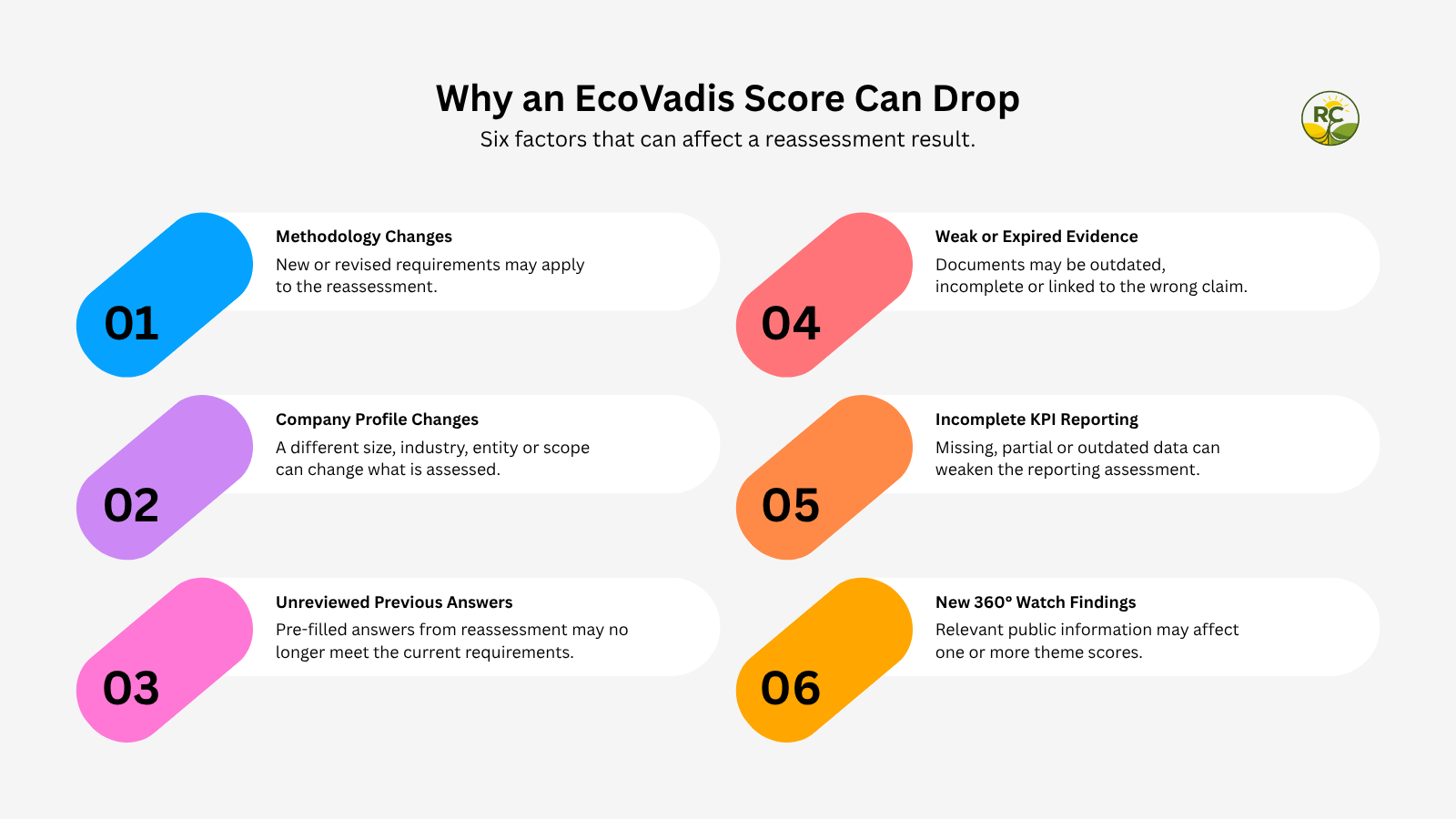
Comparing only the overall score can hide the actual reason for the change.
1. The EcoVadis methodology or questionnaire changed
EcoVadis updates its methodology regularly. Changes can affect questionnaire content, accepted evidence, assessment scope, scoring requirements and the level of detail shown in improvement areas.
For example, EcoVadis introduced several methodology changes in 2026. These included changes to the way site-level evidence coverage is calculated, broader use of certain audit reports, the end of acceptance for “in-progress” certificates, and additional environmental risk questions.
Not every methodology update reduces scores. Some changes may create new opportunities to demonstrate performance. But a document or answer that was sufficient in the previous cycle may not fully meet the current requirement.
Before starting a reassessment:
- review the latest methodology release notes;
- read the help text for every activated question;
- check whether answer options or evidence requirements have changed; and
- avoid assuming that last year’s attachments will receive the same treatment.
This is particularly important when several months pass between preparation and submission.
2. Your company profile or assessment scope changed
The EcoVadis questionnaire is adapted to the company being assessed. Industry, company size, location and assessment scope can influence which sustainability issues and questions are relevant.
A change may occur because:
- employee numbers moved the company into another size category;
- the legal entity or group structure changed;
- new sites or countries were added;
- the business activity was classified differently; or
- the reassessment covers a different entity from the previous scorecard.
These changes can alter the questionnaire and the evidence needed to demonstrate coverage.
For a company with several production sites, a group policy may still be relevant, but site-level evidence must adequately cover the assessed operations. Under the current 2026 methodology update, site-level coverage for relevant indicators is calculated using employees or sites rather than turnover.
A document from the largest factory is therefore not automatically representative of the whole assessment scope.
Check the legal entity, employee range, industry classification, locations and sites before answering the questionnaire. If the profile is incorrect, clarify it before submission rather than trying to compensate with documents later.
3. Pre-filled answers from reassessment were accepted without a full review
Pre-filled answers from reassessment can save time, but they can also create false confidence.
An answer carried over from the previous assessment may still need attention because:
- the underlying document is close to expiry;
- the policy no longer reflects current operations;
- the answer option or help text has changed;
- a new document would provide stronger evidence;
- the company scope has changed; or
- a current KPI is required.
Treat every pre-filled answer as a draft. Reconfirm that the statement remains accurate and that the attached evidence still supports the exact claim.
This is also where document mapping becomes valuable. A policy, procedure, training record and KPI report may all relate to the same topic, but they prove different parts of the management system.
My guide How to Map Evidence and Documents for EcoVadis explains how to connect each document to the relevant questionnaire answer.
4. Supporting documents expired or no longer met the requirement
Previously uploaded documents can remain available for later assessments, but not indefinitely.
EcoVadis currently applies a maximum validity period of eight years to policies and actions and two years to KPI reporting. Expired documents are automatically removed, together with the answer options attached to them.
Validity is only one issue. A current document can still be weak evidence if it is:
- incomplete;
- undated or unapproved;
- linked to the wrong answer;
- outside the assessment scope;
- too generic to prove the selected option;
- missing evidence of implementation; or
- difficult to read or verify.
Certificates also need attention. Check the certified entity, standard, scope, issuing body and validity. Since the April 2026 methodology update, “in-progress” certificates are no longer accepted as certification evidence.
Do not ask only, “Did we upload more documents?” Ask, “Did we upload stronger evidence for the right claims?”
For a detailed document review, see my guide EcoVadis Supporting Documents in 2026: What Food Companies Need to Know.
5. Your KPI reporting became weaker, older or less complete
Companies often focus on policies and actions when preparing a reassessment. Reporting receives less attention.
This creates problems when:
- the latest reporting period is missing;
- KPIs cover only one site or part of the workforce;
- definitions changed between years;
- figures cannot be traced to source records;
- targets exist but progress is not reported;
- the organisational scope is unclear; or
- a previously reported metric is omitted.
Imagine a food manufacturer that introduced several energy-efficiency measures but submitted no current energy data. Operationally, the company may have improved. From an evidence perspective, the reassessment may show less complete reporting than before.
Review each KPI for period, unit, scope, calculation method, coverage and supporting source. When the data is partial, explain the limitation clearly rather than presenting it as company-wide.
6. Improvements were made, but not converted into assessable evidence
Completing an action does not automatically improve the reassessment score.
For example:
- employees received ethics training, but no attendance record was retained;
- suppliers signed a Code of Conduct, but there is no overview of coverage;
- a waste-reduction project was completed, but results were not measured;
- a new procedure was approved, but there is no evidence that it is used; or
- a corrective action was marked as complete without sufficient supporting documentation.
EcoVadis provides a Corrective Action Plan feature to help companies manage improvement areas and communicate progress to trading partners. However, updates in the Corrective Action Plan do not change the current scorecard. The score can only be updated through a reassessment and a new analysis.
Before the next submission, translate every completed action into evidence:
1. What changed?
2. Who implemented it?
3. Which part of the assessed company does it cover?
4. When did it take effect?
5. Which record proves implementation?
6. Is there a measurable result?
A completed action with no usable record may remain invisible in the assessment.
📋 Preparing for another assessment but unsure whether your documents are strong enough? My Quick Expert Check reviews up to 25 existing documents against the relevant EcoVadis requirements. You receive a clear overview of the gaps, a written action plan and a 60-minute results call before you submit.
7. New 360° Watch findings affected the result
EcoVadis does not rely only on information submitted by the company. Its 360° Watch process considers relevant public information from sources such as media, government bodies, NGOs, trade unions and business networks.
The findings can have a positive, neutral or negative impact. A new incident, sanction, controversy or other relevant public report may therefore affect a reassessment even when the uploaded documents improved.
Check whether the new scorecard includes a 360° Watch finding and whether it relates to the correct legal entity. If the information is factually incorrect or belongs to another company, use the available review or inquiry process promptly.
During the current pre-publication process, rated companies receive a two-business-day window to identify certain factual errors before the scorecard is released to the network. This is a short period. Assign someone to monitor the platform and review the company profile and any external findings as soon as the result becomes available.
Did your score drop, or only your medal change?
These are not the same situation.
The EcoVadis score is the numerical assessment result on a scale from 0 to 100. A medal is a separate recognition based on percentile rank and additional eligibility conditions.
Current medal levels are linked to a company’s position among assessed companies:
- Platinum: top 1%;
- Gold: top 5%;
- Silver: top 15%; and
- Bronze: top 35%.
Because the percentile is calculated at the time the scorecard is published, a company’s medal can change even when its numerical score stays similar. Medal eligibility can also be affected by minimum theme scores and certain 360° Watch findings.
Compare three things separately:
1. overall numerical score;
2. theme and indicator scores; and
3. medal or badge status.
This prevents a change in recognition from being mistaken for a decline in the underlying numerical assessment.
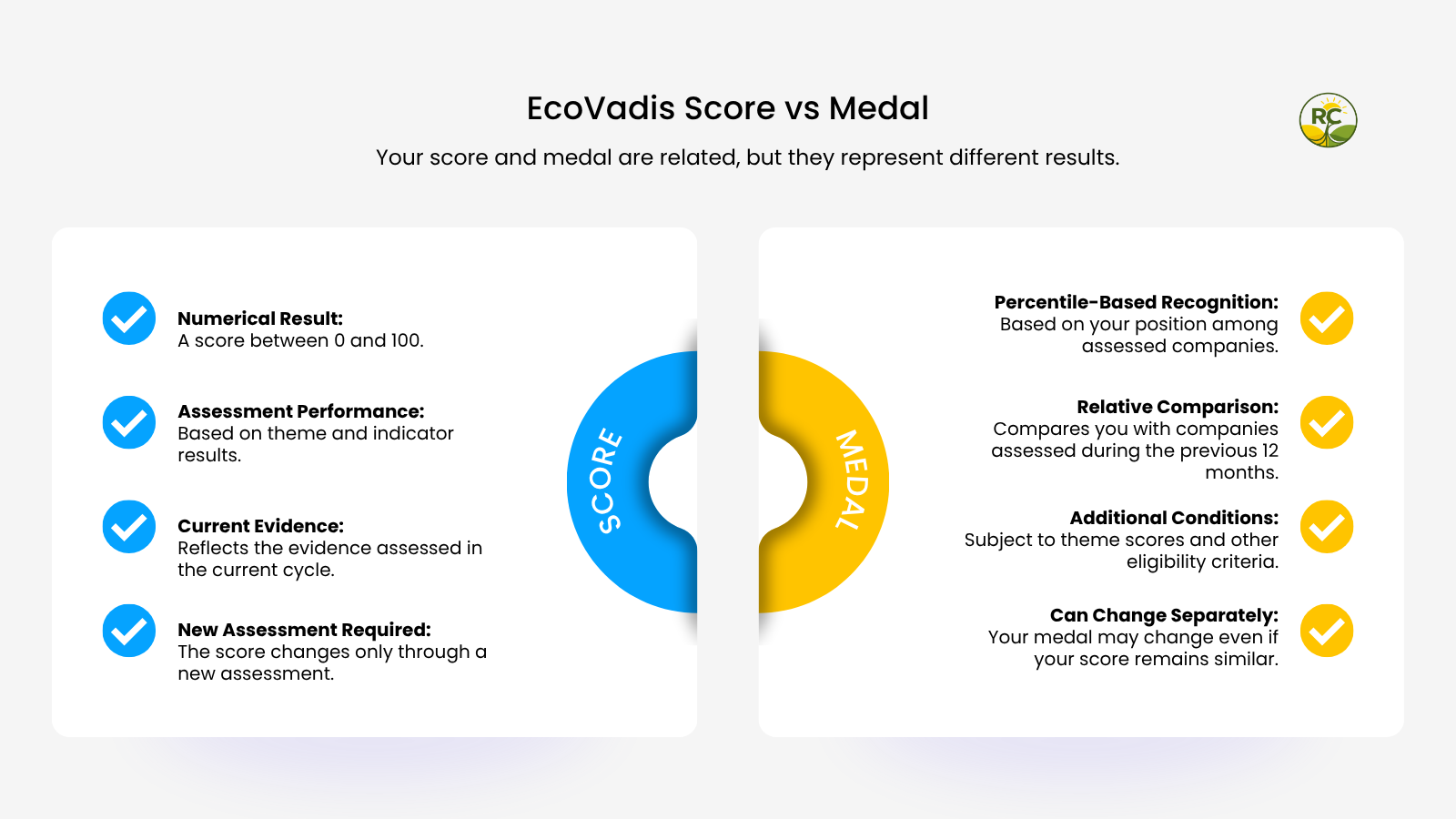
A company’s numerical score and its medal status are related, but they are not the same result.
What to do when your EcoVadis score drops
Do not begin by rewriting every policy. Start with a structured comparison.
Step 1: Compare both scorecards by theme and indicator
Record the previous and current scores for Environment, Labour & Human Rights, Ethics and Sustainable Procurement. Then compare the management indicators within the themes.
The overall score tells you that something changed. The theme and indicator results help show where.
Step 2: Review new and recurring improvement areas
Separate the findings into:
- new improvement areas;
- findings that remained unresolved;
- previous strengths that disappeared; and
- areas that improved despite the overall decline.
This produces a more useful diagnosis than focusing on the final number.
Step 3: Identify rejected, expired or missing evidence
Check the analysis of your answers and the document library. Look for changed rejection reasons, expired documents and selected options that no longer have supporting evidence.
Step 4: Verify profile and scope
Confirm the assessed legal entity, size, industry and locations. Review whether policies, certifications, actions and KPIs cover the same scope.
Step 5: Check methodology and questionnaire changes
Review the EcoVadis methodology updates released since the previous assessment. Focus on changes connected to the themes or indicators where your score fell.
Step 6: Separate quick corrections from system gaps
Some issues may involve dates, approvals, document scope or clearer mapping. Others require months of implementation, such as establishing supplier due diligence, collecting company-wide KPIs or demonstrating that a procedure is consistently used.
Prioritise based on likely relevance, implementation time and the evidence that can realistically exist before the next assessment.
Step 7: Validate the next submission before sending it
Carry out a final review of every selected answer and attachment. Confirm that the evidence is current, readable, correctly scoped and directly connected to the claim.
A reassessment should be treated as a new submission supported by previous experience, not as last year’s questionnaire with a few additional files.
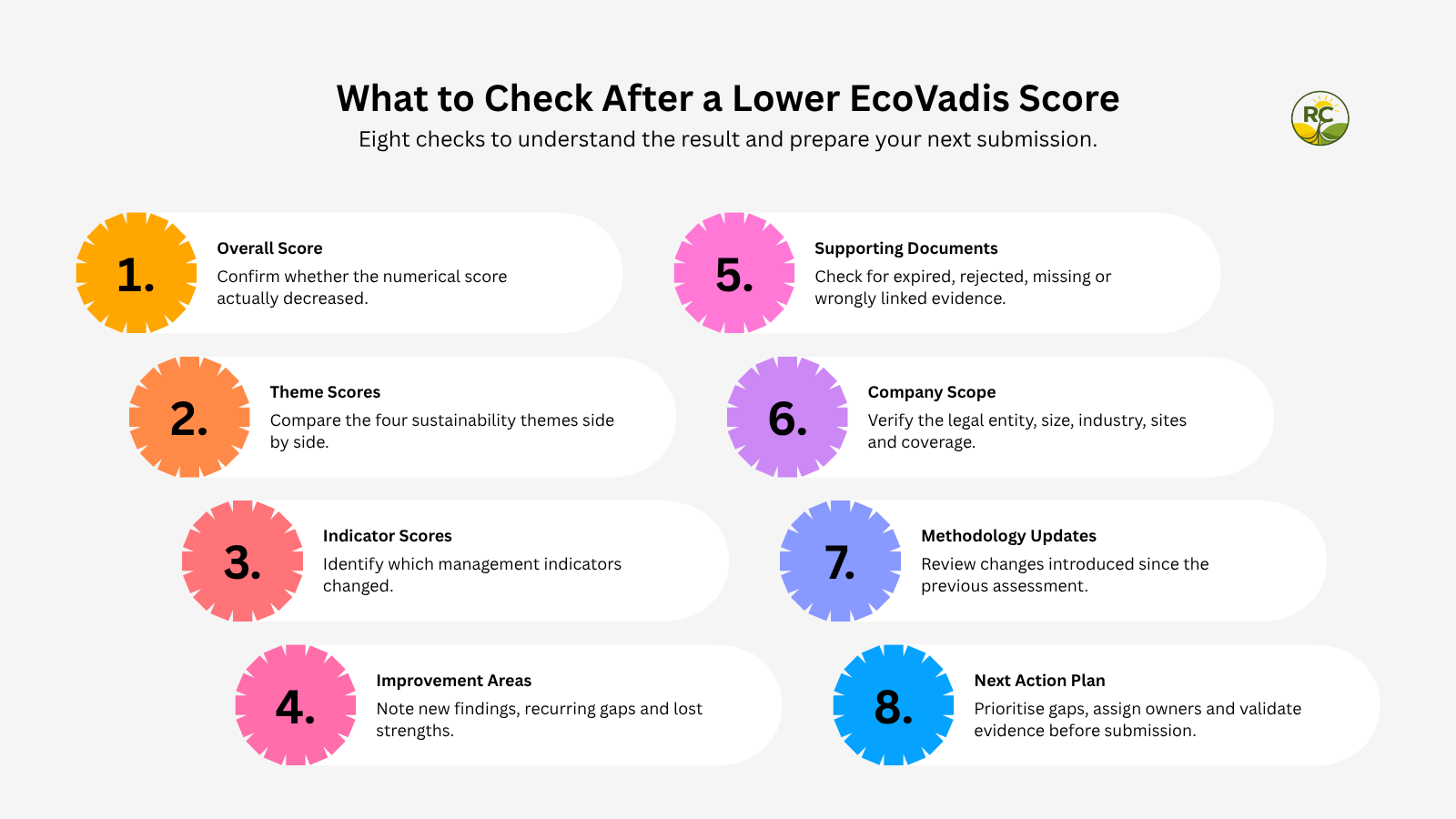
Comparing the scorecards systematically helps identify whether the decline came from evidence, scope, methodology or a wider management-system gap.
A lower score is a diagnosis, not the end of the process
A lower EcoVadis score is frustrating, especially when your company has invested time in improving its sustainability work.
But the overall number rarely explains the full result. The cause may sit in one changed theme, an expired KPI report, weaker scope coverage, a new methodology requirement, incomplete evidence mapping or an external finding.
Once the reason is visible, the next step becomes more manageable.
Compare the two scorecards carefully. Check what changed in the company and in the methodology. Strengthen the evidence behind real actions. Then build an improvement plan that reflects the time needed to generate credible records and results.
Need an expert review before your next EcoVadis submission?
If your score dropped and you cannot clearly see why, submitting again with more documents is unlikely to solve the problem on its own. First identify which themes, indicators and evidence gaps actually affected the result.
I previously worked as an EcoVadis Sustainability Analyst and have reviewed more than 300 assessments. Today, I help companies understand their scorecards, strengthen their supporting evidence and prepare their next submission with clear priorities.
Choose the level of support that fits your situation:
- Most of your documentation already exists: The Quick Expert Check gives you an independent review of up to 25 documents, a clear gap overview, a written action plan and a results call.
- You need hands-on support for the full reassessment: My Full EcoVadis Preparation and Submission Support begins with a detailed scorecard review and continues through evidence collection, questionnaire completion and final submission review.
- Policies, KPIs or implementation records are still missing: Sustainability Documentation Support helps you build the documents and evidence your customers and future assessments require.
Book a short 15-minute call to discuss your scorecard, timeline and best next step.
Disclaimer: The author is a former EcoVadis analyst. This article is based solely on publicly available information, professional experience, and independent analysis. No confidential, proprietary, non-public, or privileged information obtained during any previous employment or professional engagement has been used in the preparation of this article. The content is provided for informational purposes only and does not represent official EcoVadis guidance, methodology documentation, or scoring criteria. The author is not affiliated with, endorsed by, or acting on behalf of EcoVadis. Any views, interpretations, or recommendations expressed are solely those of the author and do not represent the views of EcoVadis.
