


You have received your EcoVadis scorecard. The overall result is visible, the four theme scores are available and the platform lists several Improvement Areas.
What should you do first?
Do not immediately rewrite every policy or rush into another assessment. Start by understanding what each Improvement Area is telling you, which gaps matter most and what evidence would demonstrate real improvement.
The EcoVadis Corrective Action Plan can help you organise this work. However, it is important to understand its purpose: the plan supports improvement management and communication with trading partners. It does not change your current score.
Here is how to turn your scorecard into a practical, evidence-based improvement programme.
What is the EcoVadis Corrective Action Plan?
The Corrective Action Plan, often shortened to CAP, is a section of the EcoVadis platform where rated companies can manage the corrective actions linked to their scorecard.
When a scorecard is published, its Improvement Areas automatically generate corrective actions with the status “Not started”. Companies can then assign responsibility, add a due date, describe their planned response, upload documents and update the status as work progresses.
According to EcoVadis’s current CAP guidance, the feature can be used to:
develop improvement plans;
show planned and completed actions to trading partners;
respond to corrective-action requests;
receive feedback from trading partners; and
retain documents for a future reassessment.
The plan is therefore both an internal management tool and a way to communicate progress to customers.
The important limitation: updating the CAP does not update your score
Marking a corrective action as completed does not recalculate the current scorecard.
EcoVadis does not review or score the information entered in the Corrective Action Plan. A scorecard can only be updated through a reassessment, when the company submits an updated questionnaire and EcoVadis conducts a new analysis.
This distinction matters.
A corrective action can be complete from an operational perspective while still being insufficiently documented for the next assessment. For example:
training took place, but no attendance records were retained;
suppliers signed a Code of Conduct, but coverage was not calculated;
a new procedure was approved, but there are no completed records showing that it is used;
an environmental project was implemented, but its result was not measured; or
a CAP item was closed after creating a template rather than using it.
The platform status is useful for project management. The underlying practice and evidence are what matter during reassessment.
💡 If your result changed unexpectedly, first read Why Your EcoVadis Score Dropped After Reassessment before deciding which corrective actions to open.
Before you start: check the pre-publication review window
EcoVadis introduced a standard two-business-days pre-publication period during 2026. During this window, the new scorecard is visible to the rated company before it is released to the EcoVadis network.
If your result is still in this stage, check it immediately for factual errors. Relevant checks may include:
the assessed legal entity;
company size and activity;
the locations included in the assessment;
certificate information;
the identity connected to an external finding; and
other objective information that may have been attributed incorrectly.
This is a factual review, not a request for a higher score or an opportunity to submit a new evidence package. EcoVadis explains the process in its Q1 2026 methodology update.
Once the scorecard is published, move from factual verification to structured improvement planning.
Step 1: read the scorecard below the overall score
The overall score tells you the result. It does not tell you what to fix first.
Review the scorecard at four levels:
1. Theme scores
Compare Environment, Labour and Human Rights, Ethics and Sustainable Procurement. Identify where the weakest results appear and which themes have the greatest relevance to your assessment.
2. Management indicators
Look below the theme score at the indicators connected to policies, endorsements, measures, certifications, coverage and reporting.
A company may have a reasonable environmental policy but weak implementation evidence. Another may have strong actions but insufficient KPI reporting. These are different problems and require different responses.
3. Improvement Areas
Read the exact wording, priority and explanation for each Improvement Area.
EcoVadis added more granular diagnostic Improvement Areas in 2026, including feedback concerning policy robustness, quantitative targets, endorsements, certifications and sector practices. This can make the scorecard more actionable, but it can also produce a longer list of findings.
Do not assume that every item requires a new policy.
4. Trading-partner requests
Check whether a customer has specifically requested action and whether it has set a due date. A customer deadline may affect the order in which you work, even when another internal project is more important for long-term performance.
Step 2: classify the actual gap
An Improvement Area describes a finding. It does not always identify the operational root cause.
Before defining an action, classify the gap.
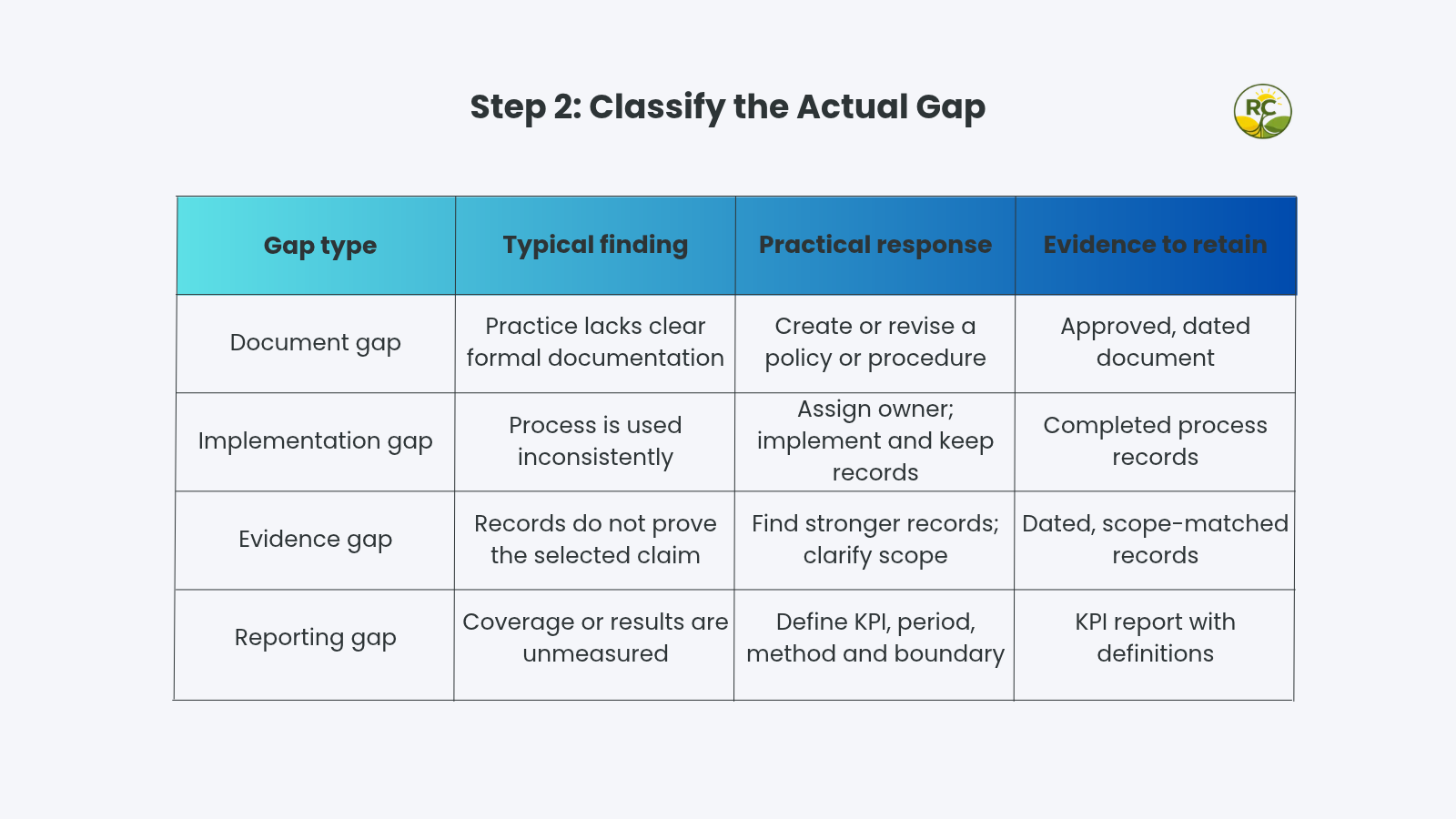
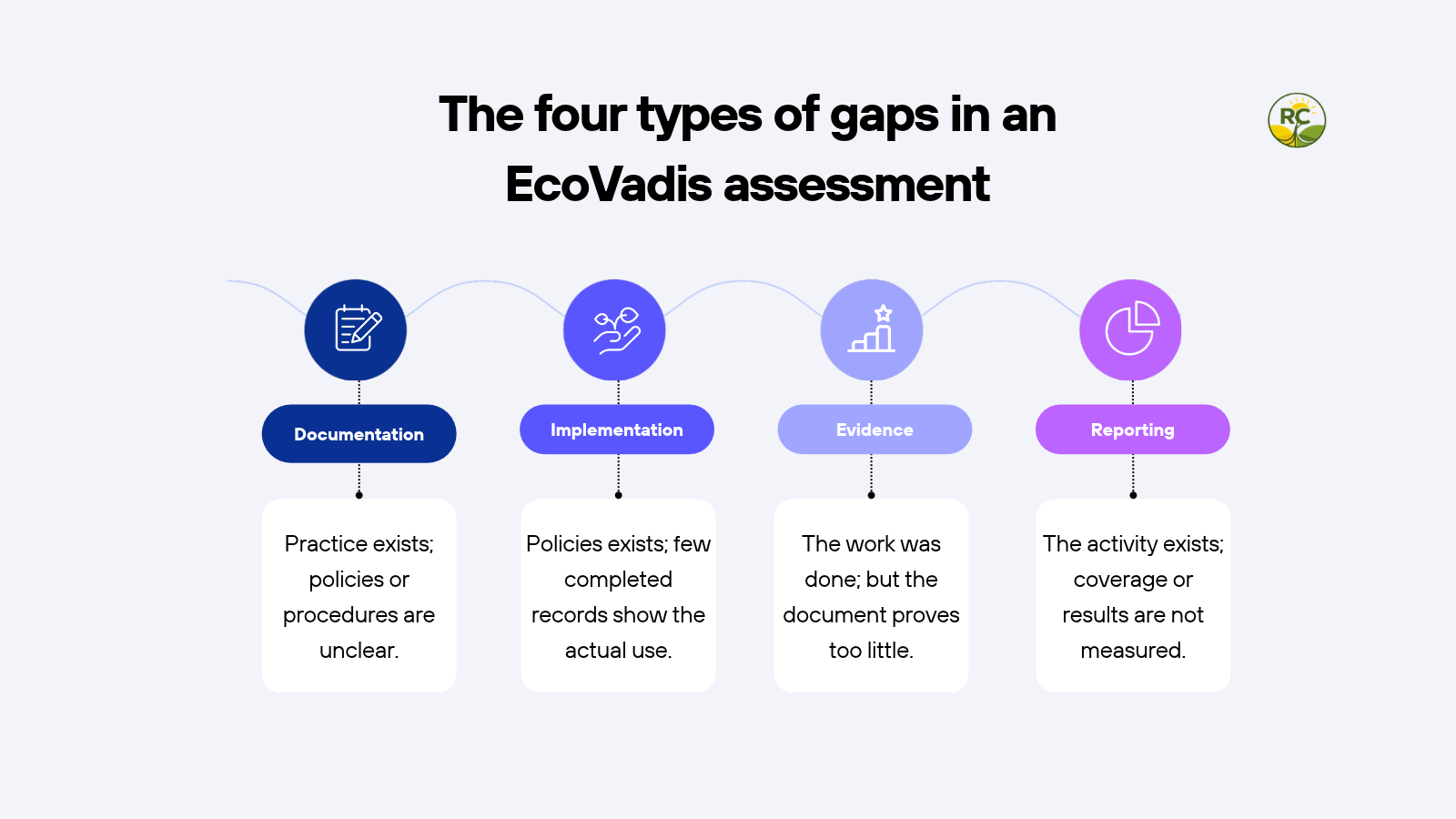
This classification prevents a common mistake: writing more policy documents when the real weakness is missing implementation or reporting.
For a fuller explanation of the evidence chain, see EcoVadis Evidence: How to Map the Right Documents.
Step 3: prioritise instead of trying to close everything
Not all corrective actions have the same potential impact. EcoVadis itself recommends using the scorecard’s theme, indicator and priority information to decide where to begin.
For each Improvement Area, ask:
Is it identified as high priority in an important theme or indicator?
Has a trading partner specifically requested action?
Is it a recurring finding from a previous scorecard?
Does valid evidence already exist but need better selection or mapping?
Does the gap require a new process and time to generate implementation records?
Is the action relevant to a customer deadline, tender or contract?
Can the improvement create value beyond the assessment?
A simple sequence is:
address factual issues immediately;
respond to customer-requested actions and deadlines;
investigate high-priority and recurring Improvement Areas;
close evidence and document-quality gaps that can be resolved credibly;
begin longer operational projects early; and
leave low-relevance items until higher-impact work is under control.
Prioritisation is not the same as ignoring difficult findings. It means giving each action an order, owner and realistic timetable.
Step 4: turn each Improvement Area into a specific action
Copying the Improvement Area into an action list is not enough. A useful corrective action should state:
what will change;
who owns the work;
which entities, sites, employees or suppliers it covers;
when it will be completed;
which evidence will be retained; and
how completion will be verified.
A weak action would be:
Improve supplier sustainability assessment.
A more useful action would be:
By 30 November 2026, Procurement will complete an initial environmental and social risk screening of active Tier 1 ingredient and packaging suppliers. Evidence will include the approved screening method, supplier register, completed screening records, identified risks and documented follow-up actions.
The second version establishes a deliverable, owner, scope, deadline and evidence trail. It is therefore easier to implement, monitor and explain to a customer.
Step 5: build evidence while implementing the action
Do not wait until the next questionnaire opens to search for evidence.
For each corrective action, decide in advance what will prove that the work happened. Depending on the issue, this may include:
an approved policy;
an operational procedure;
a completed risk assessment;
training material and attendance records;
signed supplier documents;
completed supplier questionnaires;
audit or inspection reports;
incident and follow-up records;
management-review minutes;
a KPI report with period, units, scope and methodology; or
measurable results showing coverage or progress.
EcoVadis states that supporting documents should be formalised, relevant, complete, current and connected to the assessment scope. Its current guidance applies an eight-year validity period to policies and actions and a two-year period to KPI reporting. Documents created solely to satisfy the questionnaire are not accepted as evidence.
This does not mean you cannot create a new policy or procedure after receiving your scorecard. It means the document should become a genuine part of the company’s management system. Approve it, communicate it, use it and retain evidence of implementation.
💡 For document requirements and food-sector examples, see EcoVadis Supporting Documents: 2026 Food Company Guide.
Step 6: use CAP statuses accurately
The platform provides four main statuses:
Not started
Use this while an action has not yet been assigned or initiated. Avoid leaving an important customer request here without explanation.
In progress
Change the status when work begins. Add the responsible person or department, planned steps and due date so that trading partners can understand what is happening.
Completed
Use this when the action has actually been implemented and the supporting evidence has been checked. Completing a draft or creating a blank template is not necessarily completion.
Archived
Use this when the action will not be pursued. Record the reason, particularly if the action is not applicable to the assessment scope or has been replaced by a more appropriate measure.
Remember that the information entered in the CAP is visible to trading partners. Documents uploaded through the feature are private by default, but the sharing setting can be changed. Review confidentiality and commercial sensitivity before making any document visible.
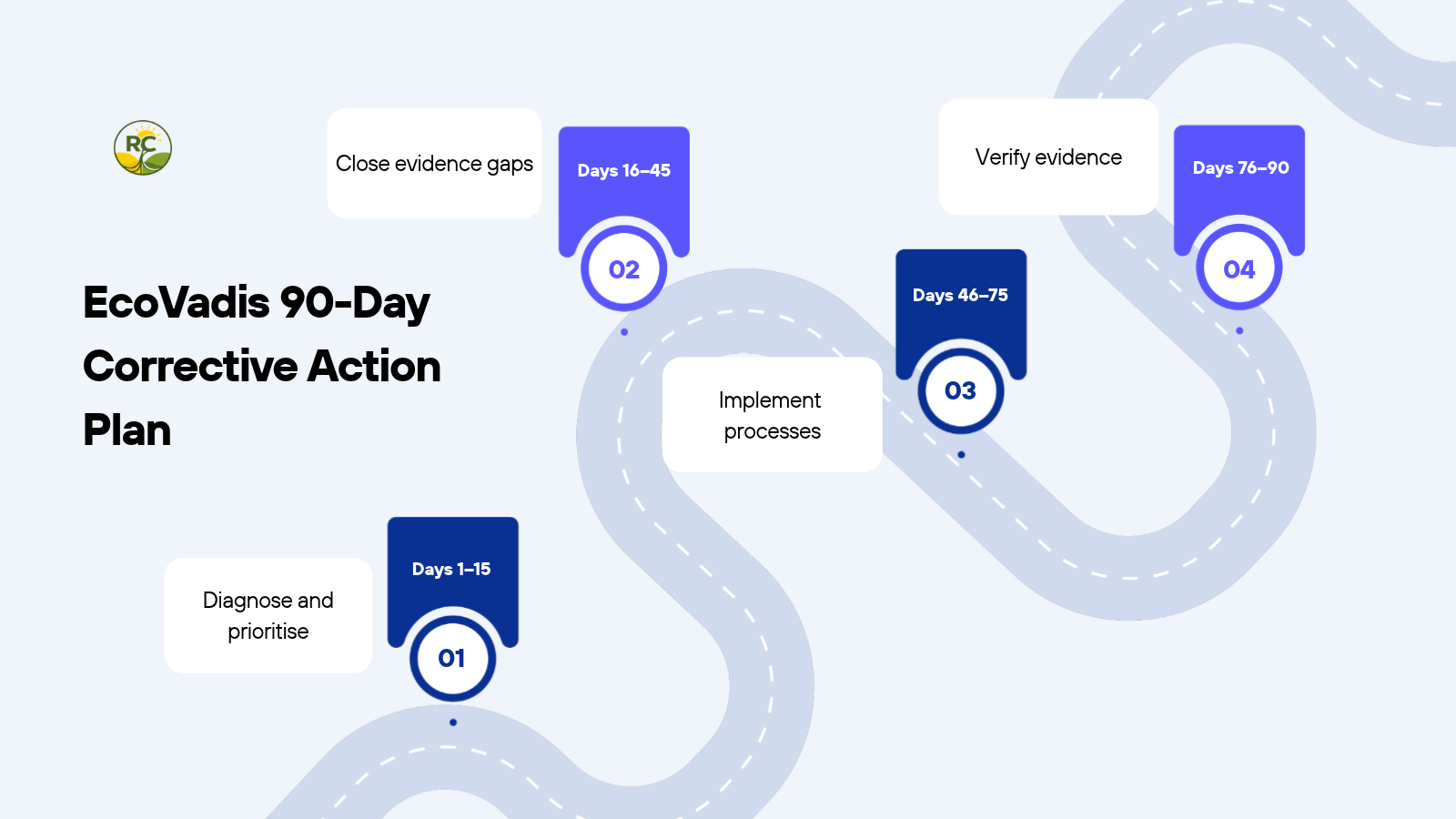
A practical 90-day corrective-action workflow
The following is a working model, not an EcoVadis deadline. Adapt it to the number and complexity of your Improvement Areas.
Days 1–15: diagnose and prioritise
Review the scorecard by theme and indicator.
List every Improvement Area and its priority.
Record customer requests and deadlines.
Compare recurring and new findings.
Classify each gap as documentation, implementation, evidence or reporting.
Assign an internal owner.
Identify quick evidence corrections and longer operational projects.
Days 16–45: close existing documentation and evidence gaps
Locate relevant pre-existing records.
Review policies and procedures for dates, scope and company identification.
Confirm that documents cover the assessed entity and locations.
Map each document to the claim it proves.
Update genuine management documents where operational information is outdated.
Define the evidence that future actions must generate.
Days 46–75: implement missing processes
This phase may include:
delivering employee training;
introducing supplier-risk screening;
carrying out environmental or workplace inspections;
implementing ethics controls;
collecting site-level data;
starting a recurring KPI review; or
completing corrective actions from audits.
Retain completed records as the process operates. A blank form demonstrates a tool; a completed form demonstrates use.
Days 76–90: verify the evidence chain
For each priority action, ask:
Is there a clear commitment?
Is there a repeatable process?
Is there evidence that the process operates?
Is coverage defined?
Is performance measured where relevant?
Does the evidence apply to the correct assessment scope?
Would the document exist and be used even without the EcoVadis assessment?
Then decide whether the company is ready for reassessment or needs more implementation time.
Example: supplier sustainability assessment in a food company
Consider a food producer whose scorecard indicates insufficient evidence of supplier sustainability assessment.
The company already has a Supplier Code of Conduct, but suppliers have not been classified by environmental or social risk. No completed assessments or coverage figures are available.
The corrective plan could include:
Define which ingredient, packaging and service suppliers are in scope.
Establish environmental, labour, human-rights and ethics risk criteria.
Assign responsibility to Procurement.
Screen suppliers and identify those requiring enhanced review.
Record the findings and follow-up actions.
Track the percentage of relevant suppliers screened.
Review the process annually.
The resulting evidence might include the approved procedure, risk methodology, supplier register, completed screenings, follow-up records and a KPI summary.
The action should not be marked complete simply because the screening template has been designed. Completion should reflect actual implementation and available evidence.
The precise requirements will depend on the company’s activated criteria, assessment scope and questionnaire. The example is a management model, not a universal upload list.
Common Corrective Action Plan mistakes
Treating every Improvement Area as equally urgent
This can overwhelm a small team and delay work on findings that matter most.
Assuming every finding requires a new policy
The weakness may instead concern implementation, coverage, evidence quality or reporting.
Marking an action complete too early
A written document is not always proof that a process operates.
Entering vague plans
“Improve training” or “strengthen procurement” does not define an accountable project.
Creating documents only for the assessment
EcoVadis expects credible, pre-existing evidence from the company’s management system, not artificial assessment files.
Uploading evidence without checking the scope
A certificate or record from one site should not be presented as group-wide evidence unless broader coverage can be demonstrated.
Sharing sensitive documents unnecessarily
Review document-sharing settings before making information visible to trading partners.
Starting reassessment before evidence is ready
A new procedure may need time to produce completed records and measurable results. A rapid reassessment is not automatically the best reassessment.
When should you start reassessment?
EcoVadis scorecards are generally valid for 12 months. A reassessment allows the company to update its answers, add documents and receive a new analysis.
Start when:
the priority actions have been implemented;
the important evidence is available and current;
documents match the assessment scope;
recurring Improvement Areas have been addressed at their root cause;
customer deadlines are understood; and
the team has enough time to review the questionnaire and submission properly.
Do not choose the date only because a new document has been approved. Choose it when the management system and evidence tell a consistent story.
EcoVadis provides further information in its guide to preparing for reassessment.
Turn the scorecard into a working improvement plan
A useful EcoVadis Corrective Action Plan is not a collection of optimistic status updates.
It should connect each important finding to:
a real operational gap;
a responsible owner;
a realistic due date;
an implemented action;
credible evidence; and
a clear reassessment decision.
That process can also support customer questionnaires, supplier audits, buyer reviews and internal sustainability management. The value is not only in preparing for the next score. It is in creating a system the company can explain and operate consistently.
Need help prioritising your EcoVadis Improvement Areas?
I previously worked as an EcoVadis Sustainability Analyst and have reviewed more than 300 assessments. Today, I help companies understand their scorecards, prioritise the right improvements and prepare evidence for reassessment.
If you already have a scorecard, my full EcoVadis support begins with a Scorecard Deep Dive covering theme scores, strengths and Improvement Areas. You receive a practical improvement plan with priorities and timelines, followed by support with evidence collection, questionnaire preparation and final review.
If the work needs to continue between assessments, ongoing sustainability support can help keep documents, KPIs and customer responses current.
Disclaimer: The author is a former EcoVadis analyst. This article is based solely on publicly available information, professional experience and independent analysis. No confidential, proprietary or non-public information obtained through previous employment or professional engagements has been used. The content is provided for informational purposes and does not represent official EcoVadis guidance or scoring criteria. The author is not affiliated with, endorsed by or acting on behalf of EcoVadis. Assessment outcomes cannot be guaranteed.
