


Your customer asks for an EcoVadis assessment of the company supplying their products.
Your head office replies that the group already has a rating. The factory manager assumes the production site is covered. The sales team uses a different company name on the contract.
Everyone may be referring to the same business relationship. They may still be talking about different assessment scopes.
Before you start the questionnaire, establish exactly which organisation is being assessed. This decision determines whose sustainability practices your submission needs to demonstrate and whether an existing assessment matches the customer’s request.
This guide explains EcoVadis’ assessment scope, the difference between group, entity and site assessments, and the questions to resolve before your team starts preparing.
What does EcoVadis assessment scope mean?
Assessment scope defines the company, group or individual facility covered by an EcoVadis assessment. EcoVadis distinguishes three scope types:
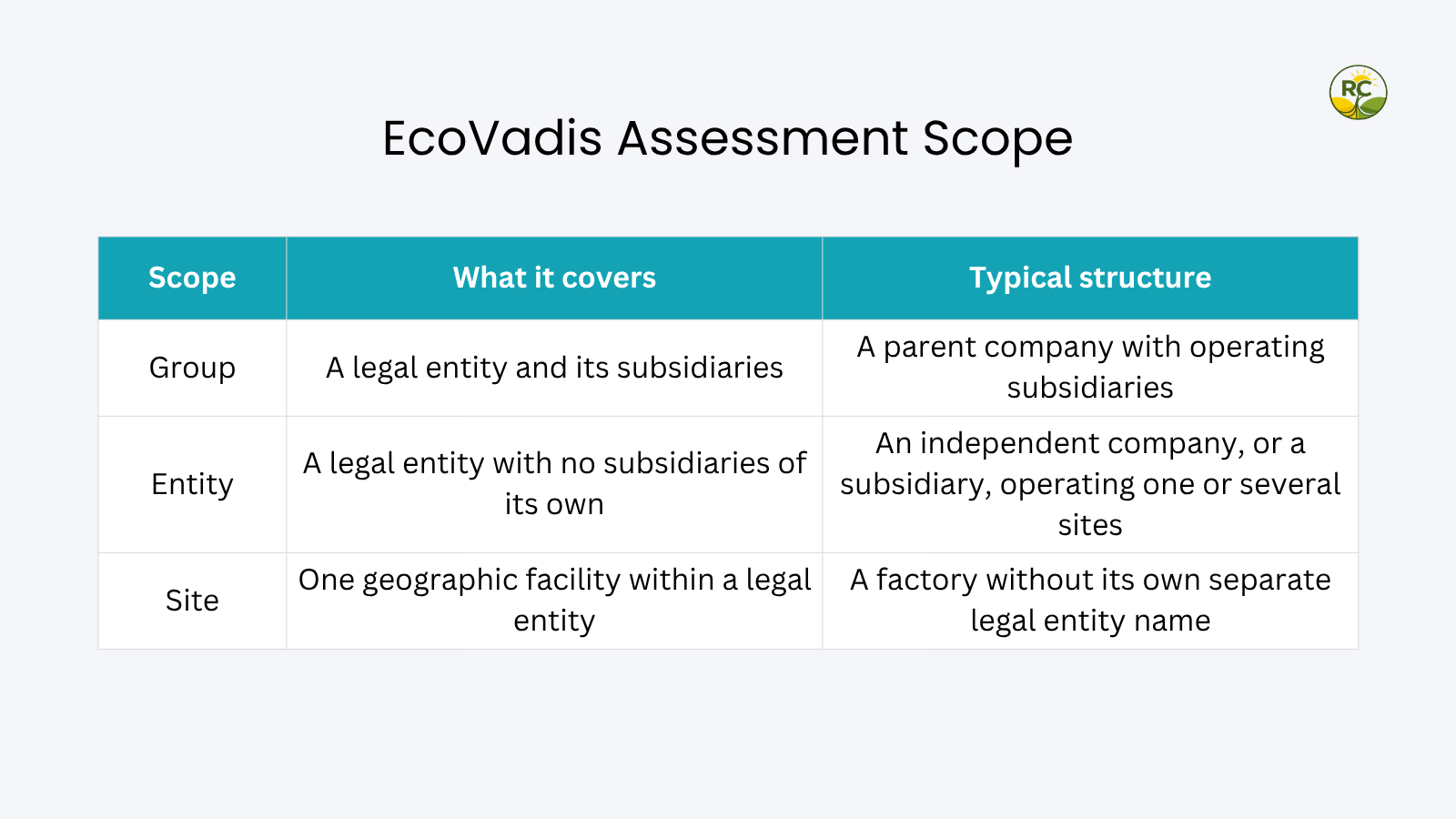
EcoVadis’s official scope guidance explains these categories and their eligibility conditions.
The practical starting point is your corporate structure: identify the registered companies and the locations operating under each one.
Two factories do not automatically make a group
A business can have several locations under one registered company.
For example, imagine a food manufacturer called Example Foods Ltd. It operates two factories and a warehouse, all under the same legal entity, and has no subsidiaries.
The locations belong to one entity. Having three addresses does not automatically make this a group assessment.
A structure with Example Foods Holding Ltd and separately registered operating subsidiaries requires a different scope discussion.
These are hypothetical examples. Use your actual registration details and ownership structure when clarifying your assessment.
The company name on the EcoVadis platform also helps identify the assessed organisation. EcoVadis uses legal entity names and, where applicable, group or site suffixes. Check the full profile rather than relying on a familiar brand name.
Start with the company your customer actually buys from
Before discussing the broadest possible assessment, clarify the commercial relationship.
Ask your account manager or customer:
- Which registered company is named in the supplier contract?
- Which company appears on the purchase orders and invoices?
- Is the request linked to a particular factory or supplier number?
- Has the customer requested a specific entity or site?
- If an existing rating has a different scope, will the customer accept it?
A useful written question is:
“Could you confirm the legal entity and, if relevant, the production site you require the EcoVadis assessment to cover? We would also like to confirm whether our existing group assessment meets your requirement.”
EcoVadis recommends aligning scope with the trading relationship. A customer sourcing directly from a particular factory may need visibility at that level. The final eligible scope still needs to be confirmed with EcoVadis. Source: EcoVadis scope guidance
👉 For help understanding the wider customer request, read A Customer Asked for Your EcoVadis Score? Here Is What to Do Next.
Can a subsidiary use its parent company’s EcoVadis rating?
A group assessment provides information about the assessed group. It does not give every subsidiary its own individual score.
If a customer requests an assessment of a different scope, an existing group rating may not fulfil that request. EcoVadis explains that a mismatch can require registration and assessment of the requested entity. If you want to provide a rating with a different scope, discuss this with the requesting company first. Source: EcoVadis guidance on assessed subsidiaries.
For your sales team, the wording matters.
“Our parent group has an EcoVadis rating” communicates a different fact from “this subsidiary has been assessed”. Use the precise assessed company name when responding to customers, and make the relationship between the entities clear.
This helps procurement understand what information you are providing and which part of the business it represents.
A group policy and a group rating are different things
An existing group sustainability policy may be relevant to an assessment of a subsidiary. You still need to establish how it applies to that subsidiary.
For preparation purposes, ask:
- Does the policy identify the companies or operations it covers?
- Has the relevant company adopted and communicated it?
- Who is responsible for applying it locally?
- Can local teams show how the commitments are put into practice?
These are practical review questions, rather than a guarantee that a document will receive credit. EcoVadis requires supporting documents to relate to the assessed scope and substantiate the selected answers. Source: Understanding supporting documents.
For example, a group health and safety policy may establish common expectations. Local training records can then show what happened at the company or factory being assessed. Group reporting may need a breakdown before your team can explain the performance of a particular entity.
Keep the connection visible between the organisation named in the assessment and the information you provide.
👉 My guide EcoVadis Evidence: How to Map the Right Documents explains how to connect commitments, implementation records and results to questionnaire answers.
📋 Preparing documents across several companies or locations? My Quick Expert Check reviews up to 25 existing documents against the relevant EcoVadis requirements. You receive a clear overview of the gaps, a written action plan and a 60-minute results call before you submit.
Confirm the scope before dividing up the work
An unclear boundary creates avoidable coordination problems.
HR may prepare a headcount for one company. Operations may report energy use for two factories. Finance may provide figures for the entire group. Each contribution may be accurate within its own boundary, while the combined submission remains difficult to interpret.
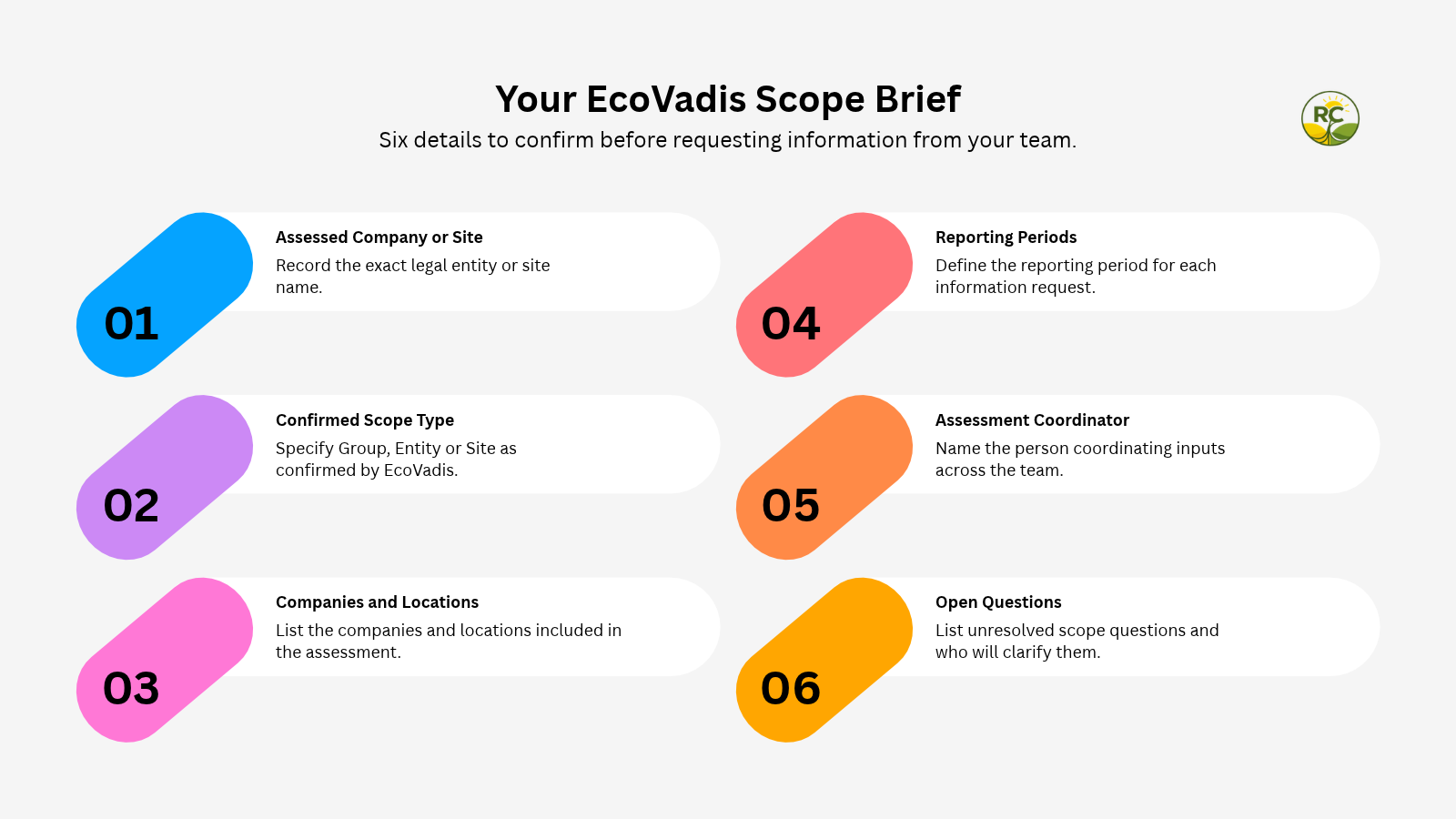
Create a short scope brief before sending information requests to colleagues. I recommend including:
1. The exact assessed legal entity or site name.
2. The confirmed scope type.
3. The companies and locations included.
4. The reporting periods needed for each request.
5. The person responsible for coordinating the assessment.
6. Any open questions awaiting clarification.
This is an internal coordination tool, not an additional document that every company must upload to EcoVadis.
Use it to give each contributor the same starting point. Ask colleagues to identify the boundary of the information they send, especially when a report includes additional companies or only one part of the assessed operations.
EcoVadis also recommends involving the relevant departments in preparation, including HR, Compliance, Environmental Health and Safety, and management. Source: Preparing for the questionnaire.
Five questions to resolve before you start
1. Do our registered company details match the profile?
Compare the assessment profile with the company information held by Finance, Legal or management. Investigate differences early, especially where several subsidiaries use the same trading name.
2. Have we listed all locations relevant to the confirmed scope?
Ask Operations to review the location list. A shared spreadsheet is useful: record the location, operating company, main activity and internal contact. This gives the preparation team a practical overview of where information sits.
3. Is there already an assessment for the requested organisation?
Check internally before registering again. Record the exact assessed name and scope of any existing profile. If the request and existing assessment differ, clarify the situation with the customer and EcoVadis before committing the team to another submission.
4. Are we preparing the operational business the customer needs assessed?
A shared brand or sales office can obscure where the relevant operations take place. EcoVadis applies specific eligibility rules, including restrictions on standalone assessments of purely commercial entities within manufacturing groups. Complex arrangements should be checked directly with EcoVadis. Source: Scope eligibility guidance.
5. Does everyone understand what is included?
Circulate the scope brief to the people providing information. Ask them to flag uncertainty before completing their requests. Resolve conflicting assumptions while the preparation is still manageable.
If the assigned scope appears incorrect, contact EcoVadis before starting the questionnaire. Source: Changing assessment scope.
Common questions about EcoVadis assessment scope
Does a shared brand mean our companies share one assessment?
A brand name does not establish the legal boundary of an assessment. Use the exact company details and confirmed scope in your assessment profile when discussing coverage.
Can we use a group rating while a subsidiary assessment is being discussed?
You can explain that a group rating exists and ask whether it meets the customer’s current requirement. Make its scope explicit. The customer may still require an assessment of the specific supplying entity. Source: EcoVadis subsidiary guidance.
Does a Corporate subscription automatically give every subsidiary the same rating?
The Corporate subscription includes features for linking subsidiaries and monitoring their assessment requests and scorecards. Those account connections should not be treated as evidence that every linked company has the same assessment result. Check the individual assessed scope. Source: EcoVadis Corporate account features.
Get your EcoVadis preparation off to a clear start
A clear scope gives your team a shared understanding of which business it is preparing to demonstrate. It helps you ask for the right information, explain an existing rating accurately and coordinate work across locations.
If your scope is confirmed and most documents already exist, my Quick Expert Check reviews up to 25 existing documents against the relevant EcoVadis requirements. You receive a clear overview of the gaps, a written action plan and a 60-minute results call before you submit.
If you need help organising the evidence, completing the questionnaire and managing preparation across teams, my Full EcoVadis Preparation & Submission Support offers more extensive support.
As a former EcoVadis Sustainability Analyst, I help companies translate assessment requirements into practical preparation. EcoVadis confirms the eligible assessment scope and carries out the assessment.
👉 Explore EcoVadis support and the Quick Expert Check
👉 Book a 15-minute fit call to discuss the best service and scope of support. This call is for choosing a service; it does not include a document review or EcoVadis advice.
Disclaimer: The author is a former EcoVadis analyst. This article is based solely on publicly available information, professional experience and independent analysis. No confidential, proprietary or non-public information obtained through previous employment or professional engagements has been used. The content is provided for informational purposes and does not represent official EcoVadis guidance or scoring criteria. The author is not affiliated with, endorsed by or acting on behalf of EcoVadis. Assessment outcomes cannot be guaranteed.
